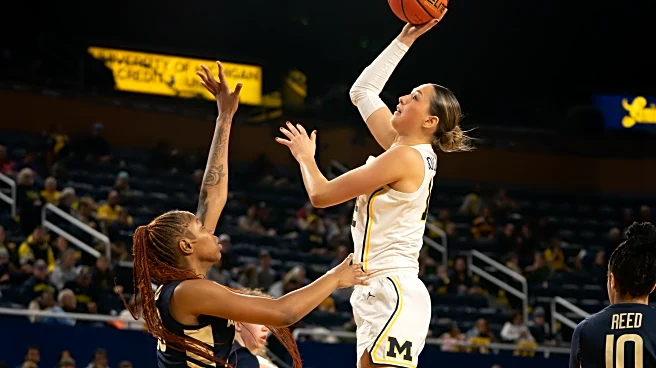

The No. 6 Michigan women’s basketball team likes to play fast. The Wolverines consistently press other teams, forcing turnovers both in the full-court and the half-court with heavy ball pressure. They
sprint down the court, racing past their opponents and attacking downhill, either finishing inside with efficient layups or drawing contact and getting to the free-throw line.
On Saturday against Akron, Michigan’s transition game proved to be the separator, despite not getting into much half-court rhythm offensively. The Wolverines (9-1) downed the Zips (1-8), by a final score of 85-59 to remain unbeaten at home.
Even with its poorest free throw shooting performance of the season (17-for-30), the Wolverines still dominated en route to the 26-point win. Compared to Michigan’s Big Ten-leading and second-ranked 40-point average victory margin entering the game, the Wolverines’ margin was poor, but they rarely let the Zips within reach.
Michigan has practically put the game away in the first quarter of every game since its sole loss of the season on Nov. 21 against No. 1 UConn. Outscoring their opponents by an average of 18 points in those four first quarters, the Wolverines had their opponents playing catch-up the rest of the way. It took a little longer for Michigan to get going against Akron, though, and in the half-court, the Wolverines never fully got in sync.
“I would say it was less of what Akron was doing and more us putting the ball down on the floor more than we usually do,” sophomore guard Syla Swords said. “We’re a team that is aiming for 20 assists a game, and the more you dribble, the (more) that number goes down.”
With Michigan’s typical pass-heavy offense reduced down to 1-on-1 takes, the Wolverines got fewer open looks outside of their successful transition offense and assisted on just 15 baskets. Their downhill drives were contested, and looking to draw contact, Michigan successfully got to the line and put the Zips in foul trouble by drawing 28 of them.
“Free throws is obviously something that we have to get better at,” head coach Kim Barnes Arico said. “We’re such a good shooting team, we should not be this poor from the free throw line, so that’s focus and concentration. We’re going to make sure that we’re working on that, we always want to get better on the defensive end, and we always want to not turn the ball over as much.”
While the Wolverines are looking to fine-tune their free throws, defense and turnovers, their transition game and – arguably — defense were polished against the Zips.
Forcing 28 turnovers and turning them into 26 points, Michigan ran away with the game. Its balanced attack concluded the contest with five scorers in double figures — Swords and junior forward Ashley Sofilkanich leading the way with 17 apiece — primarily as a result of effective play coast-to-coast.
“We have a lot of players who are strong in transition, and that helps, too,” Swords said. “We have people that can grab rebounds and the other ones can run out … and the fact that we’re so interchangeable really helps with that.”
The Wolverines have a lineup practically full of utility players, and their versatility is a strength that makes them a difficult matchup. Particularly in transition, that versatility shines, enabling them to play inside-out basketball if a quick layup isn’t open. Not only does Michigan have an arsenal of weapons, consistently accruing double-figure scoring efforts from five players, the Wolverines have multi-level, efficient scoring threats.
Sofilkanich shot an impressive 8-of-9 from the floor, scoring 17 points in an astonishing 19 minutes. Whether it was a post-up inside or rim-running in transition, she led a frontcourt clinic in the paint all while collecting a season-high four steals.
As Michigan wraps up non-conference play next Sunday, Dec. 21 against Oakland, its defense and transition game against Akron provides a blueprint for future success.






