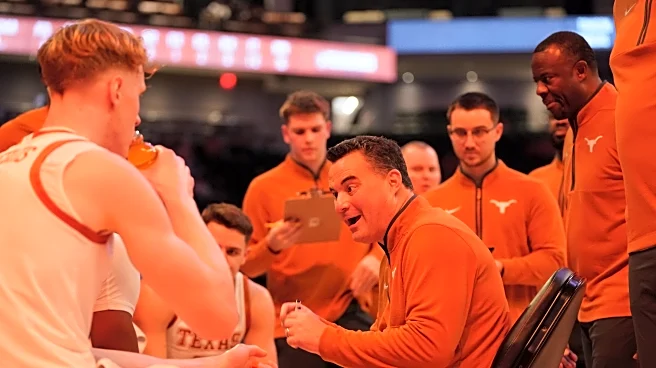




AUSTIN, Texas — Sean Miller is tired of repeating himself, and has an injured child.
After “stupid basketball plays” defined a bad 101-98 overtime loss by his Texas Longhorns to the Mississippi State Bulldogs, Miller quite remarkably laid out his frustrations with his team, which dropped to 8-5 on the season and 0-1 in SEC play after dropping arguably the most winnable contest on its 18-game conference schedule.
“We have to coach those guys better in those areas,” Miller said after the loss. “Now,
if I tell you not to cross the street, and I keep telling you, and I say, I swear, whatever you do, do not cross the street, and you do, and the bus hits you, I’m gonna take responsibility as your parent. But damn it, how many times do I have to tell you not to cross the street? We’ve got some of that going on.”
Miller’s candid assessment of his team’s lack of basketball intelligence reflects a failed roster build — the most critical aspect of his job — and an anger with his Texas team only 14 games into the season that portends an ugly record in conference play if he can’t coax better play out of his players, who keep getting hit by metaphorical buses.
Effort, a baseline expectation for his team, wasn’t there, allowing Mississippi State to come up with 19 offensive rebounds, including seven by 6’9, 230-pound Achor Achor in 24 minutes, that were the difference in the game, in Miller’s estimation.
“I thought some of the biggest plays in the game were loose balls, long rebounds, just plays where the quicker, the tougher team getting those two or three rebounds was going to win, and we weren’t,” Miller said.
Even though the difference in second-chance points was only four, 21-17, it was the ability of an extremely average offensive rebounding team in Mississippi State to out-rebound Texas, a top-30 defensive rebounding team in the country, that stood out.
If the rebounding was the biggest difference for Miller, the most concerning part was the lack of confidence and effort level from the Longhorns in the first half during which they were outscored by five points, a developing trend after similar issues in the blowout loss to the Cavaliers last month.
The statistical indicator was the lack of deflections for Texas over the first 20 minutes, only five or six, as charted by the coaching staff, with one or two coming on the last play, compared to almost 20 after halftime.
“You have to be able to come out with that confidence, that effort from start to finish. That’s something we have to continue to grow and cultivate. In particular, we’re playing at home, and we have our crowd,” Miller said.
A continued inability to defend without fouling contributed to Miller’s bus metaphor because there were multiple times in the game when Texas fouled jump shooters, a cardinal sin in basketball.
“It’s tough to win when you foul like we did,” Miller said.
One of those critical fouls came with 3:10 remaining in regulation when senior guard Jordan Pope fouled Jayden Epps on a desperation three-point attempt. Epps hit all three free throws before Mississippi State closed regulation with seven straight points to send the game into overtime.
“You can’t foul a guy 27 feet from the basket, fadeaway, step-back three, one second on the clock, look at the ref like he did something wrong. That’s the guy you want to play against. That’s not the guy you want to have on your team,” Miller said.
The staff has also debated changing pick-and-roll coverages away from the consistent drop coverage employed when sophomore center Matas Vokietaitis is on the court, but the fundamental problem isn’t the inability to throw a number of coverages at opponents, it’s that Texas can’t successfully accomplish the goals that drop coverage should achieve.
“The coverage that we’re playing favors two things — it allows you to keep your man on your man and it allows you to have great rebounding position,” Miller said. “It also puts you in a position to not rotate a lot, which usually leads to less fouls. We’re struggling with fouling, and we struggled with second shots in tonight’s game, playing a scheme that covers that. Quite frankly, that shouldn’t be the case.”
During the first half, Vokietaitis played 16 minutes and always dropped his coverage on ball screens, but Achor came up with three offensive rebounds while Vokietaitis failed to secure a single defensive rebound, at odds with his established ability this season to grab 20 percent of opposing misses when he’s on the court.
When graduate forward Lassina Traore is in the game, Texas is more apt to switch ball screens, which didn’t work in a critical moment, either — tied at 96-96 with less than a minute remaining in overtime, Traore switched onto Mississippi State’s star guard Josh Hubbard, inexplicably allowing Hubbard to create easy separation and hit the go-ahead three, the game’s single biggest shot.
“It’s just common sense — if you’re going to switch that ball screen at the top, and you’re switching on Josh Hubbard, who has already done what he’s done, and obviously is a terrific player, you’re going to get beat on a drive, but you’re never going to let him, rock you back, step sideways and shoot at three,” Miller said.
“It makes no sense to switch the screen if the guy who’s switching is going to step to his left and just kind of get a hand up. For lack of a better term, it’s a stupid basketball play.”
Miller took enough care to note he wasn’t calling Traore, who went unnamed, a stupid basketball player, but, well, if your father keeps telling you not to cross the street and then you cross the street and get hit by a bus, it’s only logical to make conclusions about the mangled child’s intelligence.