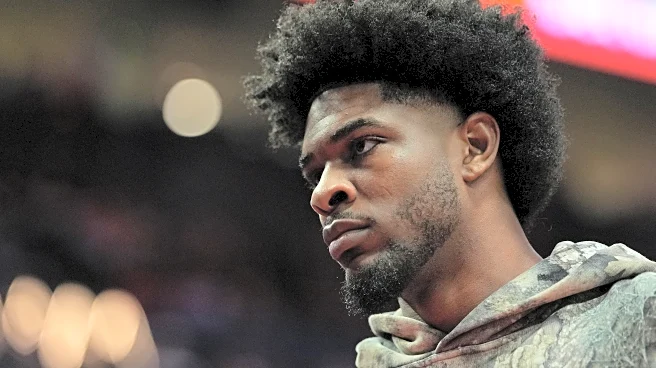

Scoot Henderson is yet to take the court for the Portland Trail Blazers this season. The third-year point guard suffered what now appears to be a pretty severe left hamstring injury, sustained during a September
offseason workout.
It’s a shame for the 21-year-old who needs this season to silence his critics, including this writer, before becoming extension eligible next summer. And, more importantly, before Damian Lillard returns to the court next season.
We all know the story. Taken third in 2023 behind Victor Wembanyama and Brandon Miller, Henderson’s rookie campaign was a disappointment. A reaction no doubt exacerbated by Lillard’s departure. The poor decision making, the turnovers, the inability to finish around the rim and the lack of composure were all serious red flags.
The second season was better, but the lack of consistency was concerning. There were truly standout performances, particularly after the calendar turned to 2025. But he would still go missing or revert to that rookie season form for stretches at a time.
By the end of his second campaign, Henderson owned career averages of 13.3 points on 34.0 percent from three, 40.1 percent from the field, 3.1 boards, 5.2 assists and 0.9 steals in 27.5 minutes. Not awful, but not superb considering the fanfare with which he entered the league.
Earlier this week, the Rose Garden Report’s Sean Highkin reported Henderson was improving but not yet ready for full contact. I’m getting the sense we won’t see the former third overall pick on the court this calendar year.
But what happens when he does return?
His role
It seems more than likely that Henderson will return to the court after fellow guard Jrue Holiday. Assuming Henderson comes back in early January, he will be available for fewer than 50 games this season.
Both he and Holiday will surely be subject to temporary minutes restrictions when they come back. The difference between the two will be that Henderson will have to earn a place in the starting unit once he’s up to speed. Not just because he hasn’t played an NBA game since March but because Holiday has an impressive body of work behind him.
I also like the Holiday-Sharpe backcourt. The combination offers a little more versatility as far as length goes, without sacrificing scoring, defense and, to a lesser extent, facilitation.
While not as true a point guard as Henderson, Holiday has the size, the experience, the smarts and the defensive acumen this team needs. As for Sharpe, I think he’s done enough to keep his starting spot, assuming he can maintain the efficiency that we’ve seen in recent weeks. Henderson completes the three-man rotation, still getting close to 30 minutes a night off the bench.
Though Holiday and Sharpe is my preferred duo, there’s nothing stopping Henderson from earning a spot. But it’s not going to just happen, there’s criteria that needs to be ticked off first.
Non-negotiables
We need to see consistency. We need to see the good performances vastly outweigh the quiet nights, which all players experience from time to time. While he’s probably not going to reach All Star status, Henderson still has the ability to be an above-average NBA point guard who can play a role on a good team.
This team desperately needs playmakers, if only to give Deni Avdija — typically a secondary facilitator — some respite. With Holiday, Henderson needs to deliver on what this team has been desperately missing in recent weeks, structure on the offensive end. I need to feel comfortable when Henderson has the ball in his hands and confident in the decisions being made.
Team success, maturity, composure and solid decision making are obviously all key. But there are a few statistical thresholds he needs to reach.
I’m fine with him hitting 35 percent from three, but I want Sharpe-like accuracy around the rim, which means lifting his percentage from 55 percent, closer to 70 percent. His shooting within 14 feet also needs to rise closer to 50 percent, up from the 34 percent last season. This hopefully results in his effective field goal percentage jumping from last year’s 49.5 percent to somewhere near 53 or 54 percent.
I want his turnover rate to drop from the 17 percent we’ve seen through his first two seasons to anything below 10 percent, I’m looking at Tyus Jones-level ball protection.
With turnovers down I want an assist rate up from the 27 percent of teammate makes he registered last year, to somewhere above 33 percent, akin to what Dejounte Murray was doing before he was injured.
Long-story short, Henderson needs to exert himself as this team’s best playmaker when he’s on the court and the numbers have to match the eye test.
Conclusion
Scoot Henderson will have a key role on this Blazers squad when he returns from the hamstring injury. But his return will be via the Blazers bench, even after his first few games. It’ll be up to him as to whether he returns to the starting unit.
As I’ve written on multiple occasions, I’m not one for just handing starting roles to young players just because they’re young and former high draft picks. That’s ludicrous. That argument is suggesting the only thing holding a player like Henderson back from greatness is because he’s not starting.
Unfortunately the young guard’s rookie campaign removed any entitlement he had to “special treatment”. While the natural ability is there, the former number three pick needs to prove his prestige as a starting-level point guard.
I’m excited to see Henderson return to the court, especially given the lack of the playmaking this team actually possesses. I’m still hopeful Henderson can impress me but he’s no longer a rookie or sophomore, it’s time to put up.
For me, a successful 2025-26 campaign for Henderson is establishing some doubt that Lillard shouldn’t simply walk into the starting point guard role next season. He needs to give pundits and fans an argument or two to support his case for the role — outside perceived potential.