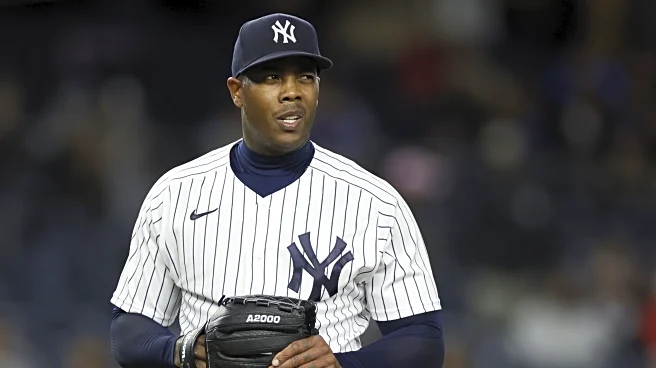

When Mariano Rivera retired in 2013, one of the greatest luxuries the Yankees had enjoyed in the Core Four dynasty came to an end. They had to start worrying long-term about who would pitch the ninth inning.
The first man to succeed the Sandman was his setup man, David Robertson, who performed well enough to score a free agent deal with the Chicago White Sox to serve as their closer. Then when Andrew Miller came aboard in 2015 and notched 36 saves in 38 opportunities, it seemed the matter was settled.
But the Yankees were thinking bigger. Ahead of 2016 they traded for All-Star Reds closer Aroldis Chapman. The Cuban Missile was famous for his record-setting fastball, and would bring his near-unhittable heat to the Bronx in his last full season before free agency.
Chapman had also, however, been suspended by MLB under the league’s domestic violence policy and would miss the first 30 games of the 2016 campaign. The Yankees sputtered and ultimately traded Chapman to the eventual champion Cubs in a deal which brought Gleyber Torres to the organization. It seemed that would be that, then. Chapman might, thanks in part to his own actions, have been a mere footnote in the record of a forgettable Yankee season.
Then they brought him back.
Albertín Aroldis Chapman
Signing Date: December 15, 2016
Contract: 5 years, $86 million
Born in Cuba in 1988, Chapman became a superstar in his native country—and in the World Baseball Classic—before defecting to the United States in 2009. Once in the States, the tall left-hander immediately became a hot commodity for MLB teams. It was the Cincinnati Reds who ultimately scored Chapman, signing him to a six-year bonus-laden contract. It wouldn’t take long for his arm to enter the history books. In September, Chapman threw a record-breaking 105.1 mph fastball, the fastest pitch ever recorded.
By that point Chapman had already been moved to the closer spot, where he would remain. His breakout campaign came in 2012, when he posted 38 saves with a 1.51 ERA and 122 strikeouts in 71.2 innings. That would quickly become the new normal as Chapman made that year’s All-Star Game as well as the ensuing three Midsummer Classics.
The Reds, though, soon became a team in decline. They had snapped a 15-year playoff drought by winning the 2010 NL Central in Chapman’s rookie season and shook off both an NLDS sweep at the hands of the Phillies and a sub-.500 season in 2011 to win another division in 2012. Another October went by the wayside when they blew a 2-0 lead and painfully dropped three in a row at home to the Giants when they needed just one win to advance to the NLCS. A playoff berth in 2013 lasted just one game, as the rowdy Pittsburgh fans rattled them in a quick Wild Card Game loss.
Following that mini-renaissance of sorts, Cincy fell to the cellar of the NL Central, dropping 86 games in 2014 and 98 the next year. So inthe 2015 offseason, the Reds shopped Chapman around, nearly consummating a deal with the Dodgers in December.
Early that month, news broke that Chapman was being investigated for an alleged incident of domestic violence which occurred in October. According to what his girlfriend told police at the time, Chapman pushed her, choked her, and later fired a gun multiple times into the wall of his garage while locked inside it. Chapman was never formally charged, but was still suspended by MLB for 30 games. He did not appeal the decision.
The Reds’ deal with the Dodgers fizzled out, but evidently not every organization thought they should stay away. On December 28th, the Yankees acquired Chapman for a bushel of prospects, none of whom made an impact in MLB (save for Caleb Cotham … but only because he was retired within two years and soon became a well-regarded Phillies pitching coach). Brian Cashman and the Yankees knew exactly what they were doing with this buy-low offer, grossly referring to Chapman as “an asset in distress.”
Chapman sat out all of April with the suspension, then managed a 2.01 ERA in 31 games for a Bombers squad plainly doomed to miss the playoffs — “No Runs DMC” be damned. Stuck in fourth place in the AL East, the Yankees dealt Chapman to the Cubs in the aforementioned deal which included Gleyber Torres in the return. Chapman went on to help win the most overdue World Series in baseball history, though his blown save in Game 7 nearly cost them the title. The Cuban Missile hit the free agent market with as stacked a resumé as any closer, but the suspension loomed large as a character concern, to say the least.
The Yankees, who had also jettisoned Miller in that trade deadline, definitely had a need at closer. They also had options. Former Yankee Mark Melancon had broken out with three All-Star campaigns in Pittsburgh (though he would quickly sign a $62 million deal in San Francisco). Dodgers closer Kenley Jansen was available, and would remain a free agent until January.
But the alleged incident hadn’t stopped the Yankees for trading for Chapman in the first place, and it wouldn’t stop them from signing him as a free agent. On December 8th, Ken Rosenthal reported that Chapman and the Yankees had agreed to a five-year, $86 million deal. That dollar figure was the highest ever given to a reliever. An apparent big-money offer from the Marlins reportedly forced the Yankees to up the ante on their deal.
Any Yankee fan who thought their hands were proverbially clean after the Cubs deal had to begrudgingly begin to root for Chapman again — or at least watch the ninth inning with a perfectly blank expression. To be entirely fair to him, he had publicly expressed contrition for his actions and is still in regular contact with his counselor, but fans understandably felt sour about him getting a record-breaking contract after the fact.
In 2017, Chapman struggled with injuries and posted subpar numbers for his lofty standards, but returned in perfect form for the playoffs. He finished five playoff games, including ALDS Game 5, in which the Yankees completed their rousing 0-2 series comeback against Cleveland.
The Bombers fell a game shy of the World Series in 2017, but were decidedly ahead-of-schedule thanks to the advent of Aaron Judge. Ahead of 2018, they geared up for a big run. Chapman returned to All-Star form with a 2.45 ERA while going 32 of 34 in save opportunities, but the Red Sox eclipsed the Yankees both in the divisional race and in the ensuing ALDS.
Chapman earned his sixth All-Star appearance in 2019, and would have his most consequential moment in pinstripes that season. It was not in victory, however, but in defeat. Of course, the Yankees dug themselves into a deep hole in their ALCS rematch with the Astros, falling behind 3-1 in the series. But they were beginning to summon that 2017 magic. After claiming Game 5 in the Bronx, a dramatic two-run home run by DJ LeMahieu off Roberto Osuna suddenly tied Game 6 when the Yankees were two outs from elimination.
But that heroism from The Machine just set the stage for humiliation in the home half of the ninth. Chapman took the mound and, with two men out, allowed Yankee nemesis Jose Altuve to end the series with a walk-off homer. There was the homer, and then there was The Grimace.
Due to opt out of his deal, Chapman received an extension to keep him in New York through 2022. But in 2020, he was was again the victim of a late consequential homer when he surrendered a bomb to Mike Brosseau in the Rays’ do-or-die Game 5 victory over the Yankees in the ALDS.
The Cuban Missile made another All-Star Game in 2021 despite a cataclysmic June in which he allowed 11 runs in 8.2 innings. He recuperated down the stretch, but the Yankees lost the Wild Card Game to the Red Sox.
The following season, in the final year of his deal, Chapman struggled with injury and fell out of the closer spot in favor of the surging Clay Holmes. He infamously went on the IL in August thanks to an infection he got from a new tattoo. Then in September, Chapman blew off a mandatory workout ahead of the ALDS, flying down to Miami and skipping a live batting practice session he was set to throw. As a result, he was left off the playoff roster. With Holmes and Wandy Peralta both capable of locking down tense matchups, the Yankees didn’t really need Chapman. But the acrimonious exit came as little surprise to a fanbase who was by now pretty tired of rooting for him.
Despite being the heir apparent to Mariano, Chapman was very rarely a comfortable watch. Throughout most years of his Yankee tenure, you knew his outings would go one of two ways: either he had his command and the game was over, or he didn’t, and you were destined to feel squeamish for however long the ordeal lasted. Then every so often, he’d give up a backbreaking homer and you were free to do something else with your day, but about 15 percent grumpier.
Of course, Chapman is still pitching in MLB. He spent a few years as a setup man and won a second World Series in more of a support role for the 2023 Rangers. Chapman returned to the closer spot with the Red Sox last year, and almost out of the blue, he posted what was statistically the best season of his career at age-37 in wake of some tweaks to his approach. He was extended by Boston in September on a deal that will go through 2027 as long as he throws at least 40 innings this year.
At this point, Chapman’s career accomplishments give him a near-Cooperstown-worthy resumé (even with bumpy playoff results). But when you betray a fanbase’s trust by crossing a line, as he did when he allegedly attacked his girlfriend in 2015—it is extremely difficult to earn that respect back. Chapman never fully did for a myriad of reasons, so while his time in pinstripes was statistically impressive, his legacy is decidedly less rosy.
See more of the “50 Most Notable Yankees Free Agent Signings in 50 Years” series here.