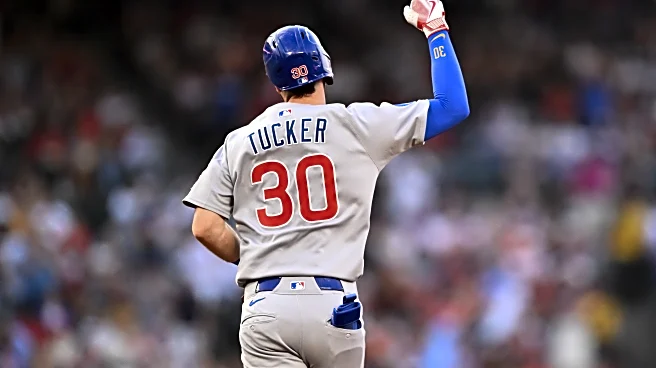

By now, of course, you have heard that Kyle Tucker signed what was initially reported as a four-year, $240 million deal with the Dodgers, with opt-outs after 2027 and 2028.
Via MLB Trade Rumors, here are
more precise financial details of the deal:
The deal includes $30MM in deferrals and will come with an approximate $57.1MM annual value for luxury tax purposes. Tucker, a client of Excel Sports Management, receives a $64MM signing bonus — all but $10MM of which is paid upfront — and can opt out after the second or third seasons.
It’s a nice birthday present for Tucker, who turns 29 tomorrow.
So, I have opinions. And likely, so do you.
Kyle Tucker, no doubt, is one of the best hitters in baseball. He showed that as a Cub through the first half of the 2025 season, but injuries (a broken hand in June and calf strain in September) limited his effectiveness in the second half and were a major contributing factor to the Cubs’ decline in that second half after they led the NL Central for most of the first half.
There were a few things that happened during that rough second half that are worth noting. There was an incident in August where Tucker was perceived to have not run out a ground ball and got booed at Wrigley Field, after which Craig Counsell benched him for a few days to give him a “reset.” To a large extent that worked, at least until Tucker had that second injury in early September. In 12 games between the end of that benching and the second injury he batted .364/.462/.727 (16-for-44) with four home runs. Then he asked to return to his home in Tampa to be examined by his own doctors and returned to play in the postseason, where he went 7-for-27 with one home run.
The injuries don’t seem to be anything chronic; including the injury which forced him to miss half of the 2024 season, they appear more like one-off freaks.
Is this deal worth it? I guess that depends on your perception of Tucker, of the Dodgers, and of baseball contracts in general. Is Tucker a great player? Of course, no one denies that. In Los Angeles, he will not have to be “the guy,” he can go about his business quietly, which is what he did much of the time he was in Chicago. This will likely work out pretty well for him, I’d think.
But here’s the thing that might derail that:
Here’s the quote from the above post:
“He’s getting hurt a little bit by Anthony Rendon syndrome. You’ve heard whispers, whether it’s Joel Sherman from the New York Post or other people who have said, ‘Yeah, maybe he doesn’t love the game now.’ Could that be a little unfair? It all depends on where they’re getting their information from. But I wonder if some teams are a little hesitant,”
Is this true? None of us can know for sure. But apparently it was a concern for some around the game.
There are a couple of other things I wanted to note regarding this signing surrounding the money and what it does to the Dodgers in connection with luxury tax.
First, as you know, the luxury tax begins at $244 million of payroll. There are four luxury tax levels. The highest level is $304 million. With this signing, the Dodgers are projected to be $100 million over the maximum level — a payroll of over $400 million.
This will now be the sixth consecutive year the Dodgers are over the luxury tax. This puts them in the 100 percent tax level at every dollar above the threshold, meaning they will pay approximately $149.6 million in penalties. There are currently eight teams in the luxury tax range, and it’s not yet clear if the Cubs will be in that range for 2026. That Dodgers luxury tax payment will be more than the other seven will pay combined, an estimated $146.4 million.
Further, that $149.6 million penalty is greater than the estimated total payroll of 12 other MLB teams, with the Royals having the highest payroll of that group at $142.6 million.
What all of this will likely do is increase the resolve of those MLB owners who want a salary cap in the next labor negotiation. As you know, players have been adamantly against a cap for pretty much the entire history of labor negotiations going back more than 50 years. This signing makes an extended lockout more likely, in my view.
I’ll end this post with a LOLMets (Bluesky link):
Which means that for just $5 million more per year — $20 million total — the Mets could have matched the Dodgers’ offer.
Good luck to Kyle Tucker in Los Angeles. Personally, I think the Cubs have put together a fine team for 2026 and who knows? Maybe the Cubs and Dodgers meet in the NLCS. The Cubs will play the Dodgers April 24-25-26 at Dodger Stadium and Aug. 3-4-5 at Wrigley Field, in addition to Spring Training meetings Feb. 28 (Glendale) and March 15 (Mesa).