
It’s prospects week here at Bleed Cubbie Blue as today I’m starting the countdown of my top 25 Cubs prospects for 2026. Each day we’re going to look at five new prospects until we get down to the top five on
Friday.
The Cubs farm system is definitely down at the moment. It’s not the worst system in the majors nor is it the worst that I’ve seen in my nearly 20 years of doing this. (Where has the time gone?) There is a lot of talent in the system at the top. I’d say that while the top prospects definitely aren’t the best I’ve seen in the Cubs system (that would probably go to 2014, 2015 or 2024), it’s at least average and maybe a little better than that. The problem is that once you get past around the eighth-best prospect, things thin out really fast. While it’s always an issue that there normally isn’t any real difference between the prospects ranked three or four spots apart as you go down the system, this year there were several players that if you wanted to rank them ten spots lower or higher, I probably wouldn’t argue with you. After the eighth prospect, it’s either guys with low ceilings or injury issues or who just haven’t proven themselves as a professional yet. There are six recent 2025 draft picks in the top 25 and I’m pretty sure that’s a record for me. Four of them have yet to even make their professional debut.
The good news is that the system is down for a lot of the right reasons. Over the past two seasons, Pete Crow-Armstrong, Cade Horton, Matt Shaw, Michael Busch, Ben Brown, Jordan Wicks, Daniel Palencia and others have left the farm system and become important contributors to the major league team. On top of that, the Cubs have traded away several very good prospects like Cam Smith, Zyhir Hope and others. I was left scrambling to find two more prospects to replace Owen Caissie and Cristian Hernandez, both of whom were traded to the Marlins for Edward Cabrera. There were other players who would have been in the top 25 this spring who were dealt at the trade deadline in July.
The bad news is that in this situation, you hope that the minor leaguers who remain step up and distinguish themselves as top prospects to replenish the system. While there are a few who really did, not enough of them did. Some prospects who were expected to be top ten prospects this year took steps backwards, either because of injury or just poor performance as they went up a level. This is one reason why there are so many draft picks this year.
A third reason the system is down that is neither good nor bad is something I mentioned last season: the minor leagues are just down everywhere. In particular, the quality of pitching has been quite poor and it’s not just the Cubs’ system that is hitter-heavy. We can only speculate why that is, although I certainly think the elimination of one level of the minors plays a role.
Another reason there are so many draft picks this year is because I simply don’t rank players who haven’t left the Dominican Summer League left. There are a few reasons for this, but the biggest one is I simply don’t have enough independent information to make my own evaluation. There isn’t much video and what there is tends to be two or three years out of date—when the player was 14 to 16 years old. But there are a few players down in the Dominican that I’m looking forward to seeing in the US this year and I hope that they’ll lift the system by this time next year.
Other than that, to be considered for this list you have to still have prospect eligibility, which is defined as fewer than 130 at-bats, 50 innings pitched and less than 45 days on an active roster. Even though Moisés Ballesteros and Kevin Alcántara have played in the major leagues, they’re still eligible.
On a “we’re all getting older” note, I expect that Riley Martin will be my final ranked prospect whose birth year starts with a “19.”
As always, any mistakes here are my fault.
If you click on a player’s name, it will take you to his milb dot com page where you can get more statistical information.
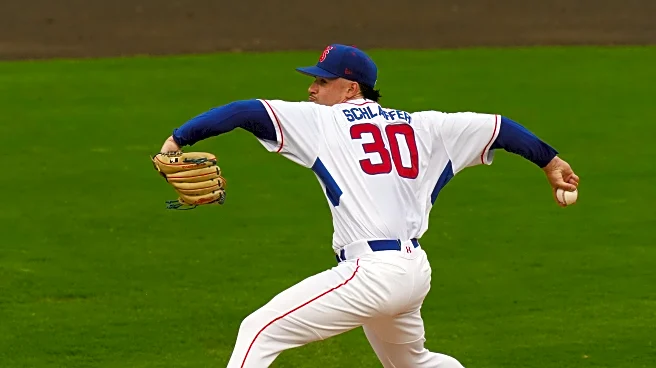
21. Tyler Schlaffer. RHP. DOB: 5/24/2001. 6’1”, 180. Drafted 9th round (2019) Homewood-Flossmoor High School (IL)
Schlaffer has been in the Cubs system a long time and is just starting to put things together now. Part of the reason for that is Tommy John surgery, which cost him the entire 2023 season. But Schlaffer put up the best season of his career in 2025 and finished the year with nine starts in Double-A Knoxville, where he went 4-2 with a 2.78 ERA.
Schlaffer’s pure stuff isn’t going to blow anyone away, but he does have five decent pitches that he mixes up well to keep hitters off balance. His fastball has average velocity in the 92-94 range, but its flat shape keeps it from being a better weapon. His best pitch is his low-80s changeup, which is a real weapon against lefties. He also has a slurvy curve ball which he can use as an out pitch when he’s locating it well. Schlaffer has a fringy slider and a sinker, although both pitches sometimes play better than that. Schlaffer does close to equally well against left- and right-handed hitting, so that versatility plays in his favor.
The big issue with Schlaffer is his overall command and control, which abandons him at times. When it’s on, he can keep hitters guessing with a smart pitch miss, When it’s not, he ends up walking too many batters and leaving fat ones over the plate. Luckily last year, he was on more often than he was off. He will need to show more consistency in throwing strikes to be a major-league contributor.
Schlaffer was “on” in June, when he went 3-0 with an 0.69 ERA and 27 strikeouts in 26 innings that earned him Midwest League Pitcher of the Month honors. It also got him promoted to Double-A Knoxville.
Schlaffer’s pedestrian pure stuff probably relegates him to being a back-of-the-rotation starter with a lot of relief risk. He should return to Knoxville this summer with a promotion to Iowa that could come sooner rather than later.
Here’s Schlaffer striking out ten batters for South Bend in June.
22. Riley Martin. LHP. DOB: 3/19/1998. 6’1”, 215”. Drafted 6th round (2021), Quincy (IL) University.
Martin is extremely likely to make his major league debut this year as the Cubs added him to the 40-man roster this past winter. He’s an odd left-handed reliever who has had consistent reverse-platoon stats throughout his professional career.
Martin is a fastball-curve reliever, although he does have a slider and a change that he breaks out occasionally. The fastball comes in at 93-to-95 miles per hour and has decent movement on it. The curve is a real swing-and-miss pitch with mid-80s velocity and a sharp downward break.
Martin repeated Triple-A Iowa last year and was one of the I-Cubs best relievers all year, going 6-2 with four saves and a 2.69 ERA. He struck out a whopping 80 batters in 63.2 innings last year and has consistently struck out more than a batter an inning throughout his career. As you probably expect, he does have issues with control with 35 walks. However, that marked an improvement over his previous years. If he can make a similar jump forward this year, Martin could end up being a real weapon in a major league bullpen.
Martin is likely to start the season in Iowa again, but with his 40-man status, he’s going to get his chance at the majors as soon as an injury opens up a spot for him. If he can seize that opportunity, he could have a decent career as a major league left-handed middle reliever.
Here are some Martin highlights from early last season.
23. Nick Dean. RHP. DOB: 12/26/2000. 6’3”, 180. Drafted 19th round (2023). Maryland.
If you look at Dean’s 2025 season, you might question why he’s on this list, beyond the fact that the system starts to get thin around here. Between South Bend and Knoxville, Dean went 1-7 with an ERA of 5.43 over 15 starts. The Cubs even took him off the roster at one point and put him on the development list so he could work on straightening things out in a lower-stress environment.
But Dean’s strikeout and walk totals speak of a starting pitcher who can control the strike zone. Last year, Dean struck out a solid 27.4 percent of batters last year between the two levels and walked an impressive 6.9 percent. Yes, Dean gave up too much hard contact and too many home runs. But his overall command of the strike zone gives the Cubs something to work with here.
Dean’s fastball is a pretty pedestrian 89-91 miles per hour with decent break, although not a lot of deception. However, it plays better than it might otherwise because of a low-80s “Bugs Bunny” changeup that grades out as plus. Dean also mixes in a fringy curve and a fringy slider.
With only one pitch grading out as even average, Dean’s upside is limited. But he throws strikes and has that changeup going for him, so he certainly could carve out a role for himself as a back-of-the-rotation starter. More likely, he’s an up-and-down sixth starter.
Dean will likely return to Knoxville to start the season. Should he find a way to limit the hard contact, he should see Iowa sometime midseason.
Here’s Dean striking out three batters in South Bend.
24. Dominick Reid. RHP. 6’3”, 201. 11/28/2003. Drafted 3rd Round (2025) Abilene Christian.
The Cubs’ third-round pick from last summer’s draft hasn’t made his professional debut yet and I try to be a bit conservative when grading players who haven’t hit a minor league diamond yet. That practice has gone a bit out the window this year, but I still think that Reid’s ranking here is perhaps overly conservative but fair.
Reid spent two seasons (barely) pitching out of the bullpen at Oklahoma State before transferring to Abilene Christian for his junior year. He made 15 starts for the Wildcats (yes, I had to look that up) and went 6-3 with a 3.26 ERA. More impressively, he struck out 112 batters and walked just 27 over 88.1 innings. That was enough to get the Cubs to take Reid in the third round and hand him a nearly $650k signing bonus.
Reid’s best pitch is his changeup that comes in at 82-to-84 miles per hour and provides an excellent contrast to his average 91-95 mph fastball. He also has a low-80s slider and an upper-70s curve. He has at least average control on all four pitches.
Beyond that strong changeup, a lot of the appeal of Reid is the belief that he hasn’t maxed out his potential. Reid is a big right-hander without a lot of college experience. He might be able to add a few more miles onto his fastball with some tweaks. He’s also going to need to improve either his curve or his slider if he wants to stay a starting pitcher, but he could probably have a career as a reliever with just that changeup.
As the Cubs are wont to do, they shut down Reid after drafting him last summer. He should make his professional debut this spring. Myrtle Beach is the most likely starting spot for him, but depending on how much progress the Cubs feel he’s made over the past six months, he could start in Mesa or South Bend. Reid is a project, but one that could pay off with a back-end starter somewhere down the line.
Here’s every pitch Reid threw in a game for Abilene Christian last year.
25. Kaleb Wing. RHP. 6’2”, 180. DOB: 1/12/2007. Drafted 4th round (2025), Scotts Valley HS (CA)
Wing is a lanky right-hander who recently converted to pitching. Wing is a four-pitch pitcher with a whip-like delivery. His fastball sits 92-to-93 miles per hour with good arm-side ride, but it has touched 95 at times. I suspect that the Cubs believe that he can hit that velocity consistently with more experience and maybe some added weight.
Wing’s primary secondary pitch is an upper-70s changeup that mimics the movement of his fastball, except with a much greater vertical drop. He also has a big, loopy, knee-buckling curveball that could be plus if he learns to locate it with any consistency. Wing’s low-80s slider is a work in progress, but it does have some horizontal cut to it.
Wing was a shortstop before converting to pitching, and that athleticism and experience helps him field his position well. That’s not something we mention often for pitching prospects, but it can make a difference.
One thing that stands out as a possible negative on Wing is his body, which is wiry to say the least. Some observers think there’s some room on his frame to add some muscle and others aren’t so sure. But there is some question as to whether his body can withstand the rigors of starting every fifth day as a professional. Certainly there’s always a relief risk with a young pitcher, but there may be more relief risk than normal. But on pure stuff, he could be a number-four starter.
Fun fact: Kaleb’s father Ryan was a second-round pick of the White Sox and made it as high as Triple-A.
The Cubs took Wing in the fourth round last year and signed him away from Loyola Marymount for $1.5 million, which is second-round money. Like nearly every newly-drafted pitcher, the Cubs shut him down for the rest of the year, so he hasn’t made his professional debut this year. Depending on how much progress he made on the backfields of Mesa last fall, he could make his pro debut in the Complex League or Myrtle Beach. But clearly the goal is to get him to Myrtle Beach some time this year.
Here’s Wing pitching in a showcase game last year:
Tomorrow: Prospects 16 through 20.