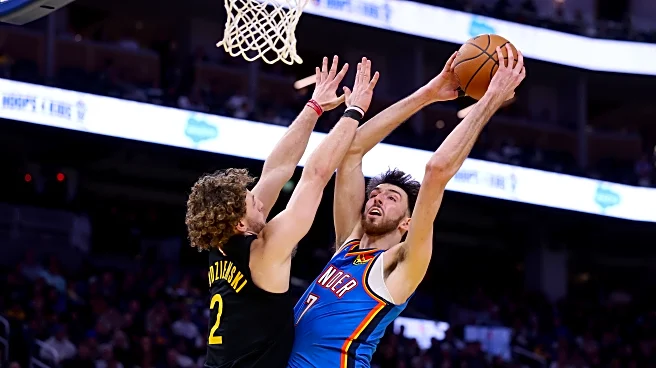



There are a few games every year where the outcome is known before the ball is tipped. Friday’s contest between the Golden State Warriors and Oklahoma City Thunder was one such game. The Warriors, who are still trying to figure things out, were always facing an uphill climb against the Thunder, the defending champions who have been the clear-cut best team in the NBA this season.
But that uphill climb turned into scaling Mount Everest naked when it was announced that the Warriors would be playing without
Steph Curry, Jimmy Butler III, and Draymond Green (and also De’Anthony Melton and Seth Curry). And unfortunately, scaling Everest naked, already an unenjoyable task, became even less enjoyable when Jonathan Kuminga — finally set for some minutes — was a late scratch due to a back injury.
And so you knew the Warriors would lose to the Thunder. It was just a matter of in what manner, and by how much.
The answer to those questions, respectively: emphatically, and by a lot.
Golden State gave it their best shot, but their best shot was, predictably, not even adjacent to being good enough. They scored their fewest points of the season, shot their worst mark of the season, and suffered their biggest loss of the season, falling 131-94 to the machine that is the mascot-stealing Thunder.
There were moments, at least in the first half. Hell, the Warriors struck first, as their opening lineup of Brandin Podziemski, Will Richard, Moses Moody, Gui Santos, and Quinten Post put the ball in the bucket on the first possession of the game. The Thunder would, admittedly, score the next 10 points of the game, as Golden State would go about four minutes without scoring after that initial bucket (a Richard three).
The Warriors were aggressive on offense and did a decent job not turning the ball over, but they simply couldn’t get shots. They tried repeatedly to attack the rim, only to find out — repeatedly — that Chet Holmgren was waiting there to make life difficult. Their defense was inspired — for a while, at least — and Al Horford sparked a late run. But it was, to quote Zaza Pachulia, a case of nothing easy, which was hardly a surprise. The Warriors trailed 34-23 after the opening frame, as MVP favorite Shai Gilgeous-Alexander put his stamp on the game with 12 points.
We saw the best version of the scrappy underdog Dubs in the second quarter. They had great energy despite the double-digit deficit, and were chasing the Thunder, rebounds, and loose balls relentlessly. Behind some inspired play from Podziemski and Richard, the Warriors scored nine consecutive points, pulling to within two after just a few minutes of second-quarter action. The Chase Center was alive, and the Warriors ever-so-briefly flirted with giving you some hope.
Oklahoma City called timeout. And during that timeout, they apparently remembered that they are the best team in the NBA, playing the broken skeleton of a mediocre team. Holmgren took over immediately following the timeout, and didn’t let up. His teammates followed his lead. The unanswered points toll rose and rose, and rose. Steve Kerr called one timeout, and then another, and still the Warriors hadn’t scored.
When the dust finally settled and the carnage was sorted, the Thunder had scored 19 straight points. A close game had turned into a blowout. A raucous arena had turned into a morgue. It was only the second quarter, but everyone knew the game was over.
And that was, essentially, that.
The Warriors, despite being down 20-plus points, still fought and showed life, with Al Horford coming off the bench to lead a late run. The Thunder shut it down quickly, though, and emphatically too: Lu Dort drained a buzzer-beating three to send Oklahoma City skipping into the locker rooms with a 64-45 advantage.
There would be no moment in the second half where it felt like the game was close. It was an uneventful start to the third quarter, and then the game started to slip further and further away. It was SGA’s world, and we — the Warriors, their fans, and the NBA and its supporters at large — were all just living in it. When the third quarter ended, the Thunder held a comical 95-66 advantage, and all that was left was to ride it out.
OKC turned to their bench for the final 12 minutes, with none of their starters stepping on the court. The Warriors, of course, were already playing their bench from the get-go, and thus were unable to do that. As such, the fourth quarter was perhaps the fairest fight in the game, but even at that, it was a frame the Thunder won by eight points, as they cruised to a 131-94 victory, and a 30-2 record against teams that aren’t the San Antonio Spurs.