








Tainara Lisboa suffered a hard loss to Lucia Szabova this past weekend at UFC Vegas 123 as she was stopped in the third round via ground and pound at the Metra APEX on Oct. 31.
Lisboa’s head coach Bruno Polengo has also faced criticism for his style of cornering.
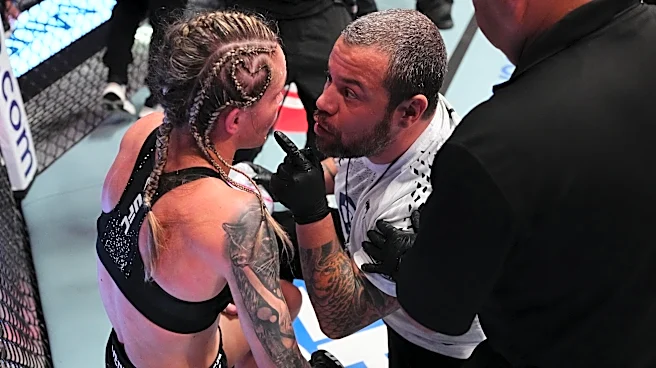
Lisboa was down on the scorecards going into the third round and needed a finish to avoid what ended up being her third straight loss in the company, and Polengo, who happens to be her husband, went all-in during the break before the final
stanza.
“You’re f*cking embarrassing yourself,” Polengo yelled at her in Portuguese. “Is this what you trained for? What the f*ck is this? This b*tch has nothing on the ground. Wake the f*ck up. Wake up. You gotta grab her. No f*cking slacking off. This b*tch is a three-time [Oktagon] champion, and that’s all she’s got? Tainara, I want you to kill this b*tch. You have five minutes.”
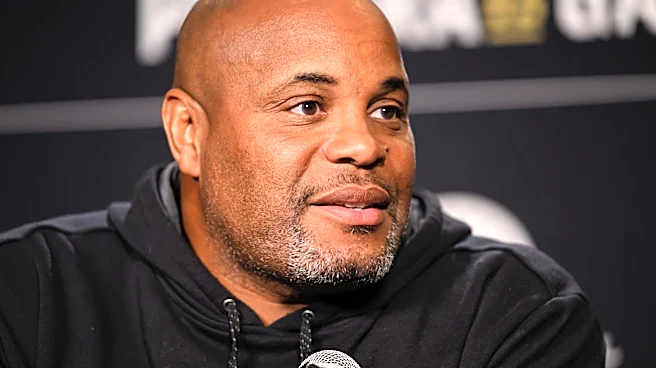
UFC commentators Daniel Cormier and Laura Sanko were very critical of his work when the final round began, saying Polengo should have given her technical instruction instead of going for an “emotional” angle.
“It’s not an emotional problem,” Cormier said on the broadcast. “She’s fighting the best that she can.”
Szabova eventually took Lisboa down in the third round and reached a dominant position to land 31 strikes and earn the TKO stoppage.
Three days later, “surprised” at all the backlash online, Lisboa comes to Polengo’s defense. According to the 35-year-old, she actually does deal with an emotional problem that sometimes affects her performance inside the cage.
“It’s so natural for me because that’s my life in there,” Lisboa told MMA Fighting. “We worked so hard to belong in that place, we went through a super complex surgery after my second fight. I had to learn how to walk again, I felt a lot of pain, trying to rehabilitate myself, find myself again, and that caused me a lot of mental problems. I had to deal with depression, I took medication, so being there is really a chance for a future, it’s how we pay our bills.
“We knew what we could deliver, and suddenly everything is lost in there. It’s not working, it’s not happening, and the coach knows the athlete he has and the problems I have. Unfortunately. I don’t think it’s good, but the reality is that I have psychological problems. I’ve been in sports since I was 13, I went through a lot during my muay Thai days, so unfortunately, my weak point is my mental game. And Bruno, ever since we met nine years ago, has helped me face things and seek treatment.
“We’ve dealt with depression a few times, with him alongside me, wanting to give up everything, wanting to end my life. We’ve been through that, with my insecurities, with my fears, which are things we athletes don’t talk about, don’t bring up, but they happen to many high-performance athletes. It’s an incredible privilege to be at an event like the UFC, living what you dreamed of, and having the chance to build a life because they pay you to work. But it’s also a lot of pressure because you think about everything you could lose, everything you might not be able to achieve, all the injuries that get in your way, all the fears, and the team you want to honor. There are so many things inside one little box.
Lisboa said it’s “part of my modus operandi” to perform better with a coach that pushes her that hard in between rounds, a person “that scolds me, but guides me along the way.”
“There’s someone trying to take your head off, someone trying to take your dreams away, so there’s no way it can be any different,” Lisboa said. “I was embarrassed by what I did, by what I failed to do, by what I know my coaches and I prepared to deliver regardless of the result. That embarrasses me. And him trying to rescue me, yelling and trying to wake me up, is actually a huge proof of love. Even if he were just my coach. Love for my dreams, because he knows how important that is to me. It’s a very decisive fight, a fight that will probably cost me my career in the organization, against an undefeated and very tough girl, and we had to accept it.
“It wasn’t a good fight, it was a fight that already carried a huge weight. We were coming in against someone who had no pressure, undefeated, excited about making her UFC debut, while I was carrying a piano on my back. Am I going to get cut? I need to win this fight. We need this money. I need to show I deserve to be here. I had to perform. So much so that in the first round I told him, ‘fight with me, fight with me,’ because I felt I wasn’t getting into the fight, that I wasn’t there. In the locker room I asked him, ‘Don’t let go of my hand, no matter what happens.’ Unfortunately, I didn’t do my part, I couldn’t wake up, I couldn’t respond, but he did what we had agreed on.”
Polengo, who is married to Lisboa for nine years, told MMA Fighting he was by her side when she has dealt with depression in the past, and said his role there is to help her “snap out of it” when dealing with difficult situations. One of those tough moments, he said, was having to learn how to walk again after a serious knee injury kept her sidelined for over a year.
Lisboa and her coach said camp was great for UFC Vegas 123 even though they felt it was a bad match-up given her status in the UFC, but it ultimately didn’t go her way.
“I cursed at her because the way I have to wake Tainara up is by becoming explosive,” Polengo said. “Explosive is the word. Anyone who knows me knows that’s how I am. When I shake Tainara up, she wakes up. But I knew that wasn’t Tainara in there anymore. Man, this is our life. If we know we’re going to lose and we know the UFC is going to send Tainara home, our life is on the line in there. My relationship with Tainara isn’t just coach and athlete. We have a life together, and our life is very tough. We gave everything up over these nine years to be here. I know how much Tainara has done, how dedicated she is, and how much she has given up her entire life since she was 13 years old.”
Polengo said he doesn’t care about hateful comments online, but was bothered to be called “abusive.”
“When it comes to abuse, you have to be very careful. Very careful,’ Polengo said. “The motto at my gym is: don’t take me away from home if you’re not going to give your best. I never leave home to do something shitty in my professional life. I won’t accept any athlete taking me away from home just to do something shitty. Tainara and I spend a fortune to be here. Now, imagine how I felt watching everything go down the drain because my athlete and wife lost herself.”
“I went crazy again,” he added. “I saw everything going down the drain, but I knew that wasn’t the Tainara I know. Tainara and I have a husband-and-wife relationship. We’re very happy together. Anyone who knows us knows I would never do anything [bad] to Tainara, or to anyone else. I can be an energetic person, but I’m not abusive. My athletes are held accountable. If they make us believe in something, they’re held accountable. Talking about abuse is very dangerous, you have to be very careful, because millions of people are watching.”