

In general, I look at “draft grading” as a three-part exercise.
The first phase takes place during the draft selection itself and then in its immediate aftermath, where you are mainly analyzing who the team is taking and how they navigated the overall process. There’s a lot more emotion and opinion involved in this phase than anywhere else, since immediate reactions are more visceral than ones made with more data in front of us.
Over the next few days, phase two begins. You can revisit picks with more
information about the players that were selected. Players begin signing, and after a few weeks, you can take stock in the total talent infusion that the team is actually receiving. Individuals like the GM/POBO and their scouting directors will have given interviews and soundbites into their though processes and the philosophy behind what they were doing.
The final evaluation period doesn’t take place until years after the draft- enough time has to actually pass so that players can mature and we can take a true look back to see how the team developed them (or not) and how they panned out. What might’ve looked good at the time, as has so often been the case in baseball history, might not have actually worked out in the long run.
It’s been a few weeks since the draft took place, and we’re firmly in phase two. The deadline to sign players has passed, some players have made their professional debuts, and things are set. In the immediate aftermath of the draft, I was extremely underwhelmed, shocked to a certain degree, and somewhat concerned: this was a bad draft. Having had some time now to digest things and become familiar with all of the players involved, my opinion has softened a little bit, but still I feel that the Mets did quite poorly here.
Expectations weren’t especially high for this year’s draft. Because of their 2025 record (83-79), penalties for signing free agents, and luxury tax penalties, the Mets would be making their first selection with the 27th overall pick and would have a $6,730,900 bonus pool to work with, the third-smallest after the Dodgers ($3,951,900) and the Blue Jays ($5,543,100). That is to say, I didn’t think that Roch Cholowsky was going tell other teams not to select him so that he could be available for the Mets at 27, and that after him they would go on a run selecting a bunch of high-profile high school players who would magically agree to underslot agreements for the honor of playing in the organization.
With all that in mind, my personal philosophy regarding the draft was to be conservative: with a single pick within the top 30, just two in the top 100, and not all that much money to work with, I thought it would be most prudent to play things safe and not take gambles on the high-risk-but-high-upside plays; when you only have two big swings, make them count. That didn’t have to mean that the players targeted would not have moderate-to-high ceilings, but rather, that players higher floors should be prioritized.
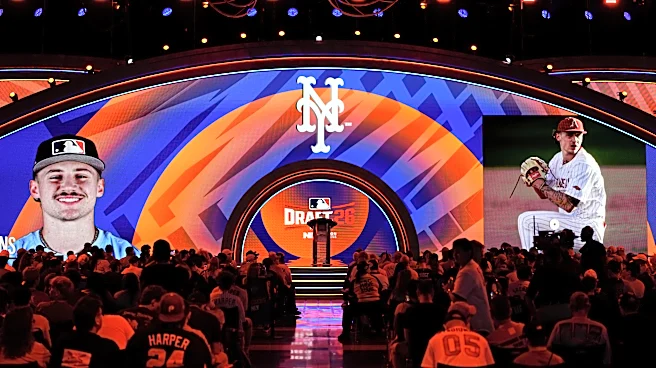
For good or bad, the Mets did the exact opposite. With their first-round pick, they took Carson Wiggins and with their third-round pick, they took Aiden Robbins.
Now, don’t get me wrong, both of those guys have as much upside as anyone else available in the draft when they were selected, but the amount of risk in their respective profiles seems disproportionate as compared to comparably selected players.
Carson Wiggins, while the fastball-breaking ball combination is truly enticing, has a UCL that is already damaged goods, and because of the damage to it and the resulting UCL internal brace surgery, has virtually no track record against live hitting. Robbins, who has the combination of power, speed, and athleticism that you want every player to have, is very likely to need an overhaul of his swing mechanics to go along with some much-needed work on his eye for spin– and the Mets as an organization do not have the best track record currently with either.
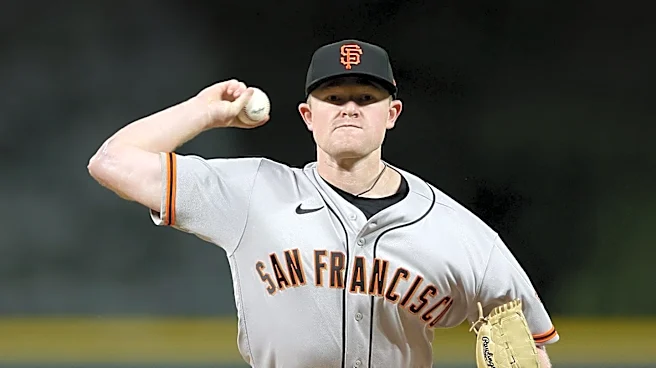
What gets me is that there were players with almost literally the same profiles as Wiggins and Robbins who were available when the Mets made their first and third round selections but with what we could perceive as much safer floors. Tegan Kuhns was drafted by the St. Louis Cardinals with the 32nd overall pick and has a potential upside just as high as Carson Wiggins with his own plus fastball and plus curve. He agreed to terms with the Cards for a $3,044,600 signing bonus, within the same realm as Wiggins and his $3,466,500 signing bonus. Those same Cardinals also drafted Dee Kennedy with the 114th overall pick in the 4th round, a player extremely analogous to Robbins both statistically this past season (Kennedy hit 20 home runs to Robbins’ 24 and posted a 1.194 OPS to Robbins’ 1.120) and approach (aggressively pulling-and-lifting balls at the expense of some swing-and-miss, especially breaking balls). He agreed to terms St. Louis for a $684,300 signing bonus, exactly slot value and almost $315,000 less than Robbins received.
In the later rounds, the team did their usual thing of identifying collegiate players that had interesting traits regardless of their performance or health track records. Having had success doing so with players such as Will Watson, or Jack Wenninger, or Zac Thornton, I have no real problem with the strategy, as college baseball is a different beast from professional baseball and results don’t really matter too much. While high school players are raw lumps of clay to be molded by professional teams, college players are only slightly more formed. Colleges play for results, not development.
What made things different this year was that the organization was selecting these kinds of players and signing them to mostly slot or even over slot deals. Fourth rounder Shane Sdao signed for $642,600, $2,500 under the MLB-assigned slot value for his pick. Fifth rounder Luke McNeillie was signed for $497,500, $25,000 over slot. Sixth rounder Alex Petrovic was signed for $364,600, exactly slot value. Seventh rounder Aiden Keenan was signed for $350,000, $62,200 over slot. Eighth rounder Landon Koenig signed for $229,600, $2,500 under slot. Ninth rounder Ryan Tayman signed for $204,700, $2,500 under slot. Tenth Rounder Nate Isler signed for $148,500, $46,700 under slot. That comes out to an additional $32,800 from the bonus pool that was spent on collegiate pitchers.
Compare to the 2025 draft, when Cam Tilly was the only collegiate player selected in rounds 4-10 who signed for over slot value ($397,500 to a slot value of $254,000). The other players in that group- Payton Prescott, Nathan Hall and Tyler McLoughlin- all signed for below slot value, a total savings of $422,200- $278,700 subtracting the $143,500 that went to Tilly. With the additional savings that the team was able to work out with first-rounder Mitch Voit and second-rounder Antonio Jimenez, the team was able to allocate those funds to a bunch of high school players, drafting and signing Peter Kussow ($341,700 over slot), Cam Lohman ($584,300 over slot), and Anthony Frobose ($193,200 over slot) in those middle rounds.
The Mets simply did not have the financial flexibility to make reasonable or even long-shot selections of high upside high school players this year. They ended up drafting two, Jacob Madrid in the 13th round and Marcus Ward in the 18th round, with the former signing for $197,500, a $47,500 overage for post-tenth-round selections and the latter honoring his commitment to Western Carolina University. The last man on the board, the Mets only had $35,945 left in their bonus pool to offer Ward, for a maximum signing bonus of $185,945. Personally, I prefer Ward to Madrid, but I do not see either possessing particularly high upside at this point. Given how the Mets’ navigated this draft, the necessary funds to entice any prep player with higher upside still available simply wasn’t there.
As a writer for Amazin’ Avenue, I have been involved in draft coverage in one way or another since 2013, initially just profiling potential draftees but then starting in 2016, providing full draft coverage, from retrospectives and reviews to previews and player profiles. All in all, this was one of the weaker drafts I have provided coverage for. With the major league team having a historically bad season and the minor league system lost a lot of its luster due to player promotions and general underperformance, an underwhelming draft could not have come at a worse time.