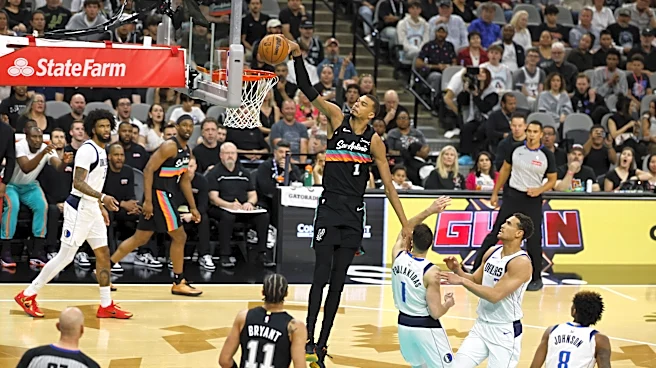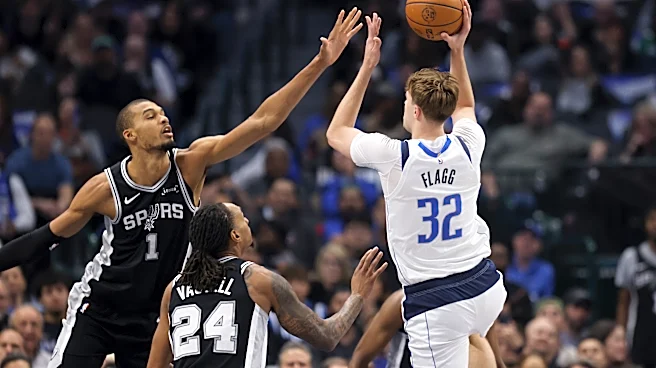







It’s wonderful to end the regular season on a high note, and it would appear that the Spurs are going to do that after securing the team’s 62nd and Vic’s 65th game in an ultimately comfortable win over the Mavs. There’s still one game to go, but San Antonio no longer has anything to play for in this regular season, and their final opponent (the Nuggets) may very well enter than game with the three seed on the line. Anything could happen, but I think a final Spurs record of 62-20 ought to be heavily
favored at this point.
In some respects, this game was like many Spurs wins recently, in that San Antonio got up early and ultimately won by nearly 20 points. However, it was also a remarkably seesaw affair for about two-and-a-half quarters, until the game clearly broke the Silver and Black’s way around the middle of the third quarter. Fortunately, this combination of characteristics helped create some interesting box score highlights:

Factors that Decided the Game
- This game looked like it was well on its way to over at the end of the first quarter, as San Antonio had opened up an 11-point lead. A resurgent 2nd and early 3rd quarter from Dallas made the game interesting, but the Spurs’ reasserted themselves in the latter half of the third, resulting in yet another comfortable blowout.
- San Antonio secured a sizable overall advantage in total rebounds (+13), but Dallas actually held the edge in offensive boards (+1). In addition, Dallas had four fewer turnovers, which played a role in them having six more field goal attempts. Furthermore, the Mavs leaned much harder into the three-ball, logging a +8 3PA margin.
- Sadly, for the Mavs, San Antonio was extremely efficient from the field, including FG% and 3P% values of 54.35% and 40.63%. This allowed the Spurs to outscore Dallas by eight outside of the free throw line.
- The final nail in the coffin was San Antonio’s large advantages in free throw volume (+8 FTA) and FT% (+17.35 percentage points), which allowed the Spurs to achieve a point differential of +11 at the charity stripe. Setting aside San Antonio’s ridiculous efficiency in this area, a big problem for Dallas in this game is that they fouled more often (+4) and at bad times, which drove the Spurs’ edge in free throw volume (and is another reason that the Mavs shot more from the field compared to San Antonio).
Rare Box Score Stats
- San Antonio became just the 31st team (winner or loser) in the last 13 regular seasons to make at least 26 free throws on no more than 27 attempts. That combination happens a bit more than twice per season, or about once in every 545 games.
- The Spurs were also just the 39th regular season winner in the last 13 seasons to record FG%, 3P%, and FT% values that were all as good or better than 54.35%, 40.63%, and 96.3%, respectively. In other words, this shooting percentage line is matched or bettered by a bit less than 3 winning teams in a given regular season, or roughly once in every 433 games.
- Although not captured in the graded team box score, Wemby’s 65th (and certainly final) game of the 2025-2026 regular season was another doozie. In fact, dating all the way back to the start of 1996-1997, this is one of just four regular season instances in which a player scored 40+ points in under 27 minutes. These cases are evenly divided across just two players: Klay Thompson and Victor Wembanyama.
What are Team Graded Box Scores?
Very briefly, these box scores grade winner-loser differentials for basic box score statistics, with the grade being based on the winning team’s differential relative to other NBA winners during a defined reference period. Think of it like a report card for understanding how a given winner performed relative to other winners. The reference period used runs from the start of the 2012-2013 season to the latest date of play, including only games in the same season category (i.e., regular season and playoff games are not compared to each other).
Data Source: The underlying data used to create these box scores was collected from Basketball Reference. In all cases, the data are collected the morning after the game is played. Although rare, postgame statistical revisions after data collection do occur and may affect the results after the fact.