



A pair of Intercontinental title matches featuring Bret Hart dominated WWE’s 2025 list of the greatest matches in SummerSlam history. At number one was Hart’s epic against the British Bulldog in 1992 at London’s Wembley Stadium, a match that still holds up to this day.
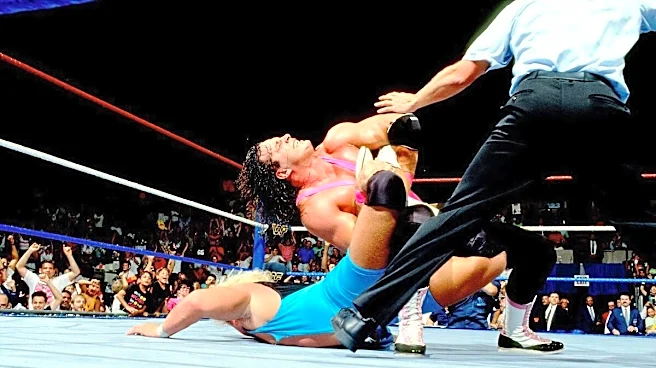
Coming in third was Hart’s showdown the year before against Curt Hennig, Mr. Perfect, which launched “The Hitman’s” solo career. For years, fans and pundits have lauded this match as an all-time classic.
As someone who watched it live
on pay-per-view and was a fan of both stars, I thought it was good.
That’s it. Just good.
But through the years, it’s earned so much praise that one would think it’s wrestling’s Citizen Kane. And I get it. Perfect came into the bout with an injured back that ultimately sidelined him for over a year following SummerSlam 1991. Under the conditions, he put on a respectable performance.
“The rumor was that he wouldn’t show because his back was too messed up,” Hart wrote in his 2009 autobiography, Hitman: My Real Life in the Cartoon World of Wrestling. “In fact his injury was bad enough that he’d been forced to do nothing all summer long but fish. Aware that this match could end up being Curt’s last one, I wanted to give him the best send-off I could.”
At the time, I wasn’t aware of Perfect’s injury, nor did WWE acknowledge it in the lead-up. The internet wasn’t a thing. I hadn’t been exposed to “dirt sheets.” Unlike fans on the East Coast, my hometown of San Diego didn’t feature pro wrestling radio shows that went beyond what fans saw in the ring.
Instead, I went into the match believing both men were at their best. To their credit, nothing about their performance indicated to me that Hennig was less than perfect. I enjoyed the contest, still do, and I was happy with the outcome.
Still, a few things soured me on the match.
First, Perfect’s manager, Bobby Heenan, retired as a manager to focus on his career in the broadcast booth. His replacement was The Coach, retired wrestler John “The Golden Greek” Tolos. Though he had been a star in the 1950s and 1960s, Tolos’ coach gimmick seemed corny, and he lacked the chemistry Perfect had with Heenan, which dulled Hennig’s presentation.
But what ultimately killed this for me was the finish.
Hart won with a Sharpshooter, but before he could fully lock it in, referee Earl Hebner called for the bell. Meanwhile, Perfect, who was selling the effects of the hold, continued shaking his head no. As a viewer, I was confused. Why did the ref call the match while Perfect was clearly saying “No”?
Years later, I understand that the early stoppage was likely to protect Hennig’s back. I can appreciate that. Still, in the moment, it took me out of everything I had just seen.
And what I saw was a solid match that held the attention of the fans inside Madison Square Garden.
But solid wasn’t good enough when the bar for I.C. title matches had been set four years earlier at WrestleMania III with Ricky Steamboat and Randy Savage. While this was good, it was nowhere near as good as “The Dragon” and “Macho Man.” Nor did Hart and Perfect have the same passionate storyline that fueled Savage and Steamboat.
Additionally, while the outcome helped put Hart on the map, his WrestleMania VIII victory over “Rowdy” Roddy Piper for the same title arguably did more for his career. Piper had only been pinned a handful of times during his WWE run, and the match focused on their history and friendship in Canada, which was threatened as championship glory hung in the balance.
What SummerSlam 1991 offered was a match between two great wrestlers, a champion defending his title against the No. 1 contender. While I was rooting for Hart to reach the next level, I wasn’t calling for the end of Perfect’s reign as I had with past champions like the Honky Tonk Man. Had Perfect retained, I would’ve been okay with that, too.
With the benefit of hindsight, I could take what I learned about Perfect, apply my appreciation for his fortitude, and view the match through a different lens.
But I can’t do that.
Why? Because that’s not how I saw it in 1991, which was what mattered at the time. Compared to other matches that year, I thought it ranked a little too high with readers of Pro Wrestling Illustrated, as it finished just behind the Steiner Brothers vs. Lex Luger and Sting, which won Match of the Year — a choice that earned my vote.
Despite the incoming flak I expect to get from readers, I stand by what I said: No Heenan, a ho-hum storyline, and a sudden stoppage while Perfect holds on earns a “just alright” with me.