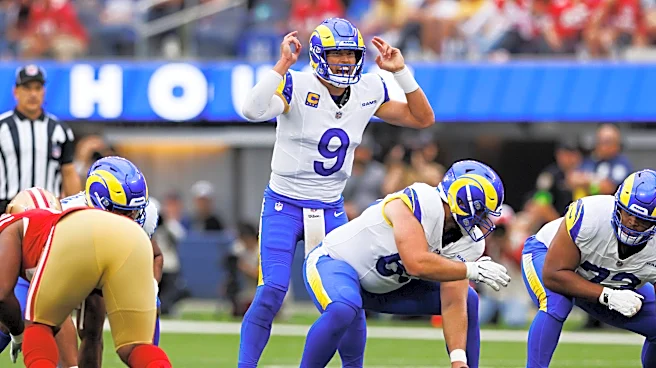



When the Los Angeles Rams sent Jared Goff (and three draft picks) to the Detroit Lions in exchange for Matthew Stafford, Sean McVay and company thought they were acquiring the missing piece for their championship dreams. Not only were they right, but Stafford almost certainly surpassed their loftiest hopes.
By leading the Rams to a Super Bowl and winning an MVP over the past five seasons, Stafford has gone above and beyond to establish his place among the NFL’s most-respected pivots, transforming
his own narrative from that of a compiler with minimal success to a legitimate Hall of Fame contender.
He’s not the first high-profile quarterback to move to another team in the second half of his career, but there aren’t many who come remotely close to matching his success. In fact, you can easily argue no quarterback has positively impacted the outside world’s perspective of their career during a second act more than Stafford has since joining the Rams.
The list below dives into the notable quarterbacks in NFL history who established a legacy with one franchise, only to make a move elsewhere to play their final seasons. Drew Brees is notably excluded because he left the Chargers after his age 26 season and spent three times as many years in New Orleans as he did San Diego. Fran Tarketon also changed teams twice and won his lone MVP at 35 years old, but spent that final tenure with the team that originally drafted him, the Vikings, so he’s out as well.
You will notice quickly that the sublist of quarterbacks even in the same zip code as Stafford’s Rams tenure is tiny.
Tom Brady – Tampa Bay Buccaneers, 2020-22
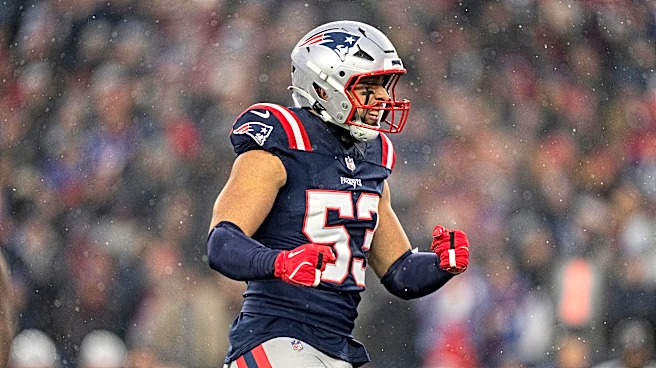
Brady led the New England Patriots to two different dynastic championship runs, one in each half of his career with the franchise, but he departed for Tampa Bay after turmoil became too much to handle with the team that drafted him. Like Stafford (in fact, the year before Stafford did), Brady won a ring in his first year with his new team, the seventh of his career.
He put up gaudy passing numbers in his three seasons with the Bucs, too, helped in large part by incredible volume; he led the NFL in pass attempts in the last two years of his career at 44 and 45 years old. Brady didn’t rack up crazy individual honors in his second act, earning one Pro Bowl nod and a second-team All-Pro honor, both in 2021.
Brett Favre – New York Jets, 2008; Minnesota Vikings, 2009-10
Whenever someone compares a modern “will he, won’t he” contract/retirement saga to Brett Favre, they’re underrating how all-consuming Brett Favre’s last days in Green Bay were. But after finally committing to play and getting shipped out, Favre was unremarkable with the Jets, starting out hot but fizzling out late in an 8-8 season.
He was legitimately great in his first year in Minnesota, finishing fourth in MVP voting and leading the Vikings to the NFC Championship Game, but he was a sad shell of himself in 2010, turning into an all-time example of a former legend who hung on to past glory for too long.
Peyton Manning – Denver Broncos, 2012-15
Peyton Manning joins Stafford as the only quarterbacks here with a Super Bowl title and an MVP at their second stop, but the way Manning got to those achievements came in stark contrast to one another. He led the Broncos offense to two of the best single seasons in recent memory in 2012 and 2013, winning MVP in the latter season.
The Super Bowl win was a different Peyton Manning, though. His arm strength was completely shot at this point, and for the first time since his rookie season he threw more interceptions than he did touchdowns. He was benched for Brock Osweiler midseason. Denver won the title that year, and Manning did enough in the postseason to keep the train on the tracks, but it was the defense that won that ring for the Broncos.
Manning is the most obvious other contender for the honor of best quarterback second act, with a championship, and MVP, two first-team All-Pros and three Pro Bowls in Denver.
Joe Montana – Kansas City Chiefs, 1993-94
Montana’s best days obviously came with the San Francisco 49ers, but he was a solid starter for two years in Kansas City, a franchise that, other than Patrick Mahomes and Len Dawson, has largely been bereft of quality quarterback play in its history. He was a Pro Bowler and led the Chiefs to the AFC Championship Game in 1993, but but went one and done the following postseason and only played in 25 regular-season games in two seasons.
While he couldn’t recreate his title success from his 49ers days, Montana did author one of the most beloved moments in Chiefs history, still to this day known as “Montana Magic.”
Philip Rivers – Indianapolis Colts, 2020 & 2025
Rivers was never an especially athletic quarterback, but it was entirely zapped by the time he got to Indianapolis. Still, he was productive up until his first retirement, leading the Colts to the playoffs and throwing for 4,169 yards with 24 touchdowns and 11 interceptions.
He’s the most unique player on this list in terms of timeline, because he spent two years with the Colts bisected by four as a high school coach, entirely out of the NFL. Indianapolis coaxed him out of retirement following Daniel Jones’s injury in 2025, making for a great story but not especially good football (the Colts went 0-3 and moved on to Riley Leonard at quarterback in Week 18).
Aaron Rodgers – New York Jets, 2023-24; Pittsburgh Steelers, 2025
After winning Super Bowl XLV and four MVPs in Green Bay (including back-to-back wins in his late 30s), Aaron Rodgers just couldn’t take it anymore with the Packers. So, like his predecessor, he was traded to the Jets to begin the next stage of his career. It didn’t go well. He played all of four snaps in 2023 before tearing his Achilles, then had one of the worst years of his career while leading the Jets to a 5-12 finish the next season.
He’s technically in the midst of his third act after joining the Pittsburgh Steelers, where he was part of an AFC North title team last year but was a far cry from his dynamic, world-beater self in his younger days. He’s playing one more season in 2026, but Rodgers’s post-Packers career almost certainly won’t be remembered fondly.
Matt Ryan – Indianapolis Colts, 2022
Another old guy who ended up with the Colts. Ryan was a four-time Pro Bowler with the Atlanta Falcons and won the MVP award in 2016, but had a nondescript final season in the Circle City. He passed for 14 touchdowns and 13 interceptions and the Colts finished 4-7-1 in his 12 starts.
Johnny Unitas – San Diego Chargers, 1973
Johnny U is one of the greatest players in pre-merger NFL history (and even won his third and final MVP post-merger in 1967), but his lone year with the Chargers is more meme than memory at this point. Unitas played in just five games and made four starts in 1973, leading the Chargers to a 1-3 record before hanging it up for good.
Kurt Warner – New York Giants, 2004; Arizona Cardinals, 2005-2009
Warner is a bit of an odd fit on this list, given that he didn’t play that long with the Rams originally after getting a late start on his playing career, then he quickly flamed out as the seat-warmer for Eli Manning in New York. He did produce at a high level for a couple seasons in the desert at the end of his career, though while he got the Cardinals within striking distance in a Super Bowl XLIII loss, he never came close to matching the individual highs of his early career.
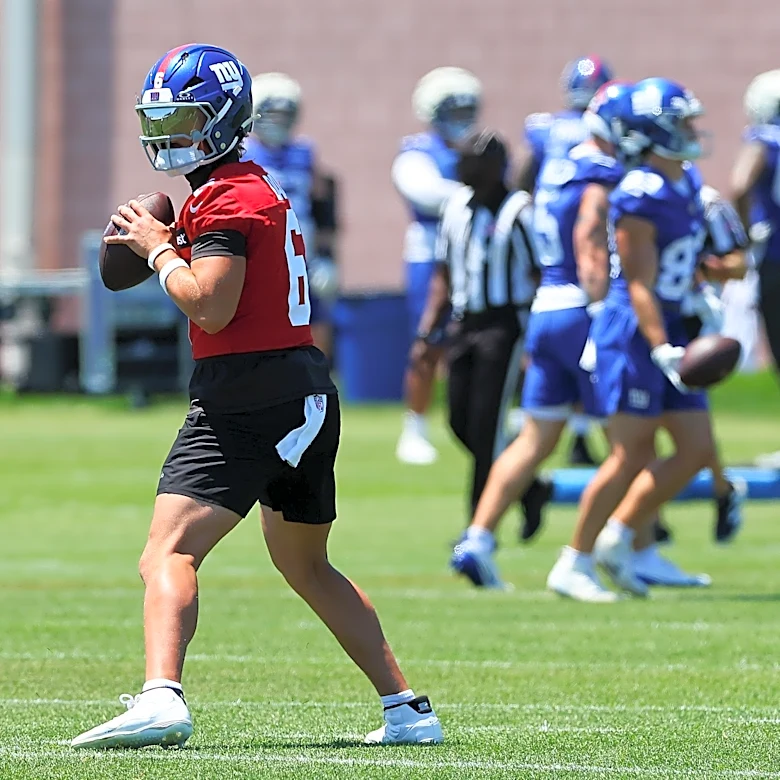
Russell Wilson – Denver Broncos, 2022-23; Pittsburgh Steelers, 2024; New York Giants, 2025
Russell Wilson was elected to nine Pro Bowls in 10 seasons with the Seattle Seahawks, but while he amazingly (and farcically) was selected for another in 2024, his career after leaving Seattle was a brutal watch. He went 17-27 as a starter across his final four seasons, and each of the three teams he played for couldn’t wait to move on from him.
***
There are a few other players you could jam onto this list. Joe Namath infamously played four games with the Rams in his final season. Cam Newton established his star in Carolina before going to New England for a year (and eventually back to the Panthers). Warren Moon made it to three Pro Bowls after leaving the Houston Oilers, and you could argue that if Wilson is included above Moon could be too, which is an entirely fair point.
But it’s ultimately moot, because the original hypothesis is clearly proven: Matthew Stafford’s second act is on the extremely short list of the best ever, and Peyton Manning and Tom Brady are the only others even remotely in the neighborhood.