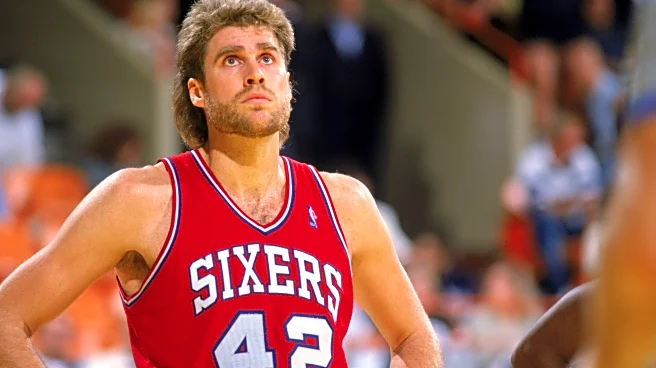

The news conference, Mike Gminski’s first as a 76er, was winding down. And now Gminski, just over in a trade from the Nets that day in January 1988, made a beeline for a rack of balls in the corner of the St.
Joe’s gym, where the Sixers practiced at the time.
Still in street clothes, he repaired to the foul line at one of the baskets in the place and began firing. Jim Lynam, a Sixers assistant (and just weeks away from succeeding his friend Matt Guokas Jr. as the head man), rebounded for him.
Not that there were many rebounds to be had. Gminski, then in the eighth of his 14 NBA seasons, would make over 84 percent of his free throws in his career – great for anyone, much less a center standing nearly 7 feet tall.
That was due in part to his approach at the foul line, which never varied. He would take three dribbles, then pause to place his right hand on the ball just so. After that he would take a breath, then crouch, uncoil and release.
That was followed, far more often than not, by a swish.
“I see you have a routine there, big fellah,” Lynam said, as he relayed the ball back to the new arrival.
Gminski’s head remained bowed, but he looked up from the ball for just a moment.
“Foul shooting,” he said, “is routine.”
By that he meant not that it was ordinary or unremarkable but rather that success is the product of repetition, of staying the course.
If only life were so simple. If only the routine guaranteed the result. If only preparation always led to the preferred outcome.
But he can at least hope that is the case.
Mike Gminski, 66 now, is a recovering alcoholic. He observed five years of sobriety on July 14 and continues to stack good days, while also serving as the Director of Mentorship at Sana House, a rehab facility in Charlotte, NC. The Connecticut native has made that city his home since retiring in 1994, starting out as a broadcaster for the Hornets, one of four teams for which he played, before transitioning to ACC broadcasts in 2003. This season is his 32nd behind the mic.
Most of us know the addict’s mantra: One day at a time. But those in the recovery community also talk about what might happen when life shows up – what to do when things go sideways, as they inevitably will. And for a very long time after he was done playing, Gminski didn’t deal well at all with the circumstances facing him – with divorce and death and disappointment – much less day-to-day matters. Those who knew and loved him wanted to help him exorcise his demons, but he fended them off, believing he could go it alone. Then, finally, it dawned on him that he could not.
So now that he appears to have come out the other side, he is taking nothing for granted.
“As I’ve learned, we don’t know anything,” he said in a recent phone interview. “We don’t even know what’s going to happen tomorrow. The choice you have is how you react to life showing up.”
That phrase again.
“That’s the one choice that you have,” he continued. “You can prepare yourself and do all the other things. It’s how you react to a given situation. And I reacted poorly to a lot of it, until I decided to get help.”
Helping others, whether through Sana or his house of worship, the nondenominational Moments of Hope Church, is invaluable to him – It “strengthens me in the stuff that I do,” he said – but he’s well aware there are no guarantees, that people relapse all the time.
So he will again lean on his routine. Doing so served him well when he was standing at the foul line, and served him ill when he became, as he put it, “a world-class drinker,” focused on nothing more than constant consumption. Every day was the same, he once told HBO Real Sports correspondent Mary Carillo: He would wake up, begin drinking and stop only when he passed out. Same thing the next day, and the next, and the next.
Charles Barkley, Gminski’s friend and former teammate with the Sixers, was among those who tried to intervene. So too did some of the guys with whom Gminski played at Duke, notably Kenny Dennard. He turned them away, sometimes angrily so.
“He kind of burned a lot of bridges,” Gminski’s son Noah said.
Noah, the only child born to Gminski and his ex-wife Stacy, bore the brunt of his dad’s descent. The two of them shared an apartment for a time, and Noah heard the excuses and the deflections. He saw his dad distancing himself from his friends, and on a particularly frightening night in 2020 called an ambulance when Mike came army-crawling out of his room, complaining that he couldn’t feel his legs.
It took several attendants to wrestle him into the vehicle, Noah said, and it was discovered that there was nothing neurologically wrong with him. It was the drinking that had once again knocked him flat. Always the drinking.
Noah was the one who arranged yet another intervention in the summer of 2020, and finally his dad acceded, going to Rebound Institute, a recovery facility run by another former Sixer, Jayson Williams, in Lake Worth, Fla.
Eleven days in detox were followed by two months in rehab. And when it was all over, it appeared that Mike Gminski had finally turned a corner. He became a mentor, first at Rebound, then in the Charlotte area. He resumed his broadcasting career. And he morphed into the best version of himself.
“I think he’s doing better than I’ve ever seen him do,” Noah said. “When I was a kid, everybody’s dad is Superman. Comparing that to now, it almost feels the same.”
Noah, who turns 28 in March, is a father himself now, to a 20-month-old boy, and he and his fiancee Madi are expecting another child in January. More than anyone else, he saw how the darkness had enveloped his dad, and how bleak his outlook had become.
“He would have died,” Noah said, “if he would have kept on going down the road that he was. He either would have been dead or in jail.”
And like Mike, Noah knows full well that his recovery is an ongoing process, that his dad will never be completely out of the woods. But at least the elder Gminski is dialed in. At least he has his routine to fall back upon, same as always.
“I put all my focus into my recovery now,” Mike said. “That’s where I am. Eventually my greatest strength has come back to help me now, but it also exposed my greatest weakness. So it was a strength, it was a weakness and now it’s back to being a strength again.”
Which matters a whole lot, since life will show up. It always does.
Beer had always been his drink of choice. That was true as far back as the age of 15, he told the Charlotte Observer’s Scott Fowler in 2024, when Gminski was hooping on the Connecticut playgrounds. A player who was of age would buy a few sixpacks and everyone would imbibe, after the games wound down.
It was much the same at Duke, where Gminski was a three-time All-American and a key cog of an NCAA finalist his sophomore year. The NBA, too. He told Fowler he tried cocaine at one point, but that became neither a crutch nor a concern. Beer was always readily available, and to some degree necessary.
“I tell people that it’s like being a Broadway actor,” Gminski told me. “I had to be on from 6 o’clock at night until 11. I had to be at my peak during those hours. And you don’t just come down after that. I didn’t drive home, hop into bed and go to sleep. It probably took me until 2 in the morning to unwind.”
The Nets had made him the seventh pick of the 1980 draft, and with the Sixers he became an integral part of an extraordinarily close-knit team, one that included not only Barkley but Rick Mahorn, Hersey Hawkins and Johnny Dawkins.
“That group of guys, it was very equivalent to my Duke experience,” Gminski said. “It wasn’t 12 guys, 12 cabs.”
Gminski, a high-post center who perfectly complemented Barkley’s work down low, enjoyed his best years In Philadelphia, averaging 14.9 points and nine rebounds a game while spending two full seasons and parts of two others in town. And the team peaked in 1989-90, winning 53 games and an Atlantic Division championship.
That was due not only to the talent and chemistry, Gminski said, but also Lynam’s leadership. Before every practice the coach would work the gym, making it a particular point to visit with players who weren’t playing much. All in the interests of taking the temperature of the team, of making sure everyone felt included.
“He was my favorite coach, by far,” Gminski said.
Lynam, now a Sixers studio analyst for NBC Sports Philadelphia, volleyed the compliment back at his former player, saying Gminski was “a delight to coach” – skilled, bright, self-motivated.
“He was a good player and a good guy,” Lynam said. “He checked both those boxes.”
Gminski was traded to the Hornets in January 1991 and spent the rest of his career in Charlotte, save eight games for Milwaukee in ‘93-94. And it was after his playing days were through that his drinking became problematic.
By then he had graduated to the hard stuff, vodka in particular. Also, life began showing up – showing up in the way Victor Wembanyama shows up for a weakside block.
Stacy’s venture-capital business went under in 2000, as the VC bubble burst. Mike told Fowler that there was litigation in the wake of that, that the couple faced “financial ruin.”
Mike and Stacy had married in 1981, but would separate in 2011, then divorce a year later. The year after that, Mike was engaged to a woman named Sarah Culpepper, but further heartache awaited. Her health had always been tenuous, and in 2015 she died of an internal hemorrhage.
Gminski has admitted more than once that he was shattered by her passing. As he told Fowler, his brain “short-circuited.”
“And,” he added, “I didn’t seek help, because the athlete in me was too proud to ask for health. … So I self-medicated.”
His friends took note of his spiral and tried to step in. That includes Dennard, who according to Hoops HQ’s Alex Squadron reached out in 2017, only to be barraged with F-bombs.
Nor could anyone else get through to Gminski.
“I uttered those fatal words of someone who’s resisting: ‘I know I have a problem, but I can handle it,’” he said.
He went underground for years, refusing calls from his friends, refusing help. But the door opened a crack when in 2019 Noah found a trove of discarded liquor bottles in the woods near the Charlotte apartment complex in which he lived with his dad. He knew immediately who had thrown them there, that Mike would put a few bottles out with the trash but then disguise the extent of his problem by tossing several others among the trees.
Noah collected 15 or 20 and arranged them on a counter inside the apartment. He also left a note: “Dad, I love you and I want to help you.” Then he left for a while.
When they reunited, Mike admitted for the first time that he needed help. Still, it wasn’t until a year later, during the height of the pandemic, that his recovery began taking shape. On the night of July 10, 2020, he had settled into his favorite chair, vodka bottle within easy reach, when Noah handed him his open laptop.
Looking back at Mike via Zoom were Williams, his former Sixers teammate and a recovering alcoholic himself, as well as Williams’ top Rebound lieutenant, Sean Nasiff. Joining them was Gminski’s long-time friend, Leigh Ann Miller, who for years has also been in recovery.
Finally, something clicked.
“I just felt a peace come over me,” Gminski said, “that I hadn’t felt since my fiancee passed away.”
He agreed to come to Rebound, and would in fact arrive three days later. But there were some details to work out first – the biggest being that Gminski had to reconnect with all the people he had cut off. That involved dozens of phone calls.
“And every one of them was so happy and relieved,” he said. “The support I had and have had through this whole journey has been unbelievable.”
One other thing: Williams’ facility, which he has since moved closer to his New York City home, engages in Adventure Therapy. Participants are required to engage in various physical activities, including skydiving.
To say Gminski balked would be an understatement.
“I immediately said there is no effing way I am jumping out of a plane, ever,” he told Real Sports.
But he did. It took him several weeks to work up the nerve, but finally, amid his second month at Rebound, he took the literal plunge. And the effect was immediate. Suddenly he felt empowered. Suddenly he believed he could do anything.
“It was kind of a conquering-your-fears type of thing,” he told me.
His head is hardly in the clouds now. Rather, he is grounded, understanding that he must continue to put one foot in front of the other, that life is going to show up. But he is bound and determined to power through, to stick to his routine. It has served him well before, and he can only hope that remains the case now.