
One possession from my childhood that is a continuous source of fascination is a Kansas City Athletics yearbook, the type that you used to be able to buy at the ballpark, or by sending in a few dollars to the club. The yearbook looks to be from 1967. It was given to me by a friend of my father’s, who attended a game. The cover has been missing for years and the brittle pages are starting to show their age which is tragic, as the yearbook is a time capsule for that era. Near the front, there are two
pages dedicated to Charlie O. Finley, and his family. No surprise there given Finley’s ego. Towards the back, there are two pages dedicated to Charlie O., the mule mascot of the Athletics.
Overall, the publication is put together very well. It has two pages of headshots of the players; all dressed in black suits and ties. Very classy. There are several pages dedicated to player profiles, talking about their careers, where they grew up and some tidbits about how they came to be Athletics, either through trades or free agent signings. Since the player draft was new, no drafted players had yet made the Kansas City roster. Rick Monday was the first ever choice of the Athletics and at this printing, he was still in the minors.
One player who figured prominently in the publication was a slugging first baseman named Ken Harrelson.
Harrelson was born September 4th, 1941, in Woodruff, South Carolina. He grew up in Savannah, Georgia, where he was a star athlete in baseball, golf, football and basketball. Like many young men from the south, he dreamed of playing basketball at the University of Kentucky. Golf may have been his best sport, but his mother convinced him to pursue baseball as she thought the sport gave him the best chance for a long and lucrative career. Harrelson listened to his mother and signed with the Athletics after graduating from high school, figuring correctly that the woebegone Athletics offered him the best chance of quickly making the majors. The scout who signed him was the legendary Clyde Klutz.
At the age of 17, Harrelson was assigned to the Olean A’s of the New York-Pennsylvania league. He started to blossom at the age of 19, hitting .301 with 25 home runs and 114 RBI at Class C Visalia. He followed that up with a .272, 38 home run, 138 RBI effort in 1962 at Class A Binghampton during his age 20 season. His rapid ascension continued in 1963 as he started the year at AAA Portland. He hit .300 with 9 home runs in 41 games for the Beavers. That was enough to convince Finley to call up the young slugger. Why not? The Athletics weren’t contending and they needed fresh young stars to attract fans, and the somewhat flamboyant, talkative Harrelson was nothing if not fresh.
He made his major league debut on June 9th, 1963, at the age of 21. He got two pinch hit at bats before he got his first start on June 12th against the Twins in Bloomington. He collected his first major league hit with a first inning single off Hall of Famer Jim Kaat. He collected his first home run, and RBIs, in the 8th inning with a two-run shot off Bill Pleis.
The Athletics acquired veteran slugger Jim Gentile in the offseason, which left no position for Harrelson going into the 1964 season. Gentile did what he was brought in to do, by hitting 28 home runs and driving home 71. Finley went all in on power for the 1964 season. Another off-season acquisition was Rocky Colavito. The Rock was very popular with Athletics fans and his 34 home runs, and 102 RBI didn’t hurt his standing.
Harrelson started 1964 at AAA Dallas. His batting average dropped to .232, but he still hit 18 home runs and drove home 52 in just 77 games.
The Athletics recalled Harrelson in July and gave him the start in leftfield on July 9th against the Twins. Facing Kaat once again, he smoked a 6th inning pitch into the left field stands for a solo home run. Welcome back to KC Hawk. Why left field? With Gentile entrenched at first, and regular left fielder Manny Jimenez only hitting .241, why not?
About that nickname. Early in his KC career, someone started calling Harrelson “Hawk” due to the shape of his often-broken nose. Harrelson wasn’t crazy about the name at first, but eventually it became his identity. It rolls nice, Hawk Harrelson. And Finley had a thing about nicknames. He even tried to convince Vida Blue to change his first name to True.
The Gentile/Colavito experiment only lasted one season (Finley had a history of being what you might describe as impulsive).
The first base job was Harrelson’s in 1965, with Tommie Reynolds and Jose Tartabull moving to left, while Mike Hersberger manned right.
Harrelson hit just .238 but did lead the team with 23 home runs and 66 RBI. Those totals don’t sound too imposing but remember, the Athletics finished with a 59 and 103 record. They were not good. Yet.

The team was starting to play some of the young talent they acquired. Dick Green and Bert Campaneris made a solid double play combo. Catfish Hunter and Blue Moon Odom both made their debuts in 1965. This was also the year that 58-year-old Satchel Paige came out of retirement and threw three scoreless innings against the Boston Red Sox.
Harrelson got off to a slow start in 1966 and in late June, the Athletics traded Harrelson to Washington for pitcher Jim Duckworth. The trade didn’t make much sense, other than to fulfill the Athletics constantly churning roster. Why trade a 24-year-old with power potential? Duckworth appeared in eight games for Kansas City during which he compiled a 9.00 ERA. He never appeared in another major league game.
On June 9th, 1967, the Athletics realized they needed Harrelson back, and with him Harrelson only hitting .237 with ten home runs during his 97 game Washington tenure, the cash strapped Senators gladly sold him back to Finley. The reunion was not peachy. After Finley fired manager Alvin Dark, Harrelson popped off to the media, calling Finley “A menace to baseball.” Harrelson denied using the word menace, but even if he did, he wasn’t wrong. The enraged Finley ordered Harrelson released, which was a major stroke of luck for the Hawk. Three days later, he signed with the Boston Red Sox and made several key contributions down the stretch in the Sox Impossible Dream season. Unfortunately, Harrelson had a miserable World Series, going 1 for 14 in the seven-game loss to St. Louis.
Harrelson had his best year as a pro in 1968, hitting .275 with 35 home runs and a league leading 109 RBI for Boston. He made his only All-Star team and finished third in the leagues MVP vote. That was Kansas City’s lot in life in those days, trade away or release a player and watch him become a star in another city.
Harrelson hit another 30 home runs in 1969, drove home 92 and drew a career high 99 walks.
Just ten games into the 1969 season, the Red Sox shocked Harrelson by trading him to Cleveland in a six-player deal. Harrelson then announced his retirement, saying that leaving Boston would cost him money from lost business interests.
Bowie Kuhn intervened, Harrelson relented and reported to Cleveland with a new contract in hand. The Hawk slugged 27 home runs and drove home 84 which endeared him to the Indians faithful. It was in Cleveland that Harrelson got his first taste of television, hosting a program called The Hawk’s Nest.
The Hawk broke his leg early in the 1970 season and when Chris Chambliss took over the first base job in 1971, Harrelson elected to retire and pursue a professional golf career.
Harrelson was a terrific golfer. His KC bio says he won the Baseball Players Golf Tournament with a record score of 290 over the 72-hole event. In 1972, he played in the British Open and missed the cut by one stroke.
While he was still playing baseball, Harrelson strode to the plate once and with his hands blistered from playing golf and used his golf glove. Some people credit Harrelson for introducing modern “batting” gloves to the sport. Records show that other players used gloves periodically, especially in the 1950’s but Harrelson and Rusty Staub were the two modern era players who popularized the use of gloves.
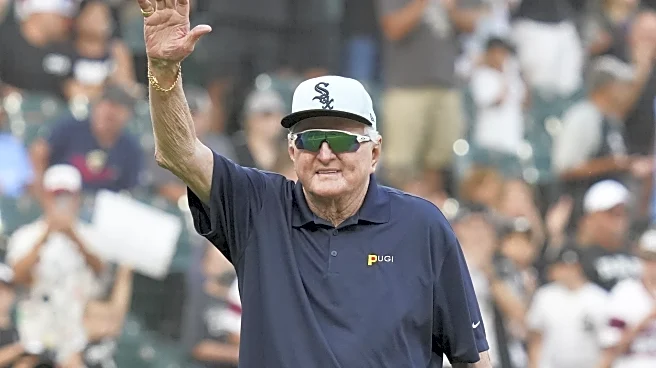
In 1975, Harrelson went to work for the Red Sox as a TV announcer. He jumped to the White Sox for the 1982 season. He served in a variety of front office jobs for Chicago through the end of the 1986 season.
He spent a couple of years with the Yankees, before moving back to Chicago for the 1990 season.
Harrelson, an admitted homer, is one of those broadcasters that you either love or you hate. He has a large collection of Hawkism’s such as “You can put it on the board” and “Mercy!”. He had a long running feud with umpire Joe West and has been called to the carpet on multiple occasions by the commissioner’s office for his colorful remarks about other umpires.
Love him or hate him, Harrelson is never boring.