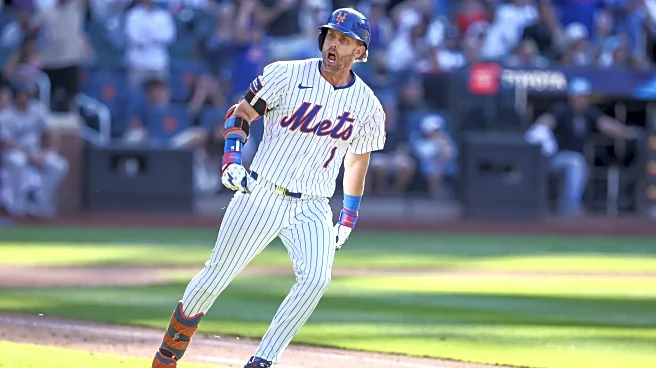




Tomás Nido was released. Drew Smith was granted free agency. Brandon Nimmo was traded to the Texas Rangers. But against all odds, Jeff McNeil still remains slotted into the first, second, or third spot on nearly half the Mets’ positional depth chart for 2026.
McNeil, nicknamed “The Squirrel” for his trademark scrappy, aggressive approach, is now somehow the longest-tenured Met. It’s a title which seems to fit oddly on a player whose name has populated trade rumors for what feels like his entire career.
In contrast with the fellow pesky, homegrown, left-handed hitting Nimmo, McNeil’s time with the Mets has taken an ever-twisting trajectory. He’s been an infielder, an outfielder, a batting champion, a bottom-of-the-order bat, an overlooked draft pick, a breakout rookie, an offseason signing, and now the last Met standing to have taken the field alongside David Wright in 2018. McNeil has switched numbers twice, jumping from #68 to #6 to #1. McNeil has even prominently experimented with switching bats, going from knob-less to torpedo-shaped . The only clear constants in McNeil’s career have been his gritty play, his animated reactions (the 33-year-old still responds to pop outs with unbridled frustration), and his complete lack of year-to-year predictability — a characteristic which was on full display in 2025.
In terms of offensive production, McNeil’s performance has been especially erratic. Over the past five seasons, McNeil has only twice posted an OPS+ above 100. The first of those seasons was 2022, when he won the National League batting title, led the Mets with 5.9 bWAR, started at second base in the All-Star Game, and earned a Silver Slugger Award. The second season was 2025, when McNeil quietly posted the sixth-highest offensive WAR (2.3) of any Met, trailing only Brett Baty and the fearsome quartet of Juan Soto, Francisco Lindor, Pete Alonso, and Nimmo. One might infer from this statistic alone that 2025 was something of a return to form for McNeil, but in reality, the modern McNeil is a far cry from his former self.
In 2022, McNeil fully embraced his pesky side, batting .326 with extra-base hits accounting for just 28.2% of his overall total. In 2025, McNeil batted a meager .243, but 39.2% of his hits were good for extra bases. In 2022, McNeil sprayed the ball evenly across the diamond, pulling an almost hilariously balanced 33.3% of his batted balls. In 2025, McNeil pulled balls at a 48.6% clip, making him the sixth-most pull-happy hitter in the National League. Perhaps most striking, McNeil in 2022 was a nightmare for opposing pitchers to game plan, handling all pitches in all parts of the zone. In 2025, McNeil hit just .206 against non-fastballs and hit .213 against pitches which weren’t thrown middle-middle.


After 2022, the Mets signed McNeil to a four-year deal with the hope that he’d be able to replicate (or at least emulate) his phenomenal season. Though his approach has morphed dramatically and his production has dropped precipitously since then, his value to the Mets remained high this year for a number of reasons. For one, McNeil still possesses elite bat-to-ball skills, with an 11.9% K rate putting him in the company of the league’s top contact hitters. For another, McNeil was quietly clutch, boasting a 1.024 OPS with two outs and runners in scoring position. That mark was the best on the 2025 Mets and the twelfth-best in all of baseball, placing McNeil between perennially clutch postseason stars George Springer and Shohei Ohtani on the league leaderboard. McNeil’s capabilities also helped create memorable moments such as his Subway Series go-ahead homer and his walk-off single.
But McNeil’s greatest asset — and arguably the most relevant factor in the length of his tenure with the Mets — is his positional versatility. Since his rookie season in 2018, McNeil has logged at least 200 innings at five different positions: second base, third base, and all three outfield positions.
McNeil’s best position has always been second base. In 2022, he was even a fringe contender for a Gold Glove Award at the position, and he still posted a strong 4 Outs Above Average in a part-time capacity there in 2025. But in a familiar twist, the Mets asked McNeil to sprint out of his comfort zone this summer, putting him in center field for 34 games. Despite his speed and arm strength having petered off over time, his performance in center was perfectly respectable, yielding -1 OAA.
Though McNeil isn’t going to provide above-average defense anywhere besides second base, his ability to provide roughly league average defense at half the positions on the diamond makes him one of the most unique players in the sport. Versatility itself is valuable, a principle which won’t be reflected by McNeil’s WAR each year; to understand McNeil’s true value, we would have to include the contributions of players like Luisangel Acuña, Ronny Mauricio, and Cedric Mullins, whose roster spots were sustainable at various points in the season thanks to (in part) the flexibility that McNeil offers.
Only time will tell where McNeil’s playing time comes in 2026. Second base is now Marcus Semien’s responsibility. Outfield positions are currently open, but they appear slated for promising prospects or prized free agents. President of Baseball Operations David Stearns alluded to the possibility of using McNeil at first base — something the team did three times late this past season — if the team doesn’t re-sign Alonso, and McNeil was even the team’s emergency catcher once upon a time. But the most likely outcome seems to be McNeil roaming the diamond, foraging for playing time and jumping from the outfield grass to the infield dirt in a manner befitting his nickname.
While McNeil’s presence in Flushing may be familiar, the 2025 version of him was anything but that. Predicting what incarnation of McNeil we can expect next Spring Training seems a futile exercise given his proclivity for change as a hitter, whether that means altering his approach or his bat itself. But at the very least, it might be time to accept that The Squirrel is really more of a chameleon than anything else — constantly changing his form, subtly striking his opponents, and seamlessly blending into whatever environment he occupies so as to avoid being hunted off the active roster.