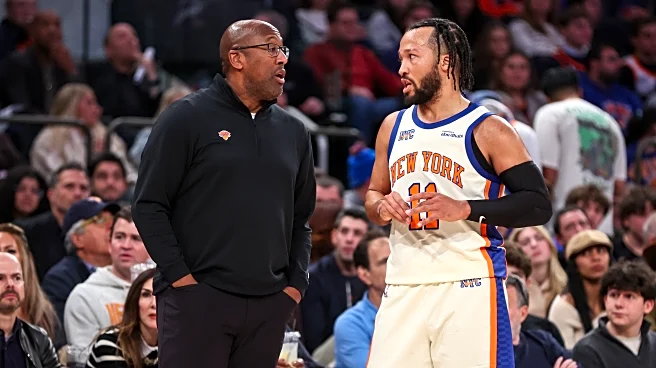

After Monday night’s embarrassing blowout loss to the Pistons, the Knicks are now third in the East and are in the midst of a four-game losing streak, the last three of which have come by double digits.
The worst part? The results, as bad as they may look, don’t even tell the whole story. New York went through a three-game winning streak in late December against an underperforming Cavaliers team, a Hawks team that is bad when starting Trae Young, and a Pelicans team that has yet to win 10 games this season. But if you look past the highlighted W next to those games, you’ll see a team that was slowly, but very surely, showing the cracks of what is now a very visible chasm.
Against the Cavaliers on Christmas Day, Karl-Anthony Towns, OG Anunoby, and Mikal Bridges combined for just 31 points. Jalen Brunson took 25 shots and made just 10. The defense gave up two 38-point quarters, and they barely squeezed out a win thanks in large part to the holiday heroics of Jordan Clarkson and Tyler Kolek, who scored 25 points and 16 points, respectively. At the time, the game was looked at not as the start of a decline, but more so as a one-off — a rare off game for a team that had been playing pretty good basketball up until that point. They had lost two of three to the Sixers and Timberwolves, but as a whole, the Knicks had just wrapped up several weeks of keeping pace with the first-seed Pistons by improving their defense, balancing their contributions, and getting some timely contributions from their bench.
But just two nights later against the Hawks, the Knicks once again needed late-game heroics to secure a win against a struggling team. They were up 13 at halftime, but gave up 70 second-half points while scoring just 60 themselves, and won by just three. The Knicks, and more specifically Anunoby, made some key stops late, but it was still too close a game considering the Knicks’ talent and aspirations.
And two more nights later, it was pretty much the same story. The Knicks allowed an eight-win Pelicans team to stick with them for most of the game, giving up 41 first-quarter points to a team that has struggled offensively this season. The optimistic reaction to this win was that the team was continuously finding ways to win close games, and doing so in an ugly way. But the realistic reaction was a myriad of questions. Why can’t the Knicks get any stops? Are the team’s injuries starting to catch up to them? How has the offense become so stagnant so quickly? What’s with the team’s slow starts?
Well, after nearly losing to one of the worst teams in the league, you’d think that the team would wake up. Sadly, as we all know, that hasn’t been the case. Since the Knicks beat the Spurs on December 16th, New York has looked downright bad outside of the very brief stretches where the team decides to try and turn it on. But what exactly is going wrong?
Passing
One of the few main criticisms former coach Tom Thibodeau often received was his overreliance on a stagnant heliocentric offense. Too many times, the offense came down to Brunson holding the ball, hunting matchups, and trying to make something out of nothing. This was inefficient for multiple reasons, as it fatigued Brunson and wasn’t the best use of the other players. Now, Brunson, due to his excellence as a scorer, often found ways to carry the Knicks’ offense just enough that the results were hard to argue against. But it was apparent that it wasn’t maximizing the talent on the roster. Mike Brown was assumedly brought in largely due to his creativity on the offensive end, and we saw a lot of that early on in the season.
The offense looked much more fluid, and we saw players being used in much more diverse ways. Towns was being used more as an offensive hub, Bridges was tasked with being an initiator much more often, and Brunson was able to play off the ball and utilize his skills while also preserving his energy for later in the game. That led to a high-octane offense that was predicated on ball movement, spacing, and player movement, and when that was mixed in with the individual talents of Brunson and Towns specifically, it was an effective and fun-to-watch offense.
But over the last couple of weeks, the offense has stalled, becoming much more stagnant and reliant on Brunson once again. For reference, from the season opener until December 17th, Brunson averaged 21 field-goal attempts per game, while Towns averaged 15, and Bridges and Anunoby averaged 12 each. Since then, Brunson is averaging just under 24 attempts per game, while Bridges is averaging 13, Towns is averaging 12, and Anunoby is averaging 11. It may only look like a few-shot difference, but it’s a difference nonetheless. And we are less than a day removed from Brunson, whose 21 shot attempts were more than Anunoby, Towns, and Bridges combined, recording zero assists while having six turnovers. We are also less than a day removed from the Knicks recording just 225 passes against the Pistons, which is significantly less than the over 290 passes they averaged per game entering the night.
Now, it’s hard to know if this is because of his teammates lacking aggression and struggling from the field, or if those things are happening because Brunson is holding on to the ball too long. Regardless, as the best player on the team, the captain, and the point guard, Brunson needs to do a better job of playing with more pace and moving the ball more.
Shooting
Another thing that has really hurt the Knicks is the lack of outside shooting they have gotten from some of their main guys. Since the Cup Finals, Deuce McBride, Jordan Clarkson, and Bridges have all shot it well from three, shooting over 40 percent, and Brunson is just under them at 38.5 percent. But Towns, who we all know is one of, if not the, greatest shooting big men ever, is shooting just 34.3 percent from three on just 3.9 attempts, and Anunoby, who started the year shooting well, has shot just 23.1 percent from three on 5.2 attempts during that span.
If Anunoby and Towns shot closer to 40 percent during that span, it would only be about another three made shots from each of them per game, given how many they are shooting now. And that’s only six additional points. But those baskets then open things up for others, and just as importantly, they let the Knicks’ defense get set.
Again, it’s hard to know for certain if they are shooting worse because the ball isn’t moving as much, or if the ball is moving less because the shooting has been bad. But it’s clear that the Knicks’ offense, which relies not just on creating a lot of threes but making them, has struggled as a result of the recent slumps their shooters have gone through.
Defense
Up until the NBA Cup Finals, the Knicks had found a way to become a solid and serviceable defense. Through their first 25 games, in which they went 18–7, they had the 10th-best defensive rating in the league at 113.3 and were just shy of passing the Timberwolves for the ninth-best defense. And there was an eight-game stretch between November 24th and December 17th where the Knicks had the sixth-best defensive rating at 110.9. Their schedule was admittedly weak during that time, but the defense looked like one that was good enough to withstand a championship run.
Since mid-December, though, the defense has been putrid. They have the 27th-ranked defensive rating at 120.7, and the eye test backs up the stats. They continue to struggle at the point of attack and routinely get burned by quick, athletic guards.
They continue to struggle defending the three-point line, and they’ve recently compounded those weaknesses with miscommunications, mental lapses, and a lack of energy and fight.
Physicality, pride, and fight
Which brings us to a non-measurable, but very clear, problem with this team right now. On both ends of the floor, this is a team that has been easy to punk. Teams have opted to be more and more physical with them, and the majority of their players shy away from it. Ironically, the smallest player on the team, Brunson, seems to be the only one who can take the physicality, but he can’t really dish it out on the defensive end, given his size, and offensively, he gets too caught up in trying to draw fouls a bit too much now. Towns has a hard time with what is a very inconsistent whistle on the offensive end and struggles to assert his dominance on the defensive end despite being one of the bigger players in the league. Anunoby isn’t afraid of physicality but rarely imposes it on others offensively. Bridges is notoriously afraid of contact, and the bench isn’t much better.
Additionally, when the going gets tough, as it has very often over the last few games, the team folds. Instead of coming together and answering adversity by fighting back, they’ve more or less laid down, except for a couple of fake comeback attempts where they decide to turn up the effort for a couple of minutes.
I get that they are tired. I get that the schedule has been rough. I get they are dealing with injuries. And I get that there are both X’s and O’s, and personnel issues that this team has to overcome. But at the end of the day, there is a level of competitiveness, physicality, pride, and fight — all of which are within the players’ control every possession — that the team does not possess right now, and that’s been disappointing and, quite frankly, embarrassing.
Body language
There’s obviously a lot that has been going wrong, as I’ve mentioned before. But maybe the most surprising and most inexplicable part is that they look like a team devoid of any connectivity or joy. Now, losing can often do that to a team. But to see a team that often talks about how close they are look so disjointed and disinterested is something many, including Mike Breen, have noted. When met with adversity, whether it’s one quarter, one game, or a stretch of games, players need to know that their teammates have their back.
We often hear players and coaches talk about how the only ones that really matter are the people in that locker room. But over the last couple of weeks, this team has looked increasingly like a group of strangers playing a pickup game, and less like the tight-knit group we’ve become accustomed to. We don’t know if something happened in the locker room, or if the players are getting sick of the way others play, or if the negative body language and constant complaining of certain individuals is starting to rub off on the others. But — and I say this as one of the biggest Brunson fans around — as Julius Campbell said in Remember the Titans, “Attitude reflects leadership.” And as the captain of the Knicks, Brunson has to find a way to galvanize this team once more.