

As another former Mets’ skipper, Yogi Berra, once famously opined: “It’s getting late early”.
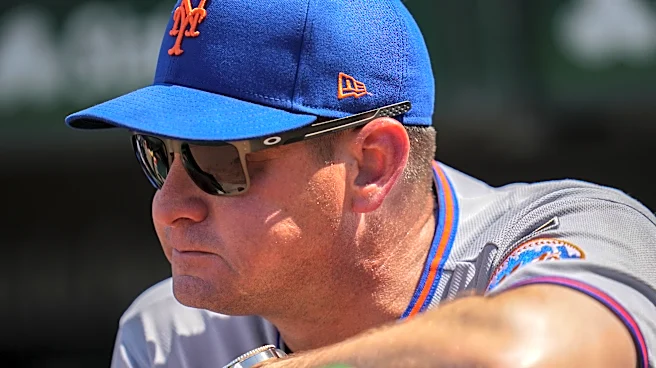
Fair or not, the writing is on the wall for current Mets’ manager Carlos Mendoza: His time with the club is approaching its end.
It felt somewhat inevitable with last year’s collapse, and it appears all but etched in stone as the team’s losing streak reached an unfathomable, incomprehensible eleven games. The Mets haven’t lost 11 straight since the 2004 season—incidentally, the team fired Art Howe about a week
after that losing streak ended. If they lose on Tuesday, their losing streak will reach 12 games, their longest since 2002. Bobby Valentine was fired at the end of that season. It’s simply hard to survive that much prolonged failure, whether it’s directly your fault or not.
The current Mets’ situation calls to mind another skipper who faced the ax. In 2006, the Mets seemed poised for a World Series run, and their season was cut short in the NLCS (sound familiar?) In 2007, the Mets suffered a monumental collapse which concluded with a loss to the Marlins on the final day of the regular season (again, familiar?) In 2008, a lethargic start with sky-high expectations led to the team firing Willie Randolph in one of the most embarrassing (and inappropriate) ways imaginable, in the middle of the night after a win at the start of a June West Coast trip. While these two situations are not entirely mirror images, they do bear striking resemblances, and will likely end the same way—did I mention the Mets also poached Randolph from the Yankees, much like Mendoza?
I think the current Mets regime knows well enough not to repeat the same mistakes of the past regime—I will add, for no reason in particular, that the Mets do have a trip to Anaheim Los Angeles coming up in a couple of weeks, so Mendoza may want to book a back-up return flight, just in case. Hell, Mendoza may not even have a job by Tuesday, let alone two weeks from now. But the greater point is that, when captaining a ship that goes down the way the 2007 and 2025 Mets, it’s hard to recover in the court of public perception, unless everything goes right (and everything has, decidedly, gone wrong).
One could argue that, in both instances, the Mets should have never let it get to the point it did. The collapse of 2007 greatly overshadowed the success of 2006, to the point that Randolph entered 2008 a dead man walking. Similarly, the failures of 2025 all but erased the good will built up during the 2024 OMG/Grimace/Rally Pumpkin playoff run. With the Mets jettisoning basically every coach besides Mendoza after last season, it seemingly made sense to just clean house entirely. In failing to do so, Mendoza entered 2026 on a short leash, one that has all but run out with a disastrous start nobody, not even the most pessimistic in the fanbase or in the media, could have seen coming.
So that brings us to the $64,000 question (or, more accurately, the $381 million question): What should the Mets do with Mendoza? In times like this, when expectations are what they are and results are…well, this…something has to be done, and as we’ve all come to learn, you can’t fire or trade an entire team. The torches are getting hotter, the pitchforks are getting sharper, and the screams are getting louder, so much so that Steve Cohen and David Stearns cannot ignore it for that much longer. This failure, to be clear, falls squarely on the shoulders of the players, and while Mendoza is far from a great manager, he is the easiest target to do something and show the outside world that they are taking this seriously.
I’m of the belief that most managers don’t really have much of an impact on the day-to-day results, especially in modern baseball. I can’t even really point to much he could do differently in this exact scenario to make things better. I don’t think firing Mendoza will functionally change anything, and I’m not a huge believer of firings to “light a fire under the players’ asses” or whatever phrase you want to use. If nothing else, the players, led by Francisco Lindor, have given Mendoza a vote of confidence, but the way they’re playing, that means less than nothing. At the end of the day, Mendoza is the public face of this mess, and there’s enough criticism of his work that it won’t seem like a desperation move and people will come to understand the rationale.
Mendoza has two things strongly working against him: a) the aforementioned collapse, and b) an expiring contract. The Mets have fired managers with many more years left on their deal, so parting with a manager with a few months left to go anyway will not phase them. If anything, it makes a decision much easier, allowing them to review an interim—Kai Correa? Carlos Beltran? Probably the former more than the latter—and make a determination on the future direction they want to go in.
We can’t close this discussion without addressing the elephant in the room: David Stearns. Fans are extremely split, to put it mildly, on the job he has done here, with some praising his focus on modernizing the organization and improving the farm system, and others blasting the choices he’s made to field a competitive major league roster. Many fans already entered this season ready to throw hands with Stearns for letting some fan favorites go, and that was before these results. Stearns, it stands to reason, should face as much criticism as anyone for the early-season struggles, but let’s make one thing clear (and I say this without any inside knowledge whatsoever): Stearns is under no threat to be fired, this year or likely in many future years. Steve Cohen has put a lot of trust into Stearns, and letting go of him this early will torpedo any trust the organization may have in searching for his replacement, and make the organization a laughingstock—well, more of one, anyway. Moreover, Cohen would have to return to making the baseball decisions, and he does not seem eager to do so. Love him or hate him, Stearns is here to stay, to make the decision on both the Mets manager and future player and personnel moves for the foreseeable future.
So that brings us back to Mendoza. The Mets ultimately face two choices: Fire Mendoza or do nothing at all. There are no player moves to be made and no front office decisions to be had. As such, Mendoza is probably gone, if not in April, then before Memorial Day. Aside from the brief boost that inevitably follows a move like this—a warning to the players, an improvement in performance, a reprieve of negative public perception—the team will likely continue to underwhelm and miss the playoffs. Very few teams have lost 11 straight and rebounded, and this one, while loaded with talent, doesn’t inspire confidence that it can buck that trend.
This is the time for decisive action, not waffling from the team’s leadership. Stearns and Cohen currently have the media and weight of the fanbase breathing down their necks, and are facing harsh economic blowback (an empty stadium, fewer merch and concession sales, etc.) if they do nothing. If this is the decision the team is currently leaning towards, then the firing should probably happen before tomorrow’s game, because if the team builds up any momentum between now and, say, when they decide to fire him, it’ll look even worse. Mendoza’s time is clearing ticking, so the best (and perhaps most humane) thing to do would be to not let it drag on any longer and relieve him of his duties. It’s not entirely fair, but as we’ve learn, baseball isn’t always that fair.