
As they entered Game 2 of the 1939 World Series, the Reds had cause for optimism. Despite facing a juggernaut Yankees squad going for their fourth straight title, and despite dropping a heartbreaking Game 1 as Bill Dickey walked them off in the bottom of the ninth, Cincinnati were turning to their not-so-secret weapon. After spending his first four and a half years in the league with Philadelphia as a back-end starter, Bucky Walters came out of nowhere in ‘39 to become the sixth pitcher to take home
an MVP. The 30-year-old led the league in everything from wins (27), complete games (31), and innings (319) to bWAR (8.2) and ERA+ (170).
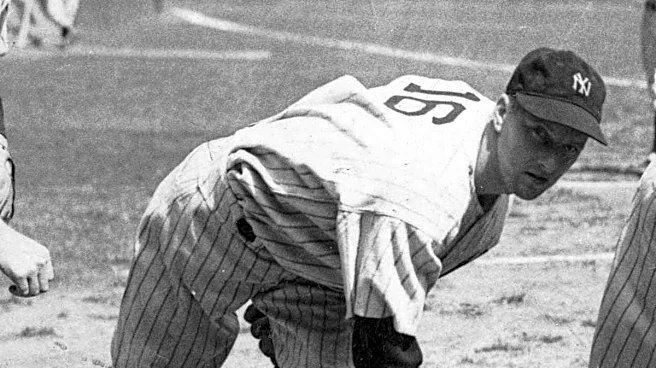
The Yankees would turn to a man who posted a subpar 97 ERA+ in 20 starts that year and who had never received an MVP vote in a solid but unspectacular regular season career. But this was not the regular season. The Yankees’ starter that day had something Walters did not — an enviable track record in the World Series. On that day, Monte Pearson would cement his legacy as one of the greatest World Series performers in baseball history.
Montgomery Marcellus Pearson
Born: September 2, 1908 (Oakland, CA)
Died: January 27, 1978 (Fresno, CA)
Yankees Tenure: 1936-40
Pearson grew up in Fresno, CA, where he played high school baseball before embarking on a career in independent ball. He performed well enough to draw the attention of Cleveland, who signed him away from the Oakland Oaks of the Pacific Coast League for the 1932 season. He impressed the club’s big-league manager, longtime Yankees shortstop Roger Peckinpaugh, with his “dazzling fastball” and debuted with Cleveland that year.
After a rough go of it in ‘32, Pearson broke out the following season, posting a 2.33 ERA in 135 innings while earning a spot in Cleveland’s rotation. His manager that year was the legendary Walter Johnson, who trumpeted Pearson’s 30-win potential. Johnson also played a pivotal role in the right-hander’s future success as a big-game pitcher. “He put this sort of a spirit in me — when you go out to the mound, say to yourself you are just as good as the fellow facing you and that you can get him out of there,” Pearson said of his mentor.
Pearson’s performance deteriorated over the next two years, culminating in his trade to New York before the ‘36 season. His first regular season in pinstripes was his best, as he won 19 games and added a strong season at the plate (recording a .253 batting average and 20 RBI) for good measure, earning the first All-Star berth of his career. Come October, in what would become a trend, Pearson had a hill to climb in his first World Series start, facing Giants star Carl Hubbell. Fresh off his second MVP, the future Hall of Famer had held the Yankees to a single run in a complete game victory in Game 1. In Game 4, Pearson outdueled him, limiting the Giants to two runs in a complete game victory of his own while holding future Hall of Famers Mel Ott and Bill Terry out of the hit column and adding a pair of knocks of his own for good measure.
Over the next four seasons in pinstripes, Pearson remained a useful starter but never became a star, missing time to injury and going through stretches of inconsistency. On August 27, 1938, he became the third Yankee to throw a no-hitter, a feat surely made sweeter because it came against Cleveland, his former team.
And each October, he stepped up his game in dramatic fashion, winning his sole starts in the ‘37 and ‘38 Fall Classics while allowing a single earned run in each.
But it was in 1939 that he would turn in the greatest performance of his postseason career. At the age of 31 and dealing with what he called a tired arm, it was unclear if he’d even be able to start. Instead, he outdueled Walters in an all-timer, taking a no-hitter into the eighth in a shutout victory to help the Yankees to a commanding two-game series lead. “I just kept bearing down on one batter just as hard as I did on the other,” Pearson said of his performance. “My only object was to get those Reds out as fast as I could.”
Pearson would spend one more year in New York, earning his second All-Star berth but missing almost the whole second half with a shoulder injury. The Yankees shipped him off to the Reds after the season but his shoulder was never the same. After posting a 5.14 ERA in seven appearances, he called it quits.
After his playing career, Pearson embarked on a career in public service, first as a firefighter in Fresno and then as Chief Sanitarian in nearby Madera County. His promising second act imploded in 1962, when he was convicted of accepting bribes to permit the installation of septic tanks that were not up to code. The infraction cost Pearson his marriage and eight months in jail, forever tainting his legacy. He continued to live in Fresno until his death in 1978 at the age of 69.
But nothing could tarnish his legacy as an October hero. Among starters with at least 35 playoff innings, only two — Sandy Koufax and Christy Mathewson — boast ERAs better than Pearson’s 1.01. He squared up against the best pitchers and lineups of his era and proved himself up to the challenge, winning each of his four World Series outings and recording all but one out across those starts. While not as well remembered, he was as integral to those championships as his Hall of Fame teammates. Join us in remembering one of the premier big-game pitchers in Yankees history, Monte Pearson.
See more of the “Yankees Birthday of the Day” series here.