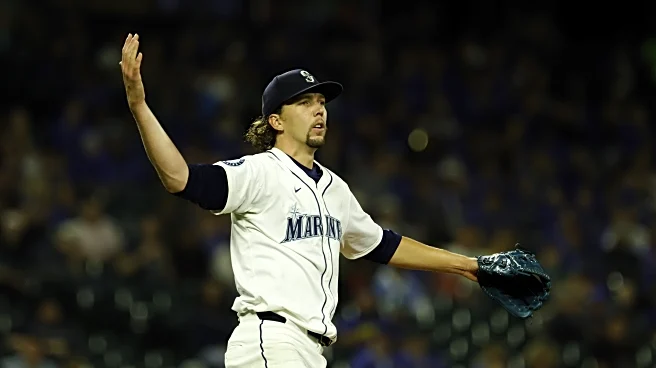

In 2024, Logan Gilbert became one of MLB’s apex predators. He led baseball in innings pitched with 208.2 and finished second in the AL in strikeouts with 220. He was rewarded with a trip to the All-Star
game and a sixth place finish in Cy Young voting. His 2025 looked just about as good on paper with his ERA, xERA, and FIP about the same or better. And he even improved his strikeout rate from 27.4% to 32.3%, going from 17th in the league to third.
Yet he wasn’t as valuable to the team.
Why? He pitched about an inning fewer per game, averaging 6.1 innings per start in 2024—workhorse numbers in the modern game—but collapsing to a more pedestrian 5.1 in 2025. A bit of this was managing the injury that caused him to hit the IL for the first time in his career in May. But the pattern actually held both before and after the IL stint (and, to frontload this, so does just about everything else in this article). And he only averaged six fewer pitches per start, which only explains about a third of an inning. Rather, the culprit is that Gilbert needed more pitches per plate appearance in 2025: His P/PA spiked from 3.78 to 4.03.
I know a jump of 0.25 P/PA doesn’t seem like much, but it adds up to the other two-thirds of an inning, or about 22 innings over the course of a season. That’s especially damaging because those are the innings that have to be covered by the soft underbelly of middle relief.
So why was he about as good on a rate basis, but less efficient? I thought I knew the answer, but what I found surprised me.
Suspect #1: The strikeout surge
The most obvious explanation is that 4.9% jump in his strikeout rate. Relatively speaking, that’s 17.9% more strikeouts, which is a lot. Strikeouts naturally take more pitches than PAs that end with balls in play since you need at least three pitches for a strikeout. For Gilbert, in 2024, his average strikeout took 4.92 pitches, and his PAs that ended in balls in play (we’ll call these BIPPAs, because it sounds better than PABIP and doesn’t risk confusion with BABIP) was 3.17. That’s a difference of 1.6 additional pitches for a strikeout.
But here’s the twist: while Gilbert was less efficient overall, he actually got more efficient in his strikeouts, from 4.918 P/K to 4.827 P/K. That’s a confounding factor in using his strikeout surge as the explanation.
The math says the additional strikeouts added 0.087 P/PA, while the better efficiency saved him 0.030 P/PA. Netted out, that’s an increase of +0.057 P/PA caused by the strikeout surge.
So, the new strikeouts explained 23% of Gilbert’s dip in efficiency. That’s sizable, but I’m not prepared to give a guilty verdict here because I’m willing to live with a little less efficiency if it means more strikeouts. I love a Maddux as much as the next guy, but strikeouts are good. The real question is: where are the other three-quarters of the pitches hiding?
Suspect #2: The walk problem
The second obvious culprit is that his walk rate increased from 4.6% to 5.8%. Walks are the worst result for pitch efficiency since they’re a bad result and come at a high pitch cost; a walk costs almost three more P/PA than a BIPPA. The increase in walk rate would be bad on its own, but Gilbert compounded that by using more pitches per walk this year. In 2024, his average walk was 6.0 pitches, which rose to 6.323 pitches in 2025.
The math here says the additional walks accounted for an extra 0.037 P/PA and the fact that his walks were less efficient added another 0.019 P/PA, for a net effect of 0.056 P/PA. That explains 22% more of the overall change. That’s a meaningful contribution, but more of an accomplice than a principal.
Taken together with the strikeouts, we’ve accounted for 45% of the increase in P/PA. But after dealing with the two most obvious suspects, we’ve still got more than half the problem unsolved.
The Red Herrings: What the problem wasn’t
False lead #1: Two-strike struggles. The culprit had to be that Gilbert was struggling to finish guys off. It had to be. The mental image is Gilbert expanding the zone too much with two strikes, getting beat by balls and fouls. Look at his slider location with and without two strikes in 2024 and 2025:

Doesn’t that look like a guy who’s trying to get too cute and chase the chase? As soon as Gilbert’s efficiency started to be a problem last year, I locked in on this. But that led to confirmation bias, as every ball or foul in a two-strike count stood out in my head. I was so sure this was the answer that I signed up for Gilbert’s 40 in 40 with a title in mind (“40 in 40: Logan. Keith. Gilbert. Stop playing with your food, young man”) and assumed I’d bang it out in 45 minutes.
So imagine my surprise when I dug in and learned that Gilbert was actually more efficient with two strikes this year. Once he got to two strikes, he only needed 0.430 additional pitches to finish the at-bat, which is down from 0.455 in 2024. This is why his P/K went down. In other words, more than 100% of Gilbert’s decrease in efficiency came before getting to two strikes.
False lead #2: Worse command. More balls and falling behind more often would explain things. The increase in walk rate even points in this direction. But no. His first-pitch strike rate went up (67.7% to 69.9%); his called strike rate remained flat (15.2%); he was in the zone slightly more (50.9% to 51.3%); and when he went out of the zone, he got more swings on those pitches (chases) (31.6% to 32.3%) and less contact on those swings (44.2% to 40.4%). That’s not a guy with a command problem.
To be sure, he did throw more balls in non-walk PAs (we exclude walks since they always have exactly four balls). But most of them came in his PAs that ended in strikeouts, and we want to strip those out of our analysis here to avoid double-counting since we already looked at P/K. The net effect of the additional balls in BIPPAs is just 0.005 P/PA. That’s not zero, but it’s just 2% of the total spike—more of a guy in the wrong place at the wrong time than a criminal.
The drawing room scene
Having accounted for strikeouts, walks, and balls/BIPPA, there’s really only one place left to look: strikes/BIPPA. (His HBP rate is too small to matter.) To quantify it, Gilbert threw 1.151 strikes/BIPPA in 2024, which spiked to 1.363 in 2025. That’s an 18% jump.
But what kind of strikes are they? If it’s all called strikes and whiffs, then that’s a problem you’d live with. Those are pure good outcomes. But Gilbert’s called strikes and whiffs per BIPPA only increased by 0.010. Nearly all the additional strikes were coming from foul balls, going from 0.448 fouls/BIPPA in 2024 to 0.650 in 2025.
So at last, we have our culprit: Hitters fouling off 45% more pitches in plate appearances that ended with contact. This single factor explains nearly half of Gilbert’s entire inefficiency spike.
What’s odd is that while there was a 45% increase in BIPPA foul balls overall, only about half of them came before Gilbert got to two strikes. Those aren’t as good as a whiff or a called strike—and they do work to make the at-bat longer since unlike a walk or a strikeout a BIPPA can happen in an 0-0 count—but it’d still be basically fine. They’re additional strikes that put Gilbert ahead, and the better a count is for a pitcher, the better all his outcomes are, increasing strikeouts, reducing walks, and even softening the contact hitters make when they connect. And indeed, the percentage of Gilbert’s PAs that reached two strikes went up dramatically, from 53.4% to 60%. That’s a good thing.
But the other half came from two-strike foul balls that extended the at-bat, pure pitch-count killers with no benefit. What makes it odd is that Gilbert’s overall two-strike efficiency improved. The conclusion we’re left with is that if Gilbert was going to get the punchout, he was way more efficient, and it was going to happen right away. But if not, Gilbert really would struggle to finish the at-bat as guys fouled things off until they saw something they could put in play. He was either on or he wasn’t.
The murder weapon: hitter adjustments?
So we know what happened: hitters fouled off way more pitches in 2025, especially in plate appearances that ended with contact. But why?
I don’t think this was a matter of consistency. While there was more game-to-game variation in his strikeout totals (standard deviation went up by 18%), his overall game scores were actually more consistent (standard deviation went down by 25%).
There’s some evidence that hitters may have adjusted their approach. Gilbert’s overall foul rate jumped from 16.6% to 19.2% of all pitches while league-wide foul rates held steady. Whether this represents a strategic adjustment by opposing hitters—perhaps sitting on certain pitches or protecting the plate more aggressively—or simply Gilbert’s stuff playing differently on different nights is hard to say definitively. His foul rate went up on his fastball, splitter, and curveball. It only went down on his slider, and even then by just a touch; and that’s a natural consequence of his using it in two-strike counts much less since guys will protect more with two strikes.
What’s clear is that in 2025, when Gilbert didn’t have his best command or when hitters were able to spoil his pitches, plate appearances dragged on much longer than they had in 2024.
The aftermath for 2026: How to adjust to the adjustment
The frustrating part is that there’s no obvious fix. Gilbert’s strikeout gains are real and valuable—jumping from 17th to third in the league is elite. His command metrics actually improved. He was more efficient with two strikes. By most measures, he got better in 2025.
And yet: fewer innings, more stress on the bullpen, less overall value to the team.
Can Gilbert find a way to maintain his strikeout gains while reducing the foul-ball problem in 2026? Perhaps. But without a clear explanation for why hitters fouled off so many more pitches, there’s no clear path forward. I’d like to look further at the impact of his splitter becoming his go-to two-strike pitch, and what happened to his slider, which had similar velocity and movement but much worse results.
The price of greatness
But while we figured out how it happened, we still don’t know why. So, until we find answers, we’re left wondering if this is who Gilbert is now: a high-strikeout, low-efficiency pitcher. Maybe that’s okay. Even at 4.03 P/PA, we’re talking about 5-6 innings per start. That’s viable for a modern starter, especially if the Mariners can get more length from George Kirby and Bryce Miller or figure out the middle of their bullpen. But it’s not the workhorse ace of 2024—and it’s hard not to be disappointed by the 2025 version in comparison.