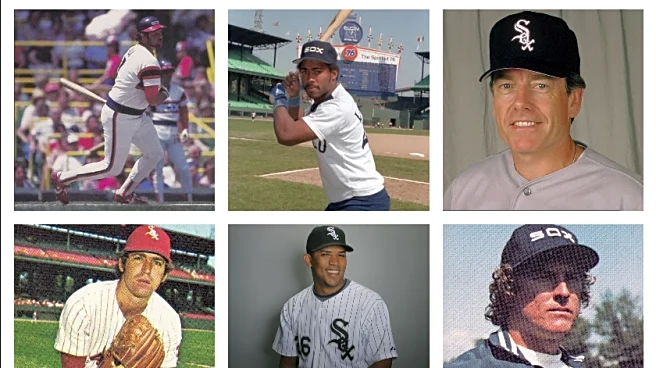

It’s the time of year where we assess the goods and bads of the year past and hope for better in what’s to come. This story looks back at those South Siders we lost in 2025. Included among them is an inspiring
manager, a defensive superstar, relief arms and a patriarch who fathered baseball superstars.
Please, feel free to use the comments to honor any White Sox close to you who we lost in 2025.

Jeff Torborg
Manager
White Sox Career 1989-91
Died January 19
Age 83
Jeff Torborg was a catcher of no-hitters who applied his baseball smarts to his first skipper job just four years retired from the game, at 35. He managed Cleveland for one full season and parts of two others, unsuccessfully enough that he had to wait a decade for his next job. That came on the South Side, and just about 100 games into his tenure the moribund late-80s White Sox began turning a corner. He left after the triumphs of 1990 and 1991 not because of failure, but front office fussiness; new GM Ron Schueler wanted his own manager, and Torborg was the victim.
Year of the Hamster penned our tribute to Jeff back in January.

Don Secrist
Left-Handed Relief Pitcher
White Sox career 1969-70
Died January 30
Age 80
Don Secrist’s baseball career began on dusty Illinois diamonds and carried him all the way to the major leagues. A 1962 graduate of Williamsfield High School, Secrist impressed early as a southpaw with a knack for the extraordinary. In the span of one remarkable high school season in 1959, he tossed a one-hitter against Brimfield, a no-hitter against Yates City, and capped it with a perfect game against Glasford that September. He went on to help lead Galesburg to the 1962 Illinois American Legion state championship, striking out 11 batters in the title game. Though committed to Bradley University, Secrist’s path changed when Orioles scout Vern Hoscheit signed him that fall, convincing him to chase a professional dream.
Secrist made his pro ball debut as a reliever in 1963 with the Aberdeen Pheasants, going 7-0 with a 1.96 ERA in 24 appearances. That success led him through organizations and opportunities, from the Baltimore Orioles to the Cincinnati Reds, and eventually to the White Sox. In December 1968, the Reds swapped backstop Don Pavletich and Secrist to the South Siders for hurler Jack Fisher. Secrist made his major league debut on April 11, 1969, surrendering only a walk over 1 1/3 frames. While a broken hand and roster shuffles tested him, he still managed to log 28 big-league appearances over two seasons with the club. Posting an overall 0-1 record, 1.463 WHIP, and 5.93 ERA in 54 2/3 innings of work, the lefty ended his professional career with a -0.3 bWAR. Secrist closed out 1971 in Triple-A for the Cubs organization and retired from the game after the end of the year.

Eddie Fisher
Right-Handed Pitcher
White Sox career 1962-66, 1972-73
Died February 17
Age 88
Adaptability, durability and quiet excellence made Eddie Fisher a stalwart on the South Side throughout the 1960s. Chicago acquired him from the San Francisco Giants in November 1961 as part of a blockbuster that included sending away franchise legend Billy Pierce, and the knuckleballer proved to be one of the most important pieces the Sox received in the deal. After pitching in the bullpen to open 1962, Fisher moved to the rotation, and he hurled a career-high 182 2/3 innings for a 9–5 record, 3.10 ERA, five saves and two complete games, including his first career shutout in a three-hitter against the Angels on August 9. It was also the highlight of a season in which Fisher established himself as a pitcher who could be trusted in any role, at any time. He both started and pitched out of the pen throughout the rest of the season in an attempt to aid the Pale Hose’s push to the postseason. At his peak, Fisher was more than one of Chicago’s most important relievers — he was one of the American League’s most valuable pitchers. Teaming with Hoyt Wilhelm, the knuckleballing pair meshed extremely well. In fact, Fisher later credited Wilhelm with teaching him to pitch a perfect knuckleball, which led to all his other pitches becoming more effective.
After hurling 125 innings in 59 games in 1964 as the White Sox won 98 games but came up just short of the pennant, Fisher replaced Wilhelm as the club’s de facto stopper and had one of the best relief seasons of the era in 1965: a league-leading 82 games, 0.974 WHIP, 2.40 ERA, 165 1/3 innings, 15 wins, 24 saves, an All-Star selection and a fourth-place finish in AL MVP balloting. Fisher would later return to the Sox during the 1970s when the team once more needed help, and he wound up contributing again in various roles. But it is his work in the 1960s that shines through the brightest. A master of the knuckleball and a workhorse by nature, Fisher’s durability, innings and consistent excellence helped define Chicago’s pitching staff in the post Go-Go era White Sox.

Scott Sauerbeck
Left-Handed Relief Pitcher
White Sox career 2008 (at Triple-A Charlotte)
Died February 18
Age 53
Scott Sauerbeck enjoyed a seven-year MLB career with four clubs, including a stellar run to start things off with the Pirates (four seasons totaling 5.4 WAR and 341 games. He reached the White Sox at the very end of his pro career, after signing a minor league deal with Cincinnati for the 2008 and season and getting scooped up by the White Sox after a May 6 release from the Reds.
The self-described “curveball-flipping freak” logged 31 games with the Triple-A Charlotte Knights. After an August 29 appearance where he struck out two in a scoreless inning against the Durham Bulls, Sauerbeck announced his retirement. For Charlotte that season, he went 1-2 with a 4.37 ERA.

Ted Wills
Left-Handed Relief Pitcher
White Sox career 1965
Died March 7
Age 91
Ted Wills’ time in the majors was brief, appearing in only 83 games during a five-year career, with his final big league chapter written in Chicago. A standout southpaw in high school and college, Wills reached the majors with the Red Sox in 1959 and later pitched for Cincinnati before the White Sox purchased his contract in the spring of 1965. The 31-year-old Wills found himself in a veteran bullpen that featured Hoyt Wilhelm and Eddie Fisher. He was effective when called upon, posting a 2–0 record and a 2.84 ERA for the South Siders. While his name rarely dominated the headlines, he did toss two complete games during his rookie year. He also shared clubhouses with legends like Ted Williams, Carl Yastrzemski, and Frank Robinson — all experiences that underscored a career spent on baseball’s biggest stages.
One memorable moment with the White Sox that The Sporting News captured came in mop-up duty against the Yankees on June 6. Skipper Al Lopez summoned Wills to face Tom Tresh, who already had three home runs and was hunting a fourth. Anticipating Wills’ occasional knuckleball, Tresh guessed right, and he still could do no better than pop it foul, a small but telling victory for a pitcher who relied on craft as much as power. The appearance that proved to be Wills’ last in the majors was a two-inning outing against Washington on June 12. Sent to Triple-A after the game with the belief it would be temporary, Wills instead found himself at odds with manager Grover Resinger over changes to his delivery, a disagreement that eventually pushed him away from the game altogether. Disenchanted with the business side of baseball despite his success in Chicago Wills chose to walk away, leaving behind a career remembered not for longevity, but for moments of resolve, grit on the mound, and a dignified final stand in a White Sox uniform.

Jim Breazeale
First Baseman
White Sox career 1978
Died March 13
Age 75
Jim Breazeale was a hitter so gifted that if not for injury would have pushed Henry Aaron back into the outfield in Atlanta to open up space in the lineup. The lefty swinger, originally a catcher, made his way up the Atlanta system and was poised for major playing time in 1973. That is, until a Christmastime 1972 car accident (a head-on collision between an oncoming passing a semi and Breazeale and teammate Mike McQueen’s car at 70-plus mph ended horrifically for all involved) left Breazeale with a shattered ankle and no real track back to the majors.
With Bill Veeck hot on his “Rent-a-Player” scheme of offering hungry players new shots at the bigs, the White Sox swiped Breazeale from Atlanta in the 1977 Rule 5 minors draft. He saw 28 games on the South Side in 1978, including a run as the club’s regular first baseman throughout June. By July, however, he was released. In 1979, Breazeale benefited from another Veeck trick by being named the player-manager of the Single-A Appleton Foxes, where he returned to catcher and crushed his much younger competition at the plate.

Octavio Dotel
Right-Handed Relief Pitcher
White Sox career 2008-09
Died April 8
Age 51
Octavio Dotel spent 15 years in the majors, playing for 13 different teams. Until White Sox almost-teammate Edwin Jackson broke the mark in 2019, Dotel was atop the leaderboard of most MLB franchises played for. The native of Santo Domingo played in as many as two seasons for only four teams, the White Sox among them.
Dotel signed a two-year, $11 million deal with the White Sox in January 2008, putting up staunch numbers for a late-inning arm not handed the closer’s role: 2.0 WAR over 134 games/129 1/3 innings, 22 games finished, one save and a 3.55 ERA. Two years after leaving the White Sox, Dotel was a World Series winner for the St. Louis Cardinals.
Dotel died in a horrific tragedy in the Dominican Republic, the roof collapse at the Jet Set nightclub in Santo Domingo on April 8. Back then, Brett Ballantini had the South Side Sox story of his tragic death.

Chet Lemon
Center Fielder
White Sox career 1975-81
Died May 8
Age 70
Often overlooked as the best player on the storied South Side Hit Men in 1977, Chet Lemon was an extraordinary talent too easily taken for granted. He was a star for his final five years in Chicago and continued on his path of greatness after being traded to Detroit in 1981 (he would win a title with the Tigers in 1984). During the rough years of the late 1970s on the South Side, Lemon was often the only bright spot. Despite playing only five full seasons for the White Sox, his 24.9 WAR ranks 19th among all position players in team history and second among center fielders.
Lemon had battled polycythemia vera, a rare blood disease that causes bone marrow to generate too many red blood cells, for the three decades since his retirement and had long outlived any reasonable longevity estimate.
Brett Ballantini wrote on the death of his first White Sox hero, back in May.

Mark Esser
Left-Handed Pitcher
White Sox career 1979
Died May 12
Age 69
Mark Esser was drafted in the eighth round in the winter draft of 1977, and spent his entire five-year career in the White Sox organization. And Esser hit the ground running as a pro, striking out 15 batters in relief in his first rookie league game and soon (moving up to A-ball Appleton and now a starter) taking a no-hitter into the eighth inning against Wisconsin Rapids.
Esser made his MLB debut just a few weeks past his 21st birthday, entering an 8-2 losing effort in Cleveland by getting the final four outs without damage (the White Sox tried to rally and get Esser his first win, as Lamar Johnson clocked a three-run shot in the top of the ninth and the tying run reached the plate with just one out, to no avail). The southpaw would see just one more game before returning to Triple-A Iowa to finish the season. Control woes, as well as an accidental cut to his pitching hand, ended his career during Spring Training 1983.

Verle Tiefenthaler
Right-Handed Relief Pitcher
White Sox career 1962
Died May 28
Age 87
Baseball and service both played prominent roles in Verle Tiefenthaler’s life. A high school hurler who won 35 games and tossed three no-hitters and a perfect game, Tiefenthaler signed with the New York Giants two weeks after his graduation from high school in 1955. A promising minor-leaguer, his progress was sidetracked in 1958 when he was drafted into the U.S. Army. He served two years in uniform during the Korean War and, in fact, got to pitch for his Army team at Fort Lewis. He was on the service team of the 32nd Infantry Division, which included Tiefenthaler and two other future major-leaguers, Tony Kubek and Deron Johnson.
In the summer of 1962, Tiefenthaler was discharged from the Army for a second time and sent to the White Sox as the player to be named later in the trade that had shipped Eddie Fisher to the White Sox and Billy Pierce to the Giants during the 1961 offseason. The righty had no Spring Training, and his most recent baseball experience was while wearing a service uniform. He reported as a major-leaguer, however, and got his first taste of the bigs with Chicago in August. He entered with the bases loaded and nobody out in the fourth inning of the second game of a doubleheader against the Detroit Tigers. He fanned Mike Roarke, then got a fly ball for the second out, but then the inning got away from him. He was charged with two runs in two-thirds of an inning, and would make only two more appearances for the White Sox — both in relief and neither of them good, for three total big-league appearances. The 25-year-old amassed a 9.82 ERA, 3.545 WHIP with seven walks and one strikeout. Unfortunately, Tiefenthaler would never pitch on a major league mound again; Chicago assigned him to Triple-A Indianapolis for the entirety of 1963, and he hung up his cleats when he could not make the Double-A squad in 1964.

Bobby Jenks
Right-Handed Relief Pitcher
White Sox career 2005-10
Died July 4
Age 44
In a relatively short career and ultimately a short life, Bobby Jenks lived out his dreams. His 2005 jump from Double-A to the majors, culminating in a save in Game 4 of Chicago’s World Series sweep, could be torn right out of “The Natural.” And by the end of his life, Jenks had ascended from problem child to mentor, coaching in the Colorado Rockies system and then settling back “home” as a manager for the independent Windy City Thunderbolts.
Among the triumphs were tragedies as well, including substance abuse and recklessness as a minor-leaguer, a botched back surgery that ended his career, and the stomach cancer that took his life at just 44.
Brett Ballantini memorialized the star closer back in July, while our entire staff shared our remembrances as well.

Lee Elia
Shortstop
White Sox career 1966
Died July 9
Age 87
A native of Philadelphia, Elia was a middle infielder who bounced around in the Phillies system for six years before being sent to the Chicago White Sox in November 1964. Despite putting up solid numbers in Triple-A Indianapolis in 1965, slugging 29 homers and 75 RBI, when a need for extra bodies in Chicago opened up, the White Sox did not promote him. So, once again, Elia would have to wait for a chance to prove himself.
Finally in 1966, at the age of 28, Elia got his big league shot. On April 23, he was first used as a pinch-runner and four days later as a pinch-hitter before finally getting a regular role at shortstop later in the season. He scored his first run and knocked his first hit in the same game in a rain-shortened tie on May 28 against the Yankees, and hit his first homer during a short hot streak he had in the first week of June. In 80 games with the White Sox in 1966, Elia slashed. 205/.265/.297 and drove in 22 runs. He started the 1967 season with Triple-A Indianapolis before being sent to the Cubs, who kept him in Tacoma for the rest of that season and then most of 1968 as well. The North Siders played him in just 15 games as a September call-up in 1968, and unfortunately, those last few at-bats would mark the end of his major league career.
Elia would go on to manage the Philadelphia Phillies and Chicago Cubs, coach for a variety of teams, and scout for many different organizations. He was also the third-base coach of the Phillies’ 1980 World Series champions. Despite all of these accomplishments, Elia will be remembered by the public as the man with the rant after a Cubs loss in April 1983. His well-chosen and creative profanity has since become one of the more well-known off-field episodes in baseball baseball history. While the rant is one of the most reprinted and replayed quotes by Elia, his body of work is far more important than one moment. Elia worked in baseball in some capacity for five decades as a teacher, evaluator, and leader for a myriad of players and clubs. Elia’s legacy shouldn’t be boiled down to just that moment, but should be celebrated as a life spent in the game he loved.

Jeff Bittiger
Right-Handed Pitcher
White Sox career 1988-89
Died July 19
Age 63
Jeff Bittiger played 23 seasons of professional baseball, and two of his four in the majors (and his most productive and successful one) came with the White Sox. Called up in May 1988 for what would be a 90-loss White Sox team, Bittiger held his own over 25 games (4.23 ERA). Pitching as a swingman for the moribund Sox, Bittiger experienced his greatest MLB highlight at the end of August, going 5 1/3 innings in a 4-1 win over Detroit for his first career win as a starter.
However, instead of that strong, late-season start catapulting him to better things with a rebuilding White Sox club, Bittiger was stuffed back in the minors. Despite starting 17 games for Triple-A Vancouver to a 2.12 ERA, Bittiger saw just two games in the bigs in 1989 and was dealt to L.A. after the season.
Bittiger kicked around the Dodgers, Cleveland, A’s and Royals systems into the 1990s but never scraped his way back into the majors. It was then that his second career phase began: Pitching for 10 seasons (until 2022, and age 40) in independent ball, and most coming with a Fargo-Moorhead Red Hawks he helped found and run. Combining the majors, minors and independent ball, Bittger won 197 games in his career, with a 3.53 ERA.
In retirement, Bittiger began scouting for the A’s and helped bird-dog players for Oakland for 20 years.

Rich Hinton
Left-Handed Pitcher
White Sox career 1971, 1975, 1978-79
Died August 7
Age 78
Talk about a player in demand: Rich Hinton was drafted four times by three different teams before signing with the White Sox in 1969. And the soap opera continued in Chicago, as Hinton was traded away three times (and re-signed twice) over the course of the 1970s.
While Hinton never found a permanent home on the South Side (or anywhere, really, playing for six different teams during the 1970s), he was an unheralded contributor to the Big Red Machine Cincinnati Reds in 1976, appearing in 12 games during that storied season.
After a year excelling for the Mexico City Reds of the Mexican League, Hinton returned to Chicago and saw action in 45 games in 1978-79 before winding up his MLB time in Seattle.

Marc Hill
Catcher
White Sox career 1981-86
Died August 24
Age 73
Marc “Booter” Hill built a long, dependable major league career by doing the thankless work that is essential for a team to run smoothly, and spent his most significant professional years on the South Side of Chicago. A Missouri high school standout behind the plate, Hill was drafted by the St. Louis Cardinals in 1970. Unfortunately, his early prospects with the Cards were dimmed by the presence of perennial All-Star Ted Simmons. After a few seasons in St. Louis and a midseason trade to San Francisco, Hill became a mainstay with the Giants as a defensive stalwart who was good at handling pitchers and getting in the way of the running game. During the 1981 offseason, Hill signed a one-year deal with the White Sox, by which point the 31-year-old catcher already had more than a decade of professional baseball under his belt.
Hill’s time with the White Sox was marked by a professionalism and readiness that endeared him to both fans and the organization. Chicago inked the backstop just a few weeks before the club acquired Carlton Fisk, and Hill’s opportunity for everyday playing time disappeared almost as soon as he arrived in Chicago. However, his value was such that he was carried on the roster as a third-string catcher behind Jim Essian, and Hill readily accepted his role and made himself as useful as possible. Hill played in 58 games during the 1983 ‘Winning Ugly’ AL West Championship season and gave Fisk important days off at the plate while throwing out runners at a slightly above-average rate. Hill’s most significant workload with the club came in 1984, when he played in 77 games and stood in capably for the injured Fisk. Hill was let go by the club in May 1986, serving as a catching instructor with the team before being re-signed after injuries hit the big club once more. However, Hill’s playing career ultimately ended after the last out of the 1986 season. Hill appeared in 737 games over 14 major-league seasons and slashed .223/.295/.317 with a solid .990 fielding percentage while also throwing out an impressive 35% of baserunners. Booter stayed with the organization and managed the Single-A Daytona Beach Admirals in 1987. He went on to coach in various other organizations over the years, including the Yankees, Mariners and Pirates.

Brian Dayett
Left Fielder
White Sox career 2000 (Winston-Salem manager)
Died September 7
Age 68
Brian Dayett was another player who finished his pro career with the White Sox, only in his case that end came well after his playing career. The onetime Yankee and Cub managed the 2000 Winston-Salem Warthogs to a 68-71 record and fourth-place finish in the Carolina League. Afterward, Dayett coached in the minors for the remainder of the 2000s, even as he battled Parkinson’s disease.
Overall, Dayett played for nine seasons in the minors, four in the majors and another four in Japan.

Jim Marshall
First Baseman
White Sox career 1986 (Buffalo Bisons manager)
Died September 7
Age 94
Like Dayett, Jim Marshall had a playing career spent on the North rather than South Side, but had a final major stop as a pro in the White Sox organization — and even passed away on the same day.
However, one difference is that Marshall was originally signed by White Sox, in 1950, although he played only one season with a White Sox affiliate (1956, with the Double-A Memphis Chickasaws). Marshall was a small piece in the 1957 blockbuster that sent Larry Doby to Baltimore as part of a seven-player swap. He cracked the bigs in 1958 with the Orioles and eventually played for five teams over five seasons.
After his playing career, Marshall managed for six seasons in the Cubs organization before spending three seasons managing the big league club (1974-76). He skippered the Oakland A’s in 1979, his last in the majors. His last managing job came with the White Sox, piloting the Triple-A affiliate Buffalo Bisons to a 71-71 record and second-place finish in the American Association North.

Sandy Alomar
Infielder
White Sox career 1967-69
Died October 13
Age 81
For Sandy Alomar, baseball was his life’s work, from the day at age 16 he signed his first professional contract to the 15 major league seasons and many years as a coach that followed. Signed by the Milwaukee Braves, Alomar came from a family steeped in the game that also included minor-leaguers Antonio and Rafael and cousin Ramón Conde (who played with the 1962 White Sox). From the day Alomar made his professional debut with Davenport at age 17, he displayed a more-than-capable bat and a versatility that was unusual for the era, two skills that served him as he filled every infield position early in his career. After breaking into the majors in 1964, Alomar was traded and demoted as he tried to establish himself, including a 1967 season that saw him pass through three organizations before arriving in Chicago in August.
It was with the White Sox that Alomar finally got his feet fully under him, playing his first full major-league season on the South Side in 1968. Appearing in 133 games, he slashed .253/.292/.287 and was a reliable presence in the infield, leading the club with 21 stolen bases and providing speed and dependability in the lineup. Though his time in Chicago was brief, it jump-started a string of his most productive seasons, including his lone All-Star appearance (with the Angels, 1970) and a streak of 648 consecutive games played. Alomar finished his career with 1,168 hits and 227 stolen bases and a reputation as one of the game’s most durable and versatile infielders. He was also an extremely influential father; both of his sons (Sandy Alomar Jr. and Hall-of-Famer Roberto Alomar, both of whom also played on the South Side in their careers) have credited him for the men and players they became, ensuring that Alomar Sr.’s influence on the game would last for generations.

Mickey McGuire
Infielder
White Sox career 1970-72 (Triple-A Tucson)
Died October 19
Age 84
Mickey McGuire came to the White Sox in a rare trade of Mickeys, as Mickey Scott was swapped to Baltimore. Despite Scott being at the start of his career and McGuire the end, neither made a big impact in the majors in the 1970s. McGuire had seen just 16 total games with the Orioles, six coming in 1962 and the other 10 — the final 10 of his career — five years later, in 1967. With the White Sox, McGuire was sent to Triple-A Tucson for the 1970 season and again languished, putting in three full seasons on the cusp of the majors. In 1971, McGuire hit .349 for the Toros yet did not get back to The Show for a subpar White Sox club. Very likely fed up with the stop sign in front of his return to MLB, McGuire moved overseas and played two seasons with the Hiroshima Toyo Carp of Japan’s NPB.
In all, McGuire played in 1,544 minor league games, slashing .277/.326/.360 with 53 home runs and 661 RBIs. He would not appear in the big leagues again, but spent two seasons playing for the Hiroshima Toyo Carp of Nippon Professional Baseball.

Mike Campbell
Right-Handed Starting Pitcher
White Sox career 1990 (Triple-A Vancouver)
Died December 15
Age 61
Mike Campbell played for three teams over six seasons in the majors, with lengthy trips back down to the minors between each stop. The first of those trips came in 1990, when Seattle had shipped the three-year veteran to Montreal as a PTBNL in the Randy Johnson-Mark Langston trade; the Expos sent Campbell to Chicago as the season opened, and the right spent the entire year hurling in Triple-A. He did not distinguish himself very well (5.83 ERA, 1.598 WHIP) and was granted free agency after the season.
Campbell saw MLB time from there with the Rangers, Padres and Cubs, wrapping up his MLB career on the North Side in 1996. And he ended on a good note, with his best season in the bigs: 3-1, 4.46 ERA over 13 games.