
There are many players to grace a professional baseball diamond who have also had controversy overtake their careers in Major League Baseball. Some have put on a Yankees uniform at different times in their careers, and some have even had their Hall of Fame chances ruined because of said off-field issues.
Darryl Strawberry’s career is no different, and while he didn’t spend the majority of his time in MLB donning white and navy pinstripes, he still made an impact for the Yankees during their glory
’90s years. But his terrific tenure in The Show also came with a large elephant in the room.
Darryl Eugene Strawberry
Born: March 12, 1962 (Los Angeles, CA)
Yankees Tenure: 1995-1999
Strawberry didn’t have the easiest childhood, as his father Henry was abusive to both him and his mother, Ruby. The police took Henry away when Darryl was 10, and he soon flourished as an up-and-coming athlete in the LA area. He excelled at baseball, basketball, and football, and would sign a letter of intent to play college baseball at Oklahoma State University. That all changed when his star was so bright that the New York Mets selected him with the first overall pick in the 1980 MLB Draft.
It took three seasons for Strawberry to reach the Mets roster, and he was already receiving otherworldly comparisons. He debuted against the Reds on May 6, 1983, when the just-turned 21-year-old went 0-for-4 with two walks and a stolen base in a 7-4 Mets win. From there, the 6-foot-6, 190-pound outfielder’s extensive career was off and running.
Strawberry’s first season in the majors was a success, as he imposed his will on opposing pitchers. He played in 122 games for the Mets and slashed .257/.336/.512 for an OPS+ of 134, smashing 26 home runs along the way. He won the National League Rookie of the Year Award with 18 of 24 first-place votes.
While Strawberry’s sophomore season wasn’t quite as dominant, he was still good enough to earn an All-Star nod, the first of eight-straight in his career. In 1985, he hit a career-high (to that point) 29 home runs and posted a career-high .947 OPS, but after tearing ligaments in his thumb while making a catch during a game, he missed a significant chunk of the Mets’ season and played only 111 games.
The Mets of 1986 were a juggernaut. There’s no other way to say it. And Strawberry was one of the heads of the beast, alongside catcher Gary Carter, first baseman Keith Hernandez, and Straw’s fellow young star, ace Dwight Gooden. In 136 games, he slashed .259/.358/.507 for an OPS+ of 139 and hit 27 home runs for his fourth straight season of 25+ bombs, good for an All-Star nod and a Mets franchise record 108 wins for the team. Strawberry played in 13 postseason games between the NLCS against the Astros and the infamous World Series against the Red Sox, recording multiple clutch hits, including a major home run in Game 3 of the NLCS and another in Game 7 of the World Series. He was a champion already at 24 years old, but he also already had a drug problem.
Strawberry’s best individual seasons came from 1987 to 1991. In 1987, he finished the year with a 5.5 fWAR, the second-highest of his career. He joined the 30/30 Club with 39 homers and 36 steals, tallied 104 RBI’s, and finished with a .981 OPS. All of this resulted in finishing sixth in the National League MVP voting, and in 1988, Strawberry hit a league-leading 39 home runs again with a league-leading .545 slugging percentage and .911 OPS. He also registered 101 RBI’s and was the NL MVP runner-up, only trailing Kirk Gibson of the Dodgers (who dispatched the Mets in a six-game NLCS). He also took home his first of two Silver Slugger awards in his career.
Following a 1989 campaign that saw another All-Star appearance (but a downgrade compared to his previous two years), Strawberry’s 1990 output was revitalized, bashing 37 home runs, tallying a career-high 108 RBI’s, and a career-high 6.5 fWAR. He finished third in NL MVP voting and was awarded another Silver Slugger. And 1990 was also the final season he would don a Mets uniform. In the offseason, he went on to sign a five-year $22.25 million contract with his hometown Dodgers, and while his 1991 season was still above average, it was the start of the downturn of a once-great power-hitter’s career.
In 1992 and 1993, Strawberry played a combined 75 games for the Dodgers and was released in 1994 by the team after failing to show up to a game. He then joined the Giants for the year, where he only played in 29 games.
Strawberry was suspended at the beginning of the 1995 season after testing positive for cocaine. Yankees owner George Steinbrenner decided to see what he had left, and Strawberry joined New York’s other team as a lefty DH/bench option. He posted a 112 OPS+ as the Yankees snapped their 14-year playoff drought with a Wild Card spot, but he got just two at-bats in the ALDS loss to Seattle and remained unsigned for the entire offseason.
Although that could have been the end of Strawberry’s life in baseball, he found new life in an unlikely locale. Given a shot with the Northern League’s St. Paul Saints, he obliterated Indy ball to such a preposterous degree—a .435 average and 18 homers in 29 games—that Steinbrenner couldn’t resist. He ended up re-signing with the Yankees in July 1996 and soon became the primary left fielder for the eventual champions.
Strawberry had a three-homer game, walked off the White Sox with the 300th bomb of his career, and while he was up-and-down in the playoffs, he slugged a trio of homers to help dispatch the Orioles in the ALCS.
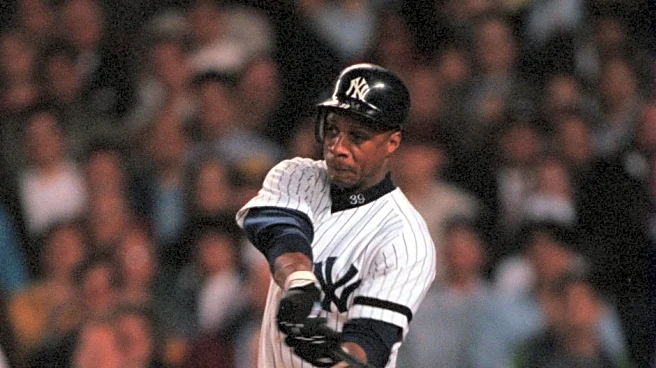
Strawberry helped lead the Yankees to three World Series titles during his time in the Bronx, and also struck up a friendship with budding star Derek Jeter. Despite the limited playing time—outside of 1998, when he played 101 games and hit 24 home runs—he posted some excellent numbers in pinstripes and was beloved in that clubhouse. Strawberry’s career slash line of .255/.362/.502 and 119 OPS+ in 239 games was more than good enough to be an above-average piece off the bench.
In ’98, Straw even turned the cool trick of getting two pinch-hit grand slams in the same season.
For everything that happened in Strawberry’s turbulent life, he also always maintained that memorable buggy-whip swing.
Strawberry was unable to join the Yankees’ World Series run in ’98, as he was diagnosed with colon cancer in the middle of the ALDS. He recovered and prepared for the ’99 campaign before his old demons struck again. He was arrested for possession of cocaine and soliciting an undercover cop posing as a prostitute. MLB suspended him 140 days and he did not return to the Yankees until the final months of the season. Strawberry showed little signs of rust, hitting .327 in 24 games and belting a pair of key playoff homers as the Yanks repeated as champions.
Strawberry’s off-field drug issues continued. He tested positive for cocaine in February 2000 while attending spring training. Commissioner Bud Selig demanded Strawberry leave the team while waiting for a decision on the suspension length. After the test news came out, Selig announced that Strawberry would be suspended for the entire 2000 campaign, and, as a result, his MLB career was over. It was a celebrated one, featuring four World Series titles, a Rookie of the Year, two Silver Sluggers, and eight All-Star nods. But for many fans, it felt like he left a lot on the table, too.
The first few years after Strawberry’s retirement were a journy through the wilderness and multiple more arrests. Thankfully, he did eventually find sobriety, and it has reportedly lasted over two decades. The Mets just retired his No. 18 in 2024, and he’s often attended Yankees Old-Timers’ Days and team reunions. Here’s wishing Darryl a happy 64th birthday.
See more of the “Yankees Birthday of the Day” series here.