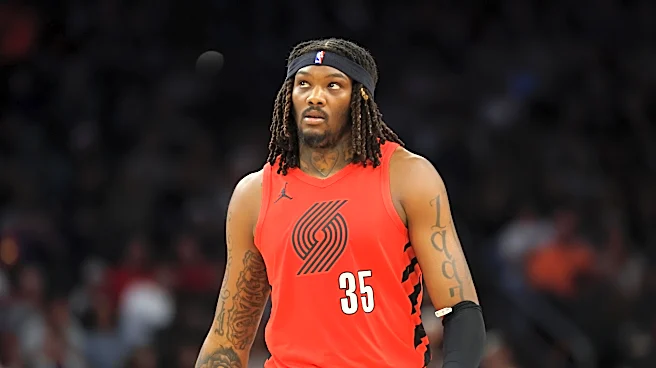





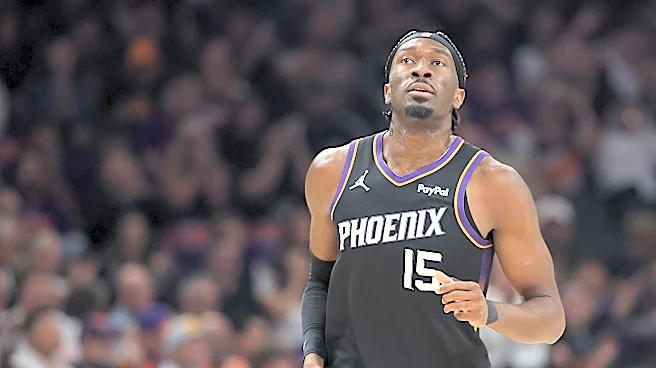
There was a time when the thought of Portland Trail Blazers center Robert Williams III getting another non-veteran minimum deal was a stretch. Just 12 months ago, Williams appeared to have been beaten by a multitude of injuries, which had kept him to just 26 games through his first two seasons with the Blazers.
Once a Defensive Player of the Year prospect with the Boston Celtics, the veteran big had been a forgotten piece in the return for Damian Lillard given his lack of availability. This lack of participation
may have led to the Blazers considering letting him walk this summer in order to clear space.
Not anymore.
Williams enters the market as one of this year’s better center prospects thanks to a productive combined 64-game regular season and playoffs. The veteran big was probably capable of more appearances if not for the Blazers’ appropriately cautious decision to keep him out of back-to-backs.
During the regular season, Williams averaged 6.7 points, 7.0 boards, 1.0 assists and 1.5 blocks in 17.1 minutes. Among bigs, he ranked eighth in both points per shot attempt at 1.43 and effective field goal percentage with 72.6 percent. He was fifth in block rate, swatting 4.3 percent of shots and 10th in defensive rebounds, grabbing 24.5 of opposition misses.
More than that, he served as Donovan Clingan’s primary backup and at times seemed like the surer option given his athleticism, basketball IQ, and ability to guard out to the perimeter. He also became a more important piece when we realized Yang Hanson wasn’t as NBA-ready as we would have liked.
Williams had edged closer to his prime Boston form, if only for the team-first plays, generating second-chance offensive opportunities, completing lobs, and getting his teammates into position on defense.
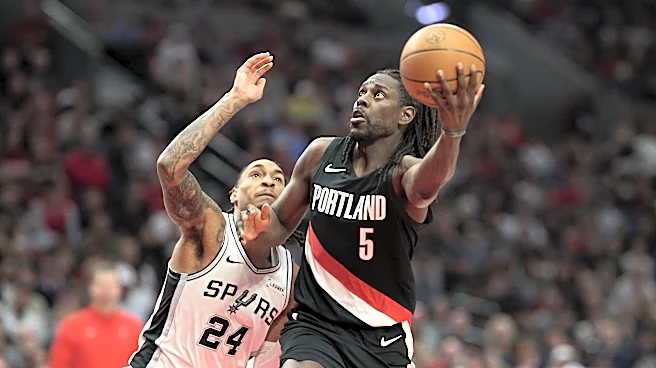
Williams raised the bar during the Playoffs, largely outplaying his sophomore starter by averaging 9.6 points, 7.4 boards, 2.6 assists and 1.2 blocks. For someone not billed as a jump shooter, he also hit crucial three pointers to keep the Blazers within arm’s reach of the San Antonio Spurs.
Beyond the stats, he anchored the Blazers defense, working hard to contain Victor Wembanyama, moved without the ball, and knew where to be. He was the veteran on a team dominated by young talent. The roster of player that any team would love to have on the roster, assuming they were available more games than not.
Now, with a potential change in injury fortunes, the Blazers have to decide firstly, whether they want him back in the fold. Secondly, how far they’re willing to go to keep the 28-year-old whose free agency is now unrestricted.
The Market
As of right now, the Chicago Bulls, Los Angeles Lakers, Brooklyn Nets, and maybe the Detroit Pistons look to have cap space this summer. The Bulls and Nets are rebuilding, and the Pistons have Jalen Duren. The Lakers – who need to re-sign Austin Reaves, Rui Hachimura and LeBron James – will probably be able to sign another free agent and could look to Williams if they’re done with Deandre Ayton who holds a player option.
The Blazers are one of about a dozen teams that should qualify for the non-taxpayer Mid-Level Exception (MLE), allowing them to spend up to $15 million in free agency. But unlike those dozen teams, the Blazer hold Williams’ Bird Rights, which allows them to sign him for more than the MLE, regardless of their cap situation.
With Williams’ uptick in production this season, combined with his reputation as one of the league’s more versatile and athletic big men, $15 million seems like a relative steal if he’s healthy. But that “if” is an important factor. Handing Williams decent money only for him to fall back into an injury morass is not the goal, especially off the back of only one relatively healthy season.
But if the goal is to ensure he returns, offering him more than the MLE takes most other bidders out of contention. The Lakers might be a threat but that’s factor they can’t escape.
We should also consider Williams’ standpoint. Sure, there’s the connection to the franchise and the work done to get him back on the court, but the big man may want to find his way back to contention and while the Blazers are improved, they’re not there yet.
Assuming there is mutual interest, there is a way to thread the needle. My ideal contract structure: three years and $51 million with the Blazers holding a team option on the third year. That’s $34 million in guaranteed money for the charismatic big and a chance to prove his health without locking the franchise into long-term money.
It takes all those MLE teams out of contention with only one or two competitors who would have to sacrifice sought-after cap space to sign a guy who’s not yet proven his health.
Conclusion
Robert Williams III might have been the most pleasing part of the Blazers’ return to the NBA Playoffs this season. Those five games were probably the best stretch we’ve seen from the big in Portland colors. Though I’m not sure whether he’s ready to return to a starting role, he might be the league’s best back up big if he can remain healthy.
We have no idea whether he’ll be able to play back-to-backs next year, regardless of who he’s suiting up for, but I can say without hesitation that he will be instrumental in his team’s success, if he is. If the series against the Spurs showed anything, it highlighted the need for versatile, veteran bigs playing both ways.
That’s Williams.
For me, his return should be the franchise’s number one free agency priority and, if necessary, they should be prepared to offer more than the non-taxpayer MLE to ensure he’s back in Portland colors next season. Williams will no doubt have plenty to weigh up given the unpredictability of the past three years but if the Blazers go to him with a fair package, he surely considers it.