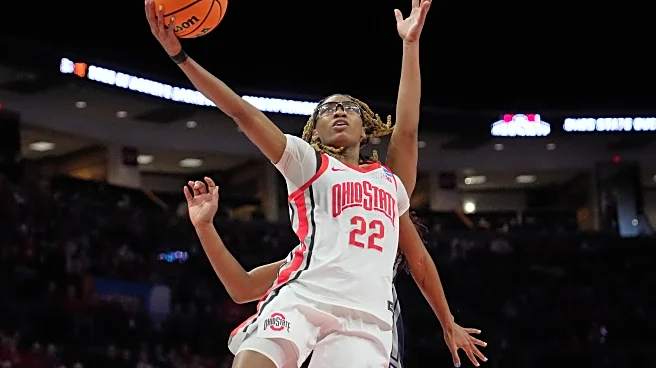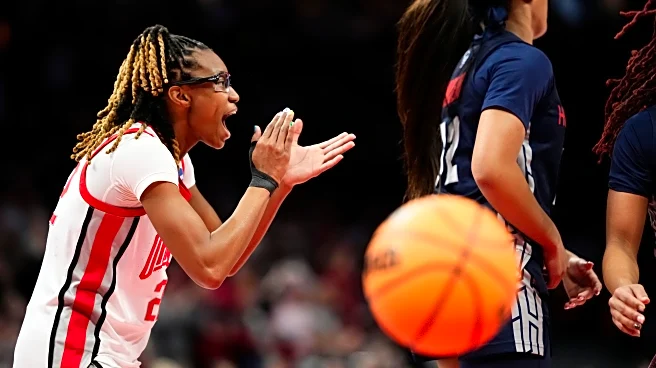

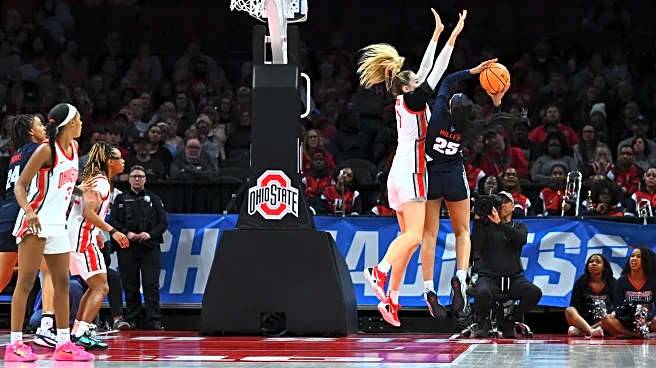
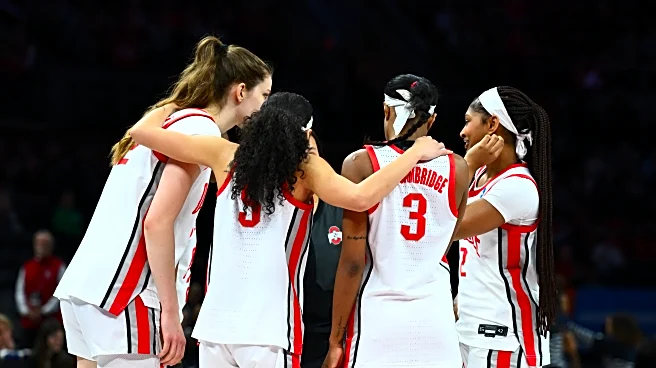
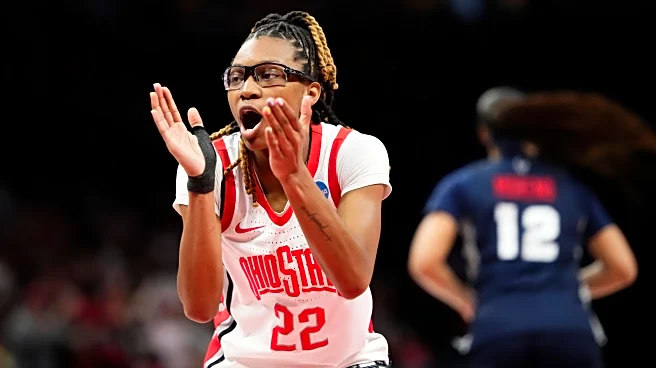
It is the Second Round of the NCAA Tournament and No. 3 Ohio State women’s basketball welcomes a deceptively ranked No. 6 Notre Dame Fighting Irish.
That ranking does not tell the whole story of an ACC side that won seven of the last eight games headed into March Madness, with the only loss coming from the ACC Tournament Champions Duke, by two points.
After the Buckeyes and Fighting Irish dispatched their first round opponents with ease, Monday afternoon is a matchup of two of the largest programs
in college sports, led by two All-American point guards. To learn more about guard Hannah Hidalgo, Notre Dame hitting their stride late and more, Land-Grant reached out to Eric Hansen from On3’s Blue and Gold.
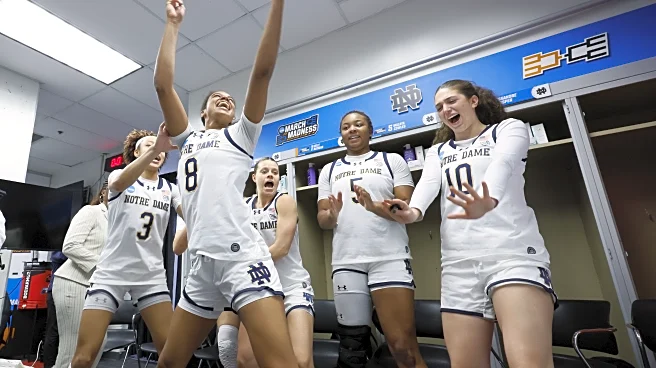
Up now in the visiting locker room.
Land-Grant Holy Land: This season has not met Notre Dame program expectations, at least from an outside perspective. After the side lost players to the portal and the pros, the team took a while to play consistent basketball, but do enter the tournament with wins in 7 of their last 8, and that one loss nearly upset Duke in the ACC semifinal. What have the Irish done late in the season to hit that stride?
Blue and Gold: The answer is pretty layered, but the three key factors driving all of that is the return of guard KK Bransford from injury, the team chemistry and familiarity finally kicking in with so many new pieces in the core rotation, and the transition-leaning Irish finding offensive answers when teams are successful in forcing them into a half-court game.
Bransford, is a 5-foot-10 guard with forward versatility on both ends of the court. The Irish went 6-6 during his 12 games nursing a knee injury and are 10-2 since her return in early February. Without her, Notre Dame’s core only went six deep, which made them susceptible to even inferior teams with deeper benches or teams that could get the Irish in foul trouble.
With regard to chemistry, five of the rotation’s seven players didn’t suit up for the Irish in 2025 — Bransford, who redshirted due to a different injury, and four transfers. One of those transfers, forward Gisella Sanchez, spent a big chunk of the summer in her native Spain. Two others, starting center Milaya Cowles and guard Iyana Moore, had cleanup surgeries in the summer that sidelined them until after the season had started. But eventually the dissonant pieces started to bring out the best in each other.
The most effective of coach Niele Ivey’s late-season tinkering with X’s and O’s produced a more fluid half-court offense. On defense, it was a sticky zone the Irish didn’t show in their first-round win over Fairfield, given the Stags’ standing as Division I’s most prolific team when it comes to 3-pointers. But the zone has given lots of teams problems, including ACC heavyweights Duke and Louisville.
LGHL: Notre Dame also has similar performances to Ohio State in that they force a lot of turnovers, grab steals in bunches but struggle on the boards. How does Notre Dame handle interior pressure and, inversely, how do they perform in the paint offensively?
BG: The Irish lean into their defense to overcome their shortcomings on the boards. So, not only do they double up their opponents — on average — in points off turnovers, Hannah Hidalgo is so disruptive against most opposing point guards that it prevents the post players from getting good entry passes. And when the Irish play zone, they do a good job of helping on and collapsing on the opposing bigs.
On offense, the Irish are outsourcing their opponents in the paint by an average of six points a game. And a lot of that is generated by the guards penetrating. Syracuse and Louisville are two of the better rebounding teams in the ACC and top 25 in rebounding margin nationally. The Irish used this formula to take down both of them in their last two games ahead of the ACC Tournament.
LGHL: Everyone talks about Hannah Hidalgo’s play, for good reason, but even ESPN painted the team as Hannah doing everything by herself. Who are other players that are pushing this team late in the regular season and now into the postseason?
BG: It really has been a rotating cast of supporting stars, but the players most consistent in stepping into those roles late in the season have been Vanderbilt transfer Iyana Moore, a former second-team All-SEC selection and prolific 3-point shooter, and Cass Prosper, a 6-3 guard who can post up and defend all five positions when called upon and who was voted the ACC’s Most Improved Player.
LGHL: I still have to ask about Hannah. Both Jaloni Cambridge and Hidalgo are quick guards, arguably two of the fastest in the country, who facilitate and play defense. How have you seen Hannah’s game change this season and how do you see the Notre Dame elevate her game in big moments over the years?
BG: She’s always had a knack for playing her best basketball when the lights are brightest. The big change this season is that she seems to be able to bring that out in her teammates in the last month and a half — when ND went from a bubble team to one that has a shot of getting the Sweet 16 for a fifth straight season. Her poise and maturity are significant areas of growth, which not only helps her push through frustrating stretches without unraveling, it helps the team around her do so as well.