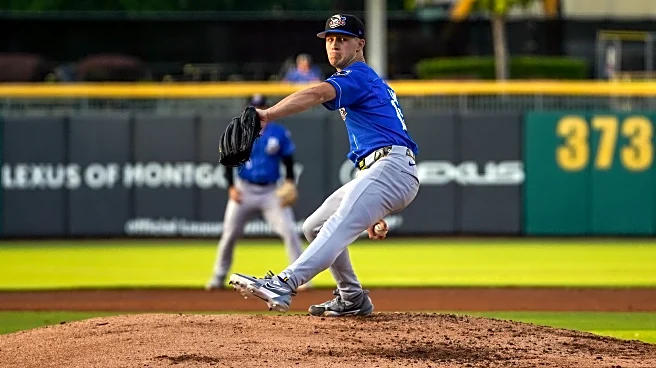

Unless you follow the Brewers’ minor league system, you probably haven’t heard of Coleman Crow. Crow just turned 25 but has been around the minor leagues for six years. He was drafted by the Los Angeles
Angels in the 28th round all the way back in 2019, but didn’t play a game of affiliated ball until 2021. Crow earned a promotion to Double-A before the 2022 season and showed signs of promise (9.0 strikeouts per nine innings, 2.5 walks per nine innings) despite an ERA approaching 5 and a 1.41 HR/9 rate. He finished the year ranked as the Angels’ No. 23 prospect.
Unfortunately, any momentum built up over 2022 came to a screeching halt in 2023. Crow tore his UCL in just his fourth start of the season and was placed on the IL. A couple of months later, Los Angeles traded him as part of a deal to acquire New York Mets infielder Eduardo Escobar before the deadline. Crow never pitched for the Mets; just months later, New York traded him to Milwaukee as the return for Adrian Houser and Tyrone Taylor.
Crow didn’t pitch at all in the 2024 season, either. That didn’t stop him from breaking out in a big way in his first year pitching for the Brewers organization. Crow posted career highs in ERA (3.34), K/9 (11.5), and batting average against (.217) through 12 starts between Double-A Biloxi and Triple-A Nashville. By the end of the season, he’d earned his way onto MLB Pipeline’s list of the top 30 Brewers prospects (No. 25). Milwaukee also added him to the 40-man roster in November to keep him from minor league free agency, suggesting they see him as a future contributor in one way or another.
Why do the Brewers like Crow?
Crow has a couple of attributes that Milwaukee values highly while evaluating prospects — a plus-plus pitch and flat vertical approach angle (VAA).
MLB Pipeline gives Crow an overall scouting grade of 40, but his mid-70s curveball is a 60. The key to his curve is an incredibly high spin rate; his average spin rate (around 3000 rpm) would be one of the best in the major leagues. Crow also regularly gets around 19” of vertical break and five feet (!!) of drop. For context, Cardinals pitcher Phil Maton was the only major leaguer to average 19” of vertical break on his curveball. Truly a plus-plus pitch — when Crow’s on, it looks like he’s throwing a Wiffle ball:
The other pitches haven’t developed to the extent that his curveball has (although the bar is certainly high). His fastball sits in the low-90s and has a fairly high spin rate (2600 rpm) itself. Crow also throws a slider, sinker, and changeup. If he’s comfortable throwing even two of those pitches (along with his curveball) at the major league level, he’ll be able to get outs consistently.
The other main thing the Brewers like about Crow’s profile is his VAA. As I’ve explained in other articles, a flat VAA means that the pitch comes in at a deceptive, flatter-than-average angle, which often causes pitchers to swing under the ball. A lot of Milwaukee’s pitchers have VAAs that are flatter than average, as does Crow.
Crow’s fastball plays best up in the zone, which is dangerous because he doesn’t throw very hard. These two traits, combined with the fact that his VAA already causes hitters to swing under the ball, mean that Crow can be somewhat home run-prone (as he was in 2022).
However, since joining the Brewers organization, Crow has shown a lot of growth in limiting the long ball, keeping hitters off balance by mixing speeds and locations. Not only did Crow have the best season of his career last year, but he also recorded the lowest fly ball rate and HR/9 rate (0.54) of his career.
So, does Crow have a path to contributing this year?
The short answer is: probably not as things stand right now. Milwaukee has at least seven pitchers on the 40-man roster — Freddy Peralta, Brandon Woodruff, Jacob Misiorowski, Quinn Priester, Chad Patrick, Robert Gasser, and Logan Henderson — who would most likely be given a chance to earn a spot in the rotation before Crow. The Brewers would probably rather use multi-inning guys Aaron Ashby, Tobias Myers, and DL Hall out of the bullpen, but any of those guys could conceivably end up starting a game or two —as could new acquisition Ángel Zerpa. Milwaukee is blessed with considerable starting pitching depth right now, so Crow probably wouldn’t earn a consistent spot in the rotation.
I say that Crow probably doesn’t have a path to contributing this year because injuries happen, as the first two months of last season made readily apparent. Even in this scenario, Milwaukee would probably rather start a guy like Carlos Rodriguez instead of starting Crow after only 10-ish Triple-A starts. Crow missed the last two months of the season with a hip injury and a flexor strain. He only pitched in two Triple-A games (7.71 ERA) before the injury. It makes more sense to let Crow develop in hopes that he can become a legitimate contributor in 2027.
With that being said, Crow is a lot closer to being a rotation option than some may think. His career season last year wasn’t a fluke — rather, it was a product of learning how to limit home runs and pitch to his strengths. It might not be next year, but I wouldn’t be surprised to see Coleman Crow in a Brewers uniform sometime soon.