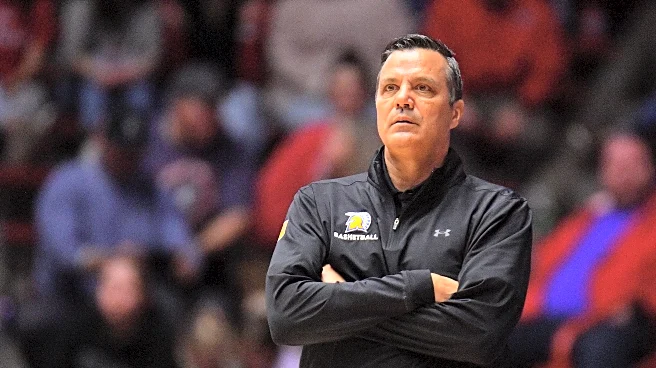

San Jose State’s (6-12, 1-6 MW) last three outings offered a clear snapshot of where Tim Miles’ program currently sits: competitive, resilient and still fighting a steep hill against depth issues and execution
gaps against more-than-capable Mountain West competition.
From a road loss at Grand Canyon last week to a short-handed but determined win over Air Force to a setback against a perimeter-savvy UNLV team, the Spartans continue to show fight though consistency remains elusive.
Rosborough leads early against Grand Canyon
At Grand Canyon, freshman Ben Rosborough once again served as the Spartan’s steadying presence.
Rosborough set the tone early, pacing the Spartans offensively and helping keep the game within reach through the opening stretches. Rosborough’s ability to score within the flow, attacking gaps, knocking down timely shots, and competing on both ends allowed San Jose to hang around longer than the final 76-58 margin suggested.
But as the game wore on, the Spartans struggled to maintain that same efficiency.
As Grand Canyon began winning the second-half battle of physicality and pace, the Spartans found much tougher looks coupled with extended defensive possessions.
Despite Rosborough’s production, the Spartans couldn’t consistently string together stops, as the Antelopes pulled away. It was another example of Mile’s team doing enough early, but not quite enough late against a confident home team.
Short-handed Spartans lean on Rosborough again vs. Air Force
If the loss to Grand Canyon exposed cracks, the 70-62 win over Air Force highlighted the Spartan’s ability to adjust on the fly.
Once again, Rosborough was central to that effort. With the Spartans “obscenely short-handed,” as Miles described postgame, Rosborough embraced a larger role; scoring when needed, settling possessions, and helping younger or less experienced lineups stay organized without their court-general Colby Garland.
The Spartans didn’t overwhelm Air Force with talent or depth. Instead, they relied on discipline, defensive connectivity, and timely execution. Rosborough’s scoring and leadership helped San Jose State weather some stretches of inconsistency.
“We’re playing different lineups all the time,” Miles said postgame. “I thought they did an excellent job staying on the floor and pulling out the win.”
It wasn’t a statement victory, but it was a meaningful one – proof that the Spartans can still manufacture results when effort and structure align.
Bell shines, but UNLV’s shooting swings the outcome
Against UNLV, the spotlight shifted to Melvin Bell Jr., who delivered one of his more assertive performances of the season; attacking the rim with confidence, finishing through contact and helping the Spartans generate inside offense inside during a strong first-half.
The Spartans were effective early getting to the foul line and limiting UNLV’s interior game. But the Rebels adjusted, spacing the floor and punishing San Jose from beyond the arc.
“We were effective inside at the rim, and we got to the foul line,” Miles said. “We just weren’t as effective in the second-half doing the same thing.”
As Bell continued to compete, UNLV’s three-point shooting heated up.
The Spartans found themselves chasing the game from there on end. San Jose’s defensive focus on taking away the paint opened the door for UNLV shooters, where the Rebels made them pay.
“That three-point shooting caught us a little bit,” Miles added. “They did a good job countering by making their threes. And that was the difference.”
Despite the 76-62 loss, Bell’s performance stood out as a positive. It was a reminder that San José State has pieces capable of rising to the moment, even when the result doesn’t follow.
Where the Spartans stand for now
Across these three games, the theme remains consistent: San Jose State is competing, but the margin for error is so razor thin, where depth challenges and second-half execution continue to test the Spartans.
The win over Air Force shows a gritty formula can work. The losses to Grand Canyon and UNLV illustrate how quickly games tilt when opponents find rhythm or when the Spartans can’t sustain its strengths for 40 minutes.
For Miles and team, the path forward isn’t about effort. That’s already there. It’s about tightening the details, quickly developing and trusting evolving roles, and finding ways to extend their best stretches just a little longer.
In the Mountain West, sometimes that’s all it seems to take.