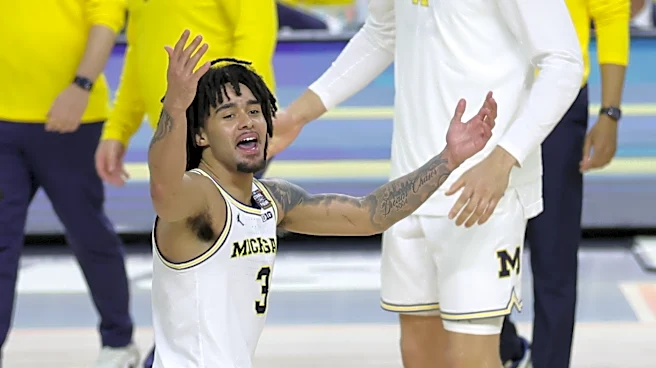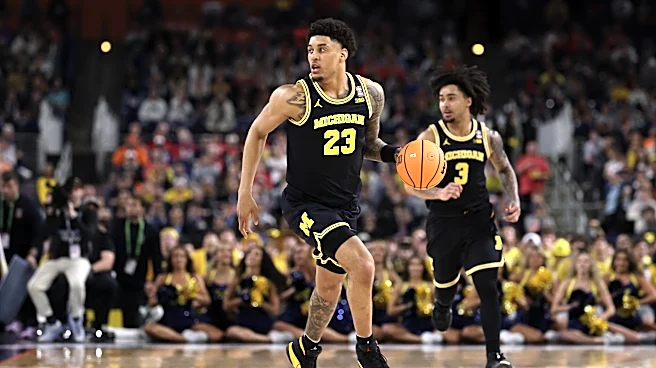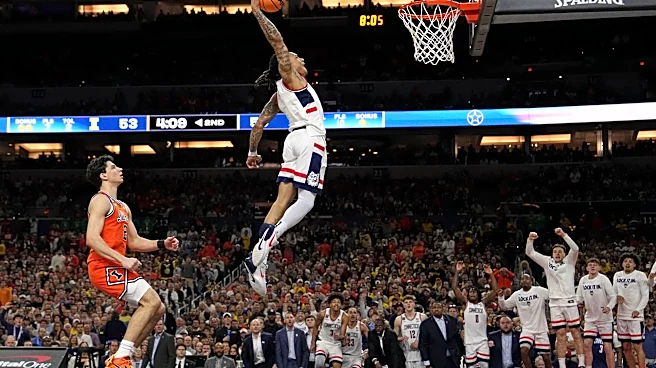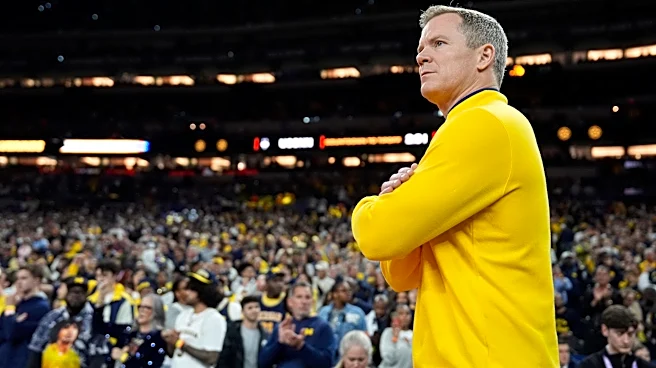




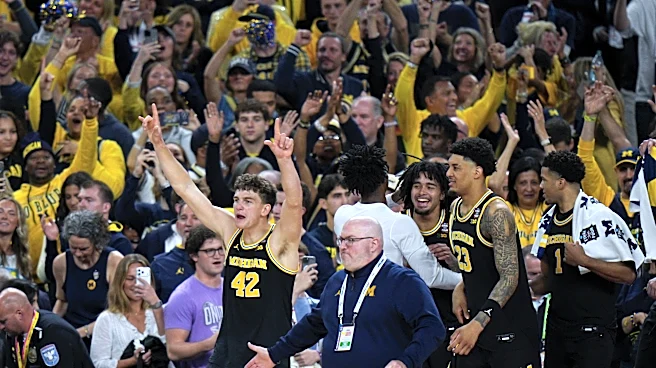


The Michigan Wolverines beat the UConn Huskies in the National Championship on Monday. Michigan won its first national title since 1989. Here is everything head coach Dusty May, Yaxel Lendeborg, Elliot Cadeau and Trey McKenney told reporters after the game, courtesy of ASAP Sports.
DUSTY MAY: What a way to wrap up the ’25-‘ 26 college basketball season with this group. I want to begin by thanking last year’s team at Michigan. We came up a little bit short, but those guys laid the foundation, established
an identity for us, and also helped attract these guys to come in and chase this dream together.
Secondly, I want to thank our FAU guys, the team and staff that really, really — this is one time I’ll make it about me — that really helped us grow together, and that was the first time I had been with a group that was truly sacrificial where we were about each other, and because of that we all improved so much, and this team has done the same thing.
When you bring a group this talented together and they decide from the beginning that they’re going to do it this way and they never waver and they never change, that’s probably the most uncommon thing in athletics now, and it’s a tribute to their character but also those in their circles around them, their coaches, their parents, their mentors. They allowed these guys to give themselves up for the group, and it’s never guaranteed, but for these guys to cut down the nets after all they’ve sacrificed is pretty special.
Q. Yaxel and Elliot, the game wasn’t a typical Michigan game in terms of your shooting, assists, three-points, almost none of that was going on. How did you find a way to shift your game in the middle of the game to almost a wholly different identity and still win?
ELLIOT CADEAU: You know, all year we’ve been just finding ways to win. We made two threes the whole game. We wasn’t making shots. We weren’t. We had a couple assists, not as many as we usually do, but we constantly just been finding ways to win all year, no matter how everybody is playing.
YAXEL LENDEBORG: To piggyback off that, yeah, early on in the season we went through our struggles, offensively trying to find our rhythm. What stuck out and really brought us together was how unselfish we were eventually in those moments and our defensive toughness. Whenever offense isn’t rolling, we find a way to make plays with our defense and make it lead to quick offense.
Q. Yaxel, when did you know you were going to go, what percentage were you at, and were you a little tentative to move on it that much?
YAXEL LENDEBORG: I knew I was going to go as soon as I got back on the court the first game. I knew there was no way I was going to miss this game no matter what was going on. I was very tentative this game. I felt like I was pretty much holding our team down. I felt like we could have been up by way more early in the game, later on in the game.
I kept having opportunities to make plays, and I couldn’t make the play. But these guys stuck with me no matter what. They all believed in me. I was trying to push through my mental and physical battle out there dealing with myself, but these guys really helped me out and helped me push through.
Q. For Yax, there was a time late in the second half you came out, you looked frustrated. I saw it on the TV monitor. L.J. was motivating you at that moment and seemed like then you went into the game and you scored a couple buckets real quick. Since he had that similar injury, perhaps share that conversation what he has meant to you?
YAXEL LENDEBORG: Yeah, he was telling me to stop being so hard on myself. He was basically saying I’m one of the reasons why we’re here, one of the biggest reasons we got to this moment. Nobody is going to downplay me, what I’ve done this year, because of one bad game. He told me to keep going, no matter what. He believes in me. The rest of my team has my back no matter what, just find a way to get easy buckets.
Coach Joyner also came to me and talked to me about the Anthony Davis game where he was having a bad game and he found a way to impact the team. So I decided to find a way to do something to help the team out, and eventually it started working out.
Q. Elliot, when you came here to this tournament, everybody was forecasting who would be the most valuable player of the tournament and such, and when you got the trophy — I know that trophy right there is what means the most to you, but what did it mean to be honored like that?
ELLIOT CADEAU: Man, it means the world to me. I’m just so proud of myself, where I came from. Last year I was really down on myself, a lot of people doubted me, and I’m just so proud of myself for me to be able to say I was the most outstanding player and win a National Championship at the same time.
Q. Follow up to that, Elliot, what did you guys see when you first got together, when you started talking about winning championships, when you maybe barely knew each other and didn’t know what you had coming here?
ELLIOT CADEAU: Yeah, I just saw so much talent around me since day one. Just like a unique set of talent, like three bigs at the same time, switching 1 through 4. I just seen a unique type of basketball that we was playing, and I knew it would be a mismatch nightmare for every single team that we played, and it was this year.
Q. Elliot, your job obviously changed when L.J. went down, a lot more responsibility on you, and somehow you went from there to in these last two games playing maybe the two best games you’ve played all year. Can you explain that journey, how you were able to traverse that through the course of this month?
ELLIOT CADEAU: Yeah, I feel like I’ve been playing the same from when L.J. went down. I feel like I just got the ball more and got more minutes and had higher usage so it seems like my stats were higher. But I think L.J. for even if he’s out, he’s still supporting us. He’s literally assistant coach out there, and it just inspires me to go out there and just play for him.
Q. Elliot and Yaxel, you both transferred in at the start of the season. What have you seen in terms of your fit with the rest of the team, and how have you seen yourselves grow since you’ve become a part of this Michigan team?
YAXEL LENDEBORG: Man, once we transferred in, I know especially for me, the whole University of Michigan welcomed me with open arms. I seen many, many Twitter arguments of these guys going back and forth with everybody saying we deserved a spot here, they’re going to cherish every moment of us being here.
And shout out to Will, Roddy, Nimari, L.J., especially those guys. Once we all got together, they were super genuine with us the whole way. They tucked us in under their wing and showed us the Michigan way. They could have easily got hurt or something because the new guys were coming in, stealing their minutes, stealing their points, but they didn’t care. All they cared about was winning, and look where it led us.
Q. Yaxel, now that you have a championship trophy, can you tell us a little bit more about the injury? Are you going to need follow-up surgery, follow-up consultation? What did it take to get back on the court tonight?
YAXEL LENDEBORG: I hope I didn’t mess anything up more than it already was. I’m going to find that out in a couple days once we finish celebrating. It took a lot to get on the court, honestly, and to stay on there. I was dealing with a lot of mental issues today.
These guys all leaned in on me and helped me out, helped me dig myself out of the hole and just continue to keep fighting. Chris, shout-out to him because he was with me pretty much all day, all night, making sure I was even 50, 60 percent ready to play. I did the best I could regardless of the outcome, but it feels really good to be a champion, to be on top of the world, man.
Q. Trey, what about your teammates just makes you the most proud to say that you won a National Championship with them?
TREY McKENNEY: I think just the way throughout the season everybody on this team is extremely talented, and for us to be able to sacrifice something for ourselves, a lot of us could be somewhere else doing more than what we’ve done this season, but I think it just shows that this team is super selfless, and I’ve never been around such a talented group of guys that are willing to take a lesser role for somebody next to them.
I’m just really grateful to be around this team, and I’m going to cherish this moment for the rest of my life.
Q. Dusty, it took you a very long time in your career to get to a point where you could pick your next move essentially. What made you think that you could do it at Michigan and do it quickly once you got to that point?
DUSTY MAY: The hardest part — first, hold that question real quick. Elliot beat me to it. L.J. Cason was playing as well as any backup guard in all the country and probably playing as well as anyone on our roster, and at Illinois he’s hooping and has the most Florida man injury in the history of injuries, and the next day you would think he retired and took over an assistant coaching spot. His spirits were up. He was immediately pouring into the guys, trying to learn, pick their brain because he had a different perspective.
And that’s very indicative of this team. He never one day brought negative energy because he felt sorry for himself. And for Elliot to shout him out, beat me to it is pretty impressive as well.
The toughest part about jobs, and this has always been my opinion because I’ve just taken jobs, my wife used to get angry with me because I would just call her and say, hey, what do you think? Do you mind if I take this job? For whatever reason. And so now you don’t get a chance to really go feel the place and see it.
And even FAU, I went to see it — and before I seen anything, I had already signed the contract. That’s how impulsive I am. Whatever the case. Anna will give you a better background than me on all this stuff.
And living in Ypsilanti when I was a young assistant in Eastern Michigan, I had never — I wasn’t that familiar with Michigan other than ’89 and being a fan of the game.
Just the feelings that people had, the pride they had in a their university, I thought that was really cool. We thought it was a great time to get back to the Midwest. We were at a stage in our life where we were empty nesters and wanted something different.
And just felt like Michigan was a place ultimately with a changing landscape that we could retain really good players, even if it wasn’t going great for them. It was going to be hard to leave.
Even Harris is a great example. He had options to go anywhere in the country. It was difficult for him to leave the University of Michigan and the relationships that he had made and all the people that poured into him. I just felt like that’s the type of place I would love to coach at.
Q. You just won the National Championship; you talk a lot about doing something internal. You’re around Terry Mills a lot. What do you think this accomplishment is going to do for this group the rest of their lives and beyond?
DUSTY MAY: It further strengthens their bond, and we didn’t need this for that to happen because of their actions all year. We talked about it early in the season, to hang a center banner — Michigan has got a proud tradition, there’s a lot of banners on the side. There’s one lonely banner up in the middle.
And if we were having a bad practice or we didn’t have our edge, we would remind them that if we were ever going to hang another banner so that one has some company, then we can’t have these type of days or these type of practices. Usually that was one way that we could refocus our group.
Q. Like I asked the players before, it seemed like this was a really unusual blueprint to try to win, free throws, blocks, and steals. That’s not the Michigan thing. Were you conscious of that was the way you were going to have to do it? Did you talk to the players about changing on the fly?
DUSTY MAY: Yeah, early in games we can tell how the game is being played, so then we talk about how we have to adjust and we have to figure out solutions based on how they’re guarding us and all the things. We actually thought the basket would open up a little bit in the second half. We felt like we were going to make shots in the second half.
We generated — I think there were two threes in the first half that we didn’t really love those attempts, and you’re not going to love them all. The rest of them we thought were really good offense and the ball just didn’t go in. We were trying not to result in all that we do and just stay with the process and evaluate the contributions and how it felt.
So then early in the second half the game got a little bit chippy and physical, so we thought, this is going to be a game we just have to figure it out. We started going offensive and defensive substitutions early. And UConn was dominating us on the glass. Credit to them, they were motivated and determined as any team we played on the offensive glass.
But we did feel like we were defending well enough that we were going to be able to find enough baskets.
Q. A lot of the players just now were talking about your assistant coaches being so instrumental in getting them ready, in game, before the game. Can you talk about your cohesive coaching staff in getting you guys to this National Championship?
DUSTY MAY: I could go on until tomorrow. That’s one of our secret sauces is we have an incredibly talented group of coaches that never make it about themselves. Look, this is an ego-driven business. This is a lot of alpha males with great egos, and that’s why they’re successful doing what they do.
These guys have made our players the No. 1, 2 and 3 priority over their own careers, over their own individual attention and accolades and things like that. It’s hard for our players not to follow the team, which is the staff, when they’re modeling that behavior every day, and they deserve a big, big chunk of credit for this.
Q. I think from the public standpoint anyway, you brought in Elliot before even the three bigs. Even he said he doubted himself. The team he played on last year did not have a great year. Other than assists, he did not have a great year. What did you see in him that you thought he could get you to this moment?
DUSTY MAY: It’s a great question. We had seen him in prep ranks and we had seen him in high school ranks and we felt like we needed a quarterback, a pass-first quarterback on the floor at all times. With Elliot, once we got him, we were able to sell him, and even — I coached Sean May years ago in AAU basketball, so I called Sean, and he gave me all the intel and everything on the background, and I just said, let me ask you one question: Would 17-, 18-year-old Sean May, who was a McDonald’s All-American, NBA player, would he want to play with Elliot Cadeau, and he said an expletive, yeah, absolutely, let’s go, and I said, that’s all I need to know because Sean is one of the smartest, best players I’ve ever been around.
So I valued his opinion that much, so that was a stamp on the intangibles and whether I thought we could win this with him because on film it was there. He’s a savant. He’s brilliant. He’s made us better coaches, and hopefully we’ve helped him become a better player.
Q. You talked there about Elliot, but the group as a whole when you’re putting it together, you never really know for sure. How rewarding is it to have it turn out this well?
DUSTY MAY: I think the most rewarding part is they never changed. This game, we weren’t very good early in the year. The first two exhibitions we beat St. John’s, but they weren’t St. John’s yet, and we didn’t play well, and at that point we considered pivoting and changing our lineup and going in a different direction and maybe admitting failure for our vision.
Because of our staff, I remember the day like it was yesterday, we were in the conference room and we did a deep dive in everything that you could come up with to try to predict whether we thought it would work. Once we left that meeting, we were more committed than ever that this is going to work, and these are the reasons why.
Now, we didn’t feel like we were — it was like bamboo. We didn’t feel like the bamboo was just going to shoot to the sky the next week in Vegas, but it did, and then it happens quickly where we’re playing that level, and that’s typically when it gets more difficult.
I’ve been an assistant on staffs when you play like that, and that’s when it really gets tough because there’s more attention, there’s more of everything coming at your guys, and for them not to waver on how they, I guess, continued to give, to me that’s probably the hardest part and most rewarding thing that these guys did.
Q. Dusty, I went up during the game into the very last row and sat with a bunch of Michigan fans, some of whom had paid a lot of money for a pretty bad view. I wondered, what is it like to coach at a program where you have that type of fan support, and also, when you came to the Final Four when you were young, did you ever sit in those really bad seats when you were a coach that was making no money or trying to get in?
DUSTY MAY: No, I never had tickets. I never attended a game until Mike Davis made it in ’02, and at that point he had already offered me a position on the staff even though he didn’t have one yet, coming from USC. So we played in the same regional. We had got upset by UNC-Wilmington and he created a position to bring me back home.
But in that process they continued to advance, so he got me great tickets right behind the team and started that process of acclimating to their program. So that was the only time I ever went.
Yeah, the tickets, all these people that pay hard-earned money and give us their time to support us, it’s appreciated. We’re very, very grateful.