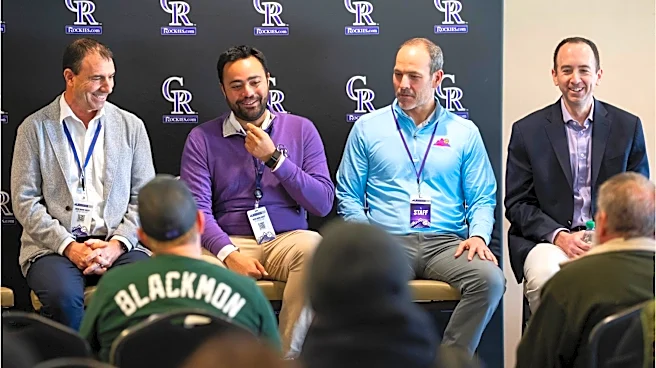


Last Saturday, Tommy Tanous, the Colorado Rockies Assistant General Manager – Player Development & Scouting, spoke with Purple Row about his first season with the organization.
As a reminder, the Rockies hired Tanous during the offseason as part of their front office rebuild. He is responsible for the organization’s player development and scouting operations. Prior to joining the Rockies, Tanous spent 15 years with the New York Mets.
Below are a few takeaways from that conversation, which has been
lightly edited for clarity.
On joining the Rockies
(It’s been) exciting, fun, great people. That that was probably the nicest surprise. The quality of people that I got to meet and work with here. So overall, it’s been an A-plus experience.
Paul (DePodesta) was my boss with the New York Mets, so I knew him quite well (laughs), and Paul is probably the number one reason why I left a really good situation. I probably wouldn’t have done that for anyone else, but enjoyed working with him so much and just appreciate the work environment he provided. So it was kind of a no-brainer when I get a chance.
On what his of scouting and player development job entails
It depends on the season, depends on the time of year. Going from January to really March, it’s a little player development and a little bit of the draft, and then from March to July, it’s mostly the draft — I’d say probably 80% is looking at players, looking at video, helping the staff, the amateur staff. And then after the draft, it’s mostly player development, going to the affiliates, helping write player plans, and now it’s a little mixture of both in the in the fall, both player development and trying to do some scouting.
You have a schedule. You touch each department a little bit each day, knowing the majority of the time is going to be in player development, but I still want to stay up on the amateurs. So your day is a mix of both, keeping your hand in both, and you have good people that help you, like we do on the amateur side and the PD side. It makes it easier.

On preparing for the draft and drafting specifically for the Rockies
Absolutely it’s taken into account — what we feel like will work here, what’s a little easier to adjust to. All of that’s taken into the evaluations, and Paul and Josh Byrnes have done, and Ian Levin, I should say, too, have done extensive work on that, and it’s been really helpful.
Going into the draft, (I was) very sick. I somehow caught some sort of virus, so for the majority of the draft, I was coughing and hacking, and people were sitting as far away from me as possible. But the draft is just about gaining as much information on players as possible. So constantly busy, constantly talking to the staff, finding out more information, using our analytics department to break down players, using our scouts to break down tools and makeup on these players. So it’s quite busy. It’s a lot of meetings, and it’s a lot of prep for basically a few days of the draft, but what I think are the most important days for the organization.
I ran the amateur department and made suggestions to both Josh and Paul on who our selections would be, but no one person runs a draft. You might have whatever title. It is a total team commitment from our area scouts to the to the cross checkers to the front office. But my day-to-day was to run the draft.
On initial impressions of the Rockies 2026 draft class
So far, so good. Obviously, we took Tyler Bell (No. 4 PuRP) knowing that he was not going to play for us this summer, and Daniel Jackson (No. 12 PuRP) just had a phenomenal start, and Jack Natili (No. 20 PuRP) really really played well. All of the prospects really hit all the benchmarks that we were looking for. Look, time will tell on all drafts. But (we’re) off to a really good start.
On attending the Community College of Rhode Island
I was a junior college kid, and then I coached in junior college, so I just couldn’t seem to get enough of junior college. But how it formed me — I really think you don’t get the benefit of a lot of things that Division I teams get the perks. You have to really want to work in baseball if you’re coaching in a junior college or playing in a junior college. The game needs everything. So that part helped me I think in a lot of ways.
And also the ability to meet other people, as far as there were really smart people in this game, and coming from my background, I always felt a little bit inferior on an intellectual standpoint, and then realized, Wow, I can kind of talk to these people on a baseball level. And then it also provided me with the humbleness of, Wow, there’s a lot more I need to learn.
So I think that’s one of my bigger strengths: I’m not necessarily the smartest person in the room, so I need to listen to a lot of different voices.
On what he wishes people understood about scouting
Just how hard it is to make predictions because that’s what you really are (doing). You’re trying to predict the future, and you’re trying to do it with human beings, and it’s incredibly hard to do. And there’s a lot of failure in it, and you need to learn from that failure. And I think really good scouts learn from mistakes and become better each year and grow almost like an AI machine. That’s really what we’re doing. Why didn’t this work out? Why didn’t this player become what we thought they would be?
So I think you need tremendous resilience. Failure is going to happen. And what are you going to do the next year? And how are you going to get better? I think people think of it as fun. You get to go to games, and they don’t necessarily see the heartbreak in it all the time.
On how the player-development side of his job works
One of the major things in Paul and Josh’s vision is having more of a handoff. Once we draft the player. We just don’t send him to player development, and they’re shocked to learn like, “Oh, we have this player. What are his tools?” That should all be done prior to the draft. So we include player development while we’re drafting.
Nic Wilson, Matt Daniels — our hitting and pitching (coordinators) — they were involved in all our drafts. So when we drafted a player, they had already scouted that player. Part of my job is to make that transition a lot easier into professional baseball, and then working with Jesse (Stender) and Chris Forbes, try to make sure that these players are given every opportunity to really get better at their weaknesses and their strengths, and put together drill packages that are going to emphasize that. They’re pros, so I feel a ton of confidence in our play development.
On his favorite and least favorite parts of his job
Favorite part of my job? I tell you what it’s not. It’s not writing reports. That’s not my favorite.
I think once you get to the game and settle in, and the unraveling of a player and trying to discover what that player is going to be is probably the most enjoyable. Like you’re a detective, and you’re trying to peel this onion back. That’s probably my favorite part.
(My least favorite part is) travel. As I get older, it is hard to put up with delays on planes, rental car shuttles that don’t come. It is by far. I love the job. I’ll never not want to be at a baseball game or be involved in it. But getting there is a real pain in the neck.
On what he likes about working for the Rockies
The fans, how good they are to come out to games by far. I’ve worked in situations where if the team wasn’t playing particularly well, nobody came to the ballpark. So when you go there and you see the support, it’s really kind of special in professional sports what they have there.
Closing thoughts
I especially appreciated Tanous’ comments about drafting players and trying to predict what would and might not work for the Rockies.
Also, as a community college teacher, I really appreciated his comments on what he learned from studying at and coaching for a community college. Tanous is surrounded by Ivy Leaguers, and I respect how he respects what his background brings to his perspective.
Let us know your thoughts in the comments.
Join the conversation!
Sign up for a user account and get:
- Fewer ads
- Create community posts
- Comment on articles, community posts
- Rec comments, community posts
- New, improved notifications system!
Download the SB Nation app on iOS or Android.
Please keep in mind ourPurple Row Community Guidelines when you’re commenting. Thanks!