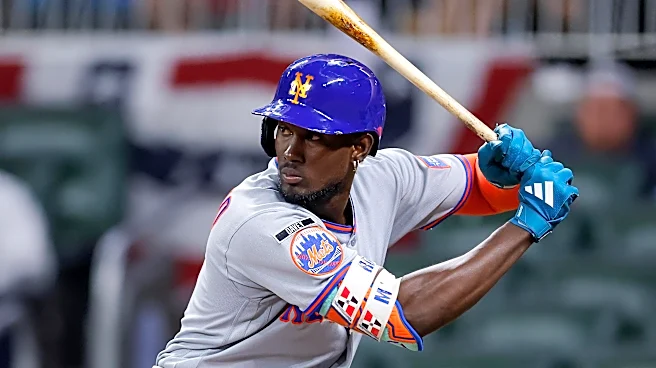


Ronny Mauricio
Week: 6 G, 25 AB, .320/.370/.840, 8 H, 1 2B, 0 3B, 4 HR, 1 BB, 2 K, 1/1 SB (Triple-A)
2026 Season: 29 G, 117 AB, .299/.341/.607, 35 H, 3 2B, 0 3B, 11 HR, 6 BB, 22 K, 8/9 SB, .282 BABIP (Triple-A) / 17 G, 50 AB, .180/.180/.260, 9 H, 1 2B, 0 3B, 1 HR, 0 BB, 18 K, 0/0 SB, .258 BABIP (MLB)
In 2023, his “breakout” season, Ronny Mauricio hit .292/.346/.506 in 116 games with the Syracuse Mets, logging 30 doubles, 3 triples, and 23 home runs, stealing 24 bases in 31 attempts and posting a 6.6% walk rate and a 18.2%
strikeout rate, all of which was good for a 106 wRC+. While plenty of individuals and outlets were leaping for joy about how great Mauricio’s season was and how great he was going to be- especially in the wake of the hot start he got off to in September 2023 after getting called up to Queens- the underlying red flags confirmed what we were saying all year and had noticed years prior: Mauricio was a dead-red fastball hitter and that’s really not a good thing. Against fastballs, he hit a healthy .348/.412/.591 with a 15.4% whiff rate, but against off-speed pitches, he hit a less impressive .260/.280/.384 with a 26.1% whiff rate and against breaking balls, he hit a lackluster .214/.254/.464 with a 36.4% whiff rate. There is some limited utility in that profile at the major league level to some degree, sure, but we would’ve optimally like Mauricio to be more than that.
In his 29 games in Triple-A this season, Ronny is hitting .295/.343/.656 against fastballs with a 23.3% whiff rate. Against off-speed pitches, he is hitting .211/.211/.368 with a 38.6% whiff rate, but surprisingly, against breaking balls, he is hitting a surprising .361/.410/.667 with a 31.5% whiff rate. Looking at his eight hits this week- three singles, a double, and four home runs- sure enough, 63% of those hits were on fastballs of one type or another. Looking at his five extra base hits, 80% were on fastballs of one type or another. Looking at his four home runs, 75% were on fastballs of one type or another.
Is this an actual positive, actionable change? Given that he struggled the most against breaking balls in his limited major league at-bats this season- he hit .050/.122/.050 against them with a 53.7% whiff rate, seeing some form of breaking ball or another 37.8% of the time- I am inclined to think not, but maybe there’s a spark of hope here. While it would be extremely depressing to say that here we are about three years later, and nothing really has changed, the hitting development infrastructure that the team has in place over the last few years hasn’t exactly been particularly encouraging. Numerous position players continuing to struggle with the same issues year-in and year-out doesn’t exactly inspire confidence. Mauricio morphing into a more complete player by overcoming his allergy to breaking balls would be great, but I’m going to be holding my breath for now.
Conner Ware
Week: 2 G (0 GS), 7.0 IP, 3 H, 0 R, 0 ER, 2 BB, 12 K (Single-A)
2026 Season: 17 G (10 GS), 61.2 IP, 50 H, 37 R, 29 ER (4.23 ERA), 32 BB, 76 K, .264 BABIP (High-A)
It’s not too often that non-starting pitchers get the Pitcher of the Week nod, and for most of the week, it was looking like Noah Hall was going to make it back-to-back wins after a strong performance earlier in the week that saw him throw a quality start and add 10 more punchouts to the Brooklyn Cyclones all-time strikeout record, which he set earlier this season. But Conner Ware did some yeoman’s work in relief on Sunday the 26th, adding to the solid outing he had on Tuesday the 21st where he threw three innings as an opener, and snatched Pitcher of the Week honors from Hall.
Ware was drafted by the Mets in the 15th round of the 2025 MLB Draft out of Louisiana State University. The left-hander spent his freshman and sophomore seasons at Pearl River Community College in Poplarville, Mississippi and then transferred to LSU for his junior season. He looked like a solid addition to the Tigers in the fall during inter-team scrimmages and early on in the season, but head coach Johnson did not trust him late in the season after repeated late-inning blowups. Ultimately, he ended up appearing in 16 games for the Tiger and posted a 5.48 ERA in 21.1 innings, allowing 13 hits, walking 18, and striking out 23. After being drafted, he was assigned the FCL Mets, but did not actually pitch.
The southpaw was assigned to the St. Lucie Mets to begin the 2026 season and has pitched there since. Ware has appeared in 17 games in total, making 10 starts, and has allowed 29 earned runs in 61.2 innings, good for a 4.23 ERA, while giving up 50 hits, walking 32, and striking out 76.
The 6’4”, 205-pound left-hander throws from a high-three-quarters arm slot with a medium arm action through the back. He hides the ball well with his leg lift, gets good extension off the mound, and attacks batters from a challenging angle, dropping and driving off the mound and lowering his release point. He had some fairly significant command issues at LSU, stemming from a failure to repeat his release point consistently and pitches that have a lot of natural movement to them, and while his command is still spotty, it is much better in comparison. The left-hander appears to have increased his stride length and raised his arm slot slightly this season as compared to last year.
At LSU, Ware was predominantly a two-pitch pitcher, relying on a four-seam fastball and slider; he occasionally threw a low-to-mid-80s changeup but did not trust the pitch much. The right-hander has refined his arsenal a bit and now throws a four-seam fastball, slider, curveball, cutter, and two different changeups, a mid-80s pitch and a slower low-80s split changeup. So far this season, he has thrown his fastball at a 36.5% rate, his cutter at a 30% rate, his curveball at a 15% rate, his slider at a 9% rate, his split-change at a 8% rate, and his changeup at about a 1.5% rate. A lot of Ware’s pitches are high variance, as I will explain below, and as such, some of these ratios may be off as one pitch gets misclassified as another.
Ware’s four-seam fastball is a below-average pitch in most regards. The pitch sits in the high-80s-to-low-90s, averaging 90 MPH this season and topping out at 94 MPH. The pitch has been extremely volatile in terms of spin rate, averaging but registering numbers anywhere between a well below-average 1,840 RPM and a well above-average 2,520 RPM. When the southpaw is able to get the seams spinning, the ball has above-average carry, registering as much as 18 inches of induced vertical break, but when it dips down into the lower end of that spectrum, it behaves more like a sinker, with more downward, arm-side movement as pitch is unable to resist the force of gravity as much. Because of its below-average characteristics, Single-A hitters have had few problems with the pitch, hitting .309/.467/.779 with an 18.8% whiff rate.
His cutter sits in the low-80s-to-high-80s, averaging 85 MPH this season. The pitch features average glove-side movement and has been an effective addition to his arsenal, with opposing batters hitting .241/.313/.431 against it with a 41.1% whiff rate.
Ware’s curveball sits in the low-70s-to-low-80s, averaging 78 MPH. It flashes well above-average spin rates, occasionally flirting with and/or exceeding 3,000 RPM, averaging 2,770 RPM, giving it sharp horizontal and vertical break; batters are hitting .184/.205/.289 against it this year with a 33.9% whiff rate. His slider sits in the low-70s-to-mid-80s, also flashing well above-average spin rates. Batters are hitting .071/.133/.286 against it with a 40.6% whiff rate.
The left-hander’s faster changeup sits in the low-to-mid-80s and features a spin rate between 1,500 RPM and 2,500 RPM. His split changeup sits in the high-70s-to-high-80s and features a spin rate between 1,260 RPM and 2,420 RPM. The faster changeup features more horizontal movement while his split changeup features more vertical drop. The two pitches have been mostly effective, but when his split changeup fails to fall off the table, batters are able to punish it; the pitch has the highest hit hard% of any of Ware’s offerings.
Consistency is Ware’s biggest area of opportunity. From release point to his command to the advanced metric properties of his individual pitches, there is a large window of variance that the left-hander needs to work in order to improve himself as a player.