

I think by now most understand the dangers of the dreaded 2nd apron. However, I’ll sheepishly admit that I may have missed the differences between the 1st apron and the luxury tax lines. Can you help clarify and provide some context to why the Celtics might be motivated to further cut salary this year (or not)?
The Celtics accomplished their first, and primary goal, this offseason when they got under the second apron. That had to happen to begin resetting the penalties from being over the second apron in previous
seasons (thawing out the frozen draft pick, not seeing a pick moved to the end of the first round, etc.). Now, the real question is if Boston wants to get out of the tax entirely.
There is no real benefit to getting under the first apron (Celtics are currently about $4M over the apron), minus freeing up a few restrictions that aren’t likely to matter much for the Celtics anyway. And, of course, lowering the luxury tax bill or eliminating it. And therein lies the idea of getting out of the tax entirely. As it stands today, Boston is a tax repeater team. That means that they get dinged at a higher tax rate than just being a regular tax team. Getting under the tax line (Celtics are currently about $12M over the tax threshold) would start the process of no longer being a tax repeater. That probably has some interest to Celtics ownership (and, by extension, the front office). But there are two important things to note:
- Like the second-apron penalties and restrictions, getting under the luxury tax line for one year isn’t enough to reset everything. To keep things simple: getting under the tax line this year and then again next season, would rest the tax repeater clock.
- This is the important one: Brad Stevens said there is no mandate from ownership to get under the tax line. That’s huge for this current season’s overachieving group, because it means they don’t need to shed talent simply for tax reasons. That means that any trades the Celtics make ahead of the trade deadline will be about basketball, not bank accounts.

Most people have assumed that the Celtics will be looking to trade Anfernee Simons this year. However, as you’ve pointed out, there’s a real chance that the team simply decides to hang onto him. Can you walk us through a few scenarios that the team might consider this offseason if he isn’t traded (let walk, re-sign, sign-and-trade)?
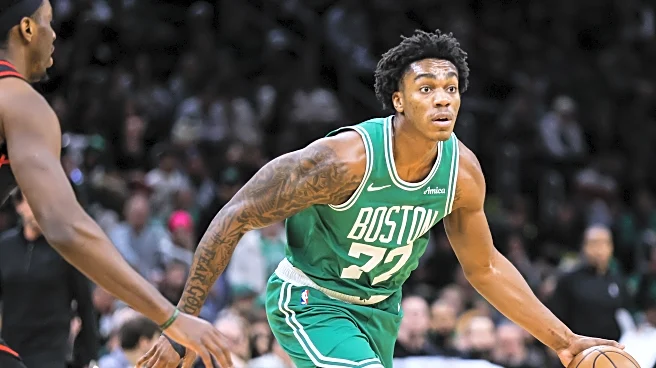
Anfernee Simons has played really well for Boston. While we’ve gotten all atwitter about Hugo Gonzalez’s ridiculous plus/minus stats, Simons has been nearly as impactful. The veteran combo guard has given the Celtics consistent scoring, ballhandling and playmaking. That’s been huge for Boston’s bench production.
Moving forward, if the Celtics keep Simons though the deadline, they’ve got all kinds of options. They can re-sign Simons, likely for a good amount less than the $27.7 million he makes this season. That will likely be impacted by the growth of the team’s younger players, as well as what things look like rotation-wise when Jayson Tatum returns to the lineup.
Boston could also let Simons walk. That would remove a big chunk of salary from the books and could possibly open up the projected $15.1 million Non-Taxpayer Mid-Level Exception. Having the full NTMLE would be a boon to finding a rotation piece to a team that looks poised to be right back in title contender status, assuming they aren’t still there already.
The last viable option would be to move Simons as part of a sign-and-trade. This one is a bit more difficult, as some of the teams who might want Simons could simply sign him outright in free agency using cap space. And acquiring a player via sign-and-trade hard-caps a team at the first apron. So, it’s a bit trickier to make work, but certainly a path Boston could go down, assuming Simons agrees. Let’s not forget that a sign-and-trade involves the “sign” portion first, which means the player still has the control here.

Put on your GM hat and give us your best (legal) trade ideas for the Celtics this season. I’d prefer to find some big man depth, but I’m open to anything that makes us better for the next few years.
We’ve worked together long enough that you know I don’t live in fantasyland when it comes to trade ideas. I tend to be a bit of a wet blanket when people start dreaming about acquiring superstars or three-, four- or more team trades.
That said, I do think Boston will do something. I think the general idea will be to improve the team this year, while adding helpful players (or movable future salary) for upcoming seasons. I don’t think any moves will be rest-of-season additions only, unless they are fairly minor end-of-bench types of transactions.
One of the ideas that has floated in my head all year is to trade Anfernee Simons to the Brooklyn Nets for Terance Mann. The Nets would use some of their $15 million in remaining cap space to bring in Simons, without taking on any long-term salary. Boston would get a ballhandler in Mann to replace Simons, albeit not nearly as good a shooter/scorer. And, crucially, Boston would bring $15.5 million in tradable salary onto the books for next season. Think of that is a pre-agency MLE addition, with the added benefit of being able to flip Mann in a future trade down the line. Do I think that will happen? Probably not. But that’s the kind of trade to be on the lookout for.
If you want frontcourt depth, the Celtics should have the ability to add someone without having to give up too much. Players like Nick Richards, Jalen Smith, Marvin Bagley III, and Drew Eubanks are all acquirable players without tripping back over the second apron. At the beginning of the season, adding a starter-level center would have been a goal, but Neemias Queta has more than held up as a starter. Could the Celtics upgrade over Queta? Sure. Do they desperate need to? Nope.

Are there any pet topics that you would like to help Celtics fans understand this year?
I’ll reiterate that Boston doesn’t have to get under the first apron or even get under the tax this year. That’s been a somewhat common misunderstanding I’ve seen from parts of the Celtics fanbase. If they do so, it’ll be something that happens vs being the primary motivation of a deal.
Boston has a huge $22.5 million TPE that they can use a chunk of at the deadline to make an unbalanced trade. They also have a good-sized $8.2 million TPE too. And then a couple of smaller TPEs too. Could they be used at the deadline? Sure. But I think they’ll probably hold those until the offseason. A reminder on TPEs: They can’t be combined with other TPEs or outgoing salary to bring in more salary than the TPE is worth by itself.
What are you working on next?
I appreciate the opportunity to plug some work I’m doing! Over on Spotrac, I’ve got a piece up about G League players to watch for 10 Day callups (the Celtics do have an open roster spot!) and for two-way movement. I also recently wrote about contracts that become fully guaranteed if the players aren’t waived by January 7. We have the best Trade Machine in the business, which people are using a LOT! As real trades happen, I’ll be writing up reaction pieces for the site. Every deal will be covered from blockbusters to salary-dumps!
In addition, if you like all the stuff we covered here, check out NBA Front Office Show on YouTube, or wherever you listen to podcasts. Trevor Lane (yeah, he’s a Lakers guy, but we make it work!) and I cover all the latest news and notes from the NBA with a focus on roster- and transaction-related topics. We have a lot of fun and try to be informative and educational as we break down all the latest around the Association.
Lastly, thanks for the opportunity to come “home” again and contribute to the best Celtics site there is! I wouldn’t be where I am without the time I spent at CelticsBlog, and I’m forever thankful for everyone on the team and the audience on the site. Go Celtics!