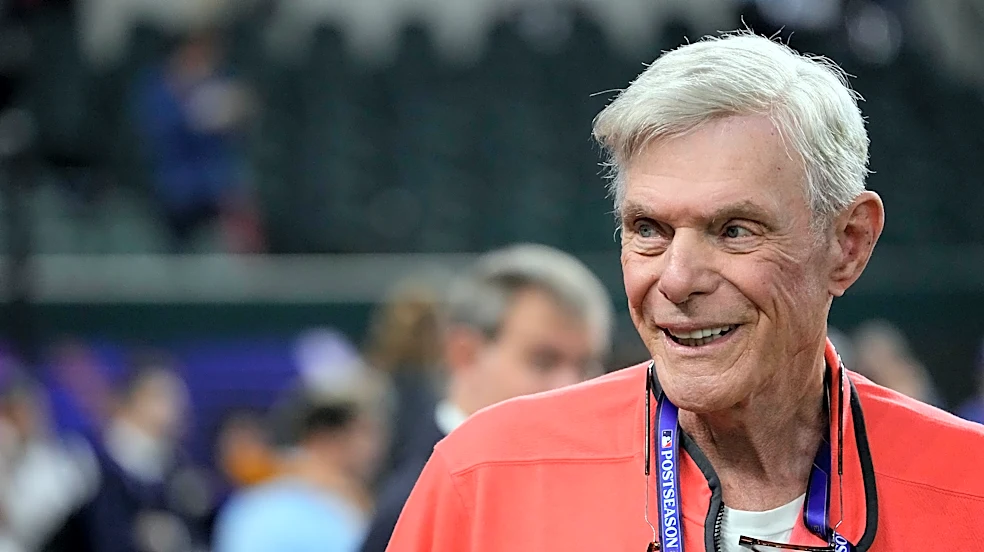


At this point, anytime there’s a post that features a photo of Ray Davis, it doesn’t bode well, does it?
I’ve kind of put off doing this, because I don’t want to think about the Texas Rangers’ payroll situation for 2027, or their budget, or the looming lockout, with Rangers owner Ray Davis reportedly being one of the salary cap hawks on the ownership side.
That being said, we are going to take a look at the Rangers’ current payroll situation this morning. As always, Cot’s Contracts is our invaluable
source for most of this information.
As a sidenote…the past few seasons, when we have done this exercise, we have looked at both the actual payroll and the payroll for luxury tax purposes, in order to get a handle on where the Rangers are relative to the luxury tax thresholds. Given that the organization has made it clear that ownership is not going to spend close to the current luxury tax levels,* there’s no reason to deal with that.
* With the CBA expiring, we don’t know what the luxury tax threshold will be in 2027, or even if there will be a luxury tax anymore. However, if the luxury tax threshold moved up at the same rate it did throughout the expiring CBA, teams with over $247M in luxury tax payrolls in 2027 would pay the luxury tax. Each team pays roughly $20M in player benefits and the pre-arb bonus pool, so that would mean a team could get to approximately $227M in player payroll without paying the tax, in that scenario.
Texas currently has five players under contract for the 2027 season:
Jacob deGrom — $37,000,000
Corey Seager — $31,500,000
Nathan Eovaldi — $24,000,000
Brandon Nimmo — $20,500,000
Danny Jansen — $8,000,000
In addition, the Rangers have $1M due to Kyle Higashioka to buy out his mutual option for 2027, and $1.25M due to Jakob Junis to buy out his mutual option for 2027.* There’s a mutual option with Joc Pederson, as well, but no buyout.
* Mutual options are almost never picked up, since a club is either going to decline the option as being more than they are willing to pay, or a player is going to decline the option because they think they can do better on the open market, or at least want to explore their options.
Those commitments total $123.25M.
The Rangers also have ten players who are arbitration-eligible for 2027. Those ten players, along with their projected arbitration salaries in 2027 (per MLB Trade Rumors), are as follows:
MacKenzie Gore — $8,700,000
Jake Burger — $6,900,000
Josh Jung — $5,200,000
Ezequiel Duran — $4,000,000
Wyatt Langford — $3,300,000
Logan O’Hoppe — $3,100,000
Jacob Latz — $3,000,000
Evan Carter — $1,700,000
Cody Bradford — $1,300,000
Robert Garcia — $1,100,000
In looking at this list, there are only two players who I see as being potential non-tenders — Jake Burger and Logan O’Hoppe.
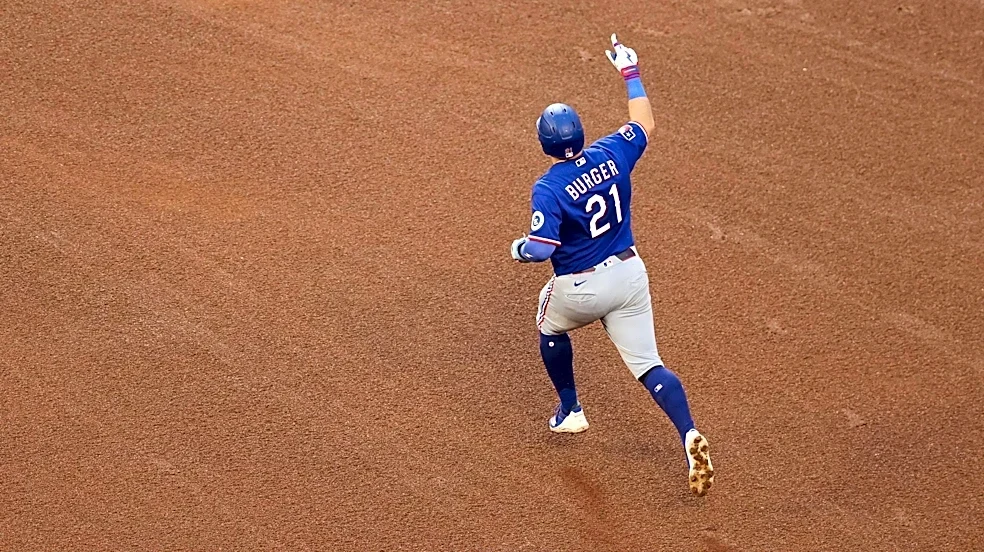
The Rangers got Burger two offseasons ago for three prospects who the team doesn’t miss (and who don’t appear in the current BA Marlins top 30 list), and he’s given the team two cheap seasons of middling performance at first base. $6.9M is in the ballpark of what middling first basemen cost on the open market — it does not, at first blush, appear to be the sort of discount against market value you hope to capture with players in their arbitration years.
Complicating things for Burger is that Sebastian Walcott is knocking on the door. Were it not for his elbow injury, which cost him most of 2026, Walcott may have already kicked the door down and staked a claim for a major league job. Still, his strong performance over the final couple of months, when he returned to action (though primarily at DH), as well as his Arizona Fall League performance, would suggest he may be a viable option for an infield job in the majors in 2027.
The Rangers could move Josh Jung — who graded out as below average defensively in 2026, and has been underwhelming with the glove the past three years — to first base, opening up the third base position. The hope, I imagine, would be for Walcott to earn the spot in spring training, with Cody Freeman, Justin Foscue (who would be at second base, pushing Ezequiel Duran to third base), and an NRI or two also vying for the job.
That would theoretically make Jake Burger expendable. Of course, the Rangers still don’t have a DH, and we all know about the durability concerns with Jung, so a team that isn’t pinching pennies might see Burger as having value as the DH and backup first baseman.
My guess is that the Rangers look to sign Burger to a modest raise from the $3.2M he made in 2026 — say, $4.5 to $5M — and let him know he’ll be non-tendered at the November 20 contract tender deadline if he doesn’t agree. It would make for a difficult decision for Burger, who is old for an arb-eligible player (he turns 31 in April), has a skill set and profile that doesn’t tend to be financially rewarded by the market, and who would be on the market for less than two weeks before the lockout hits.
As for O’Hoppe, the Rangers got him from the Angels, along with Chase Silseth, for little other than taking on his salary (which was offset by the Rangers dumping Josh Smith and his salary in the subsequent deal with the Jays, and if you’re curious, MLBTR projects Smith as getting $3.875M in arbitration this year). The DMN reported just this past week that they view him as a long-term project on defense, which would suggest that they are interested in keeping him around and working with him. Given the lack of catching depth in the upper levels, keeping O’Hoppe around, even as a third catcher who you can option to the minors, would make sense, if you think the defense is salvageable.
O’Hoppe made $2.63 million in 2026. My guess is that the Rangers do with O’Hoppe what I am guessing they do with Burger, offering him around $2.5 million — perhaps on a split contract — and non-tendering him if he doesn’t accept. Catchers are always in demand, but with the concerns about O’Hoppe’s receiving, I don’t know what the market for him would be like, and he could end up landing in the pile of fungible veteran catchers who get NRIs every spring.
To head off any comments about Gore being a non-tender candidate, he’s made 96 starts over the past three seasons, is lefthanded, and has quality stuff. He’d get more than one year at $8-9 million if he were a free agent. And that’s without even getting into the fact that the Rangers traded five prospects for him last offseason, and non-tendering him would be an admission of failure that I don’t think the front office wants to make.
So let’s assume that the Rangers keep all ten of their arb-eligible players, at the MLBTR projected salaries, except for Burger and O’Hoppe, who we would slot in at $5M and $2.5M, respectively.
That would put us at $159.05M for 2027 payroll. Add in roughly $12M for the rest of your pre-arbitration players rounding out the active roster and the 40 man roster, and that’s a $171.05M payroll
To put this in perspective, Cot’s has the Rangers’ 2026 year-end payroll at $191.7M. So if the Rangers were to keep payroll static, they’d have $20 million to spend this offseason.
That is not a lot.
On the other hand, the lineup and starting rotation don’t have a lot of holes right now. You’re bringing back all your starters in the lineup except for Pederson at DH, though if you are moving Jung to first base and Burger to DH, that problem is solved.
You probably want a righthanded hitting outfielder who can play center field to either platoon with Evan Carter, or push him to the bench if he continues not to hit, though they could opt to put Duran in the outfield — at least against lefties — and use Justin Foscue or Cody Freeman at DH. Or, hell, they could let Burger go and put Foscue at DH, now that I think about it.
And you also need a backup catcher, unless you decide you’re confident in O’Hoppe, though if they have Jansen and O’Hoppe and feel like O’Hoppe is a potentially viable backup option, they could just go with some veteran NRIs and, if O’Hoppe doesn’t have the Chopp-es behind the plate in Surprise, have one of them back up Jansen.
The rotation currently features deGrom, Eovaldi, Gore, Jack Leiter, Kumar Rocker, and Cody Bradford. The latter three all have questions and concerns, but overall, I don’t see the Rangers spending money on adding starting pitching. There will be your usual collection of NRIs brought in as depth, of course, but I can’t see the Rangers going out and spending money to add a middling innings eater, given where things stand now.
The bullpen, of course, is the bullpen, and once again, the Rangers will be going out into the market to get cheap, functional arms. That said, they are bringing back Garcia, Silseth, Jacob Latz, and Peyton Gray, which would represent half of their projected Opening Day bullpen. Young, Fenstermaker & Co. will probably need to add three or four relievers, and will likely do it, as they have the previous couple of seasons, on the cheap.
So if the Rangers are looking at a 2027 payroll in line with what they had in 2026, they don’t have a lot to spend, but would be able to fill the holes.
The problem, of course, is that the Rangers don’t have the financial resources to make any real upgrades or improvements to the roster in this scenario. They’d essentially be running it back — something that the front office seems to have signaled they don’t want to do. If they want to upgrade a spot, they’d likely need to increase payroll from 2026, make a trade that would cost prospects and/or current major league pieces, or move one of the four veterans with large salaries in an effort to re-allocate those funds elsewhere.
Its a conundrum. And its made all the more difficult by the pending lockout, and the uncertainty of the future financial landscape with a new CBA.