
As we saw when the Angels had literally Shohei Ohtani and Mike Trout at the same time and couldn’t sniff the playoffs, you need more than just a couple stars to make a good roster in baseball.
The “Murderers’ Row” Yankees of the 1920s and ‘30s are a good example. Yes, they had the likes of Babe Ruth and Lou Gehrig, and without those two, those teams would’ve gone nowhere. However, if it was just those two with a roster of below average players everywhere else, those teams might not have won a World
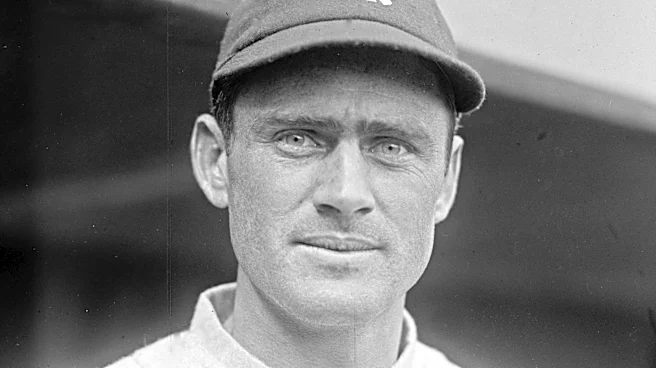
Series, never mind be historically notable. One of the other good players who played on those great Yankees teams of the ‘20s and ‘30s was Earle Combs. Today happens to be his birthday, so let’s look back on the life and times of “The Kentucky Colonel.”
Earle Bryan Combs
Born: May 14, 1899 (Pebworth, KY)
Died: July 21. 1976 (Richmond, KY)
Yankees Tenure: 1924-35
As that nickname might suggest, Combs was born and raised in Kentucky, and basically lived his entire life there apart from his baseball career. He grew up working on his family’s farm, but eventually decided to attend Eastern Kentucky University to study to be a school teacher. He played on several of the college’s sports teams, including baseball, where he was a star. After graduating, he did follow through on becoming a teacher, but eventually the pull of baseball, including the money that came with it, became too much to ignore.
Combs first signed with the local Louisville Colonels, where he was managed by his future Yankees skipper Joe McCarthy. Combs quickly locked down the center field role for Louisville and became a star, hitting .380 in his second season. That season led to the Yankees purchasing him ahead of the 1924 season.
In Louisville, Combs had been not only an excellent hitter but a dangerous base-stealer. Upon getting to New York, Miller Huggins had him tone down that aspect, as Combs would be tasked with hitting in front of Ruth and a strong Yankees’ lineup. With Combs’ on-base ability, that ended up allowing him to become the perfect lead-off hitter for the Yankees’ Murderers’ Row era.
Over the course of a 12-year career with the Yankees, Combs hit .325/.397/.462, which equated to a career 125 OPS+. He was extremely adept at getting on base ahead of he likes of Ruth and Gehrig, as he was skilled at both getting hits and walking. Even with all the stars that littered the 1927 Yankees, it was Combs who ended up recording a league-leading 231 hits that season. In addition, Combs could still use his speed even without stealing bases. He recorded 154 triples in his career, and led the league on three occasions.
Over the course of his 12 seasons in the majors, Combs would be part of three World Series championship teams with the Yankees: 1927, ‘28, and ‘32. Combs performed especially well in the third of those, as he OPSed 1.125 in the sweep of the Cubs in ‘32.
In addition to his remarkable career on the field, Combs was also regarded as one of the best human beings in baseball in his era. He was also a fan favorite in the Bronx, and some fans even apparently once took up a collection to buy him a gold watch. That’s something that won’t — and shouldn’t to be real — happen in today’s game.
Combs remained a very solid player to the Yankees until 1934. He was on pace for another good year that season, but he suffered a fractured skull after crashing into an outfield wall trying to make a catch. There were briefly fears for his life after the accident, but Combs eventually recovered in time to return to the Yankees for 1935. However, he dealt with further — not as serious — injuries that year. He was limited to just 89 games and didn’t play to his previous level. At that point, Combs was 36 years old, and the Yankees had also signed a young center fielder named Joe DiMaggio. Sensing that the writing was on the wall, Combs retired after 1935.
After retiring as a player, Combs joined the Yankees as a coach, where he was credited with helping DiMaggio learn how to play center field at Yankee Stadium. Combs would also spend time on the coaching staffs of the St. Louis Browns, Red Sox, and Phillies before leaving baseball for good and returning to his Kentucky farm.
In 1970, Combs was voted into the Hall of Fame via the Veterans Committee. He’s considered a bit of a reach in retrospect, although the Veterans Committee still makes plenty of those choices today. Combs himself was surprised by his induction, saying “I thought the Hall of Fame was for superstars, not just average players like me.” He was a bit unfair to himself, there, as he was definitely not “average.”
Combs eventually passed away in 1976 at the age of 77. He was never as famous or as good as the likes of Babe Ruth or Lou Gehrig, but if you look ever look back at the play-by-play data of Yankees’ games of those era, chances are good that he was the one scoring on their hits.
See more of the “Yankees Birthday of the Day” series here.