






From now until preseason camp starts in August, Land-Grant Holy Land will be writing articles around a different theme every week. This week is all about Ohio State heroes, from the biggest names in Buckeye athletic history to underappreciated icons to the athletes who will eventually become all-time Buckeye greats. You can catch up on all of the Theme Week content here and all of our ”Buckeye Heroes” articles here.
Sometimes, athletes don’t get the flowers they deserve for what they do when they are
either playing college sports or when they move on to the professional level. Ohio State has some players who are beloved for what they did in the scarlet and gray. Archie Griffin, Eddie George, and Chris Spielman are Buckeyes of the past who many fans speak of fondly, while Jeremiah Smith is well on his way to being the most popular wide receiver in school history.
Then there are players who put their bodies on the line and helped Ohio State do some great things, but they don’t quite get recognized when people are talking about the great Buckeyes. Sometimes there are some off-the-field issues that prevent players from truly completing their careers, other times injuries hamper production, and then there are times where an athlete doesn’t quite connect with fans even though they put up big numbers.
Today, we are going to look at which Ohio State players have been overlooked to some extent, which has kept them out of the conversation for when it comes to Buckeye heroes. Who do you think hasn’t gotten proper recognition? While the minds of most fans immediately go to football, answers don’t strictly have to be football players for this exercise. Maybe there is a Buckeye basketball player who gets lost in the mix when it comes to talk of the greats to play in Columbus. No Ohio State sport is off limits for this topic.
Today’s question: Who is the most unheralded Ohio State hero?
We’d love to hear your choices. Either respond to us on Twitter at @Landgrant33 or leave your choice in the comments.
Brett’s answer: Terrelle Pryor
Imagine rewinding time about 20 years to just after Terrelle Pryor committed to Ohio State, and tell yourself he would barely be talked about when it comes to great Buckeye quarterbacks. Pryor was the top quarterback in the 2008 recruiting class, and had he not decided to play football, he would have had a bunch of offers from Division I programs to play basketball. At the time, after losing in the BCS National Championship Game the previous two seasons, it felt like a national title was inevitable with Pryor taking the snaps.
As a freshman, Pryor went 8-1 as a starter after he replaced Todd Boeckman following a blowout loss at USC. In 2009, Ohio State posted an 11-2 record after losing to USC and Purdue during the regular season. Pryor threw for over 2,000 yards and rushed for nearly 800 yards as a sophomore, totaling 25 touchdowns. Then, in his junior season, the only loss the Buckeyes suffered was at Wisconsin. It was obvious Pryor was improving as a passer, tossing 27 touchdowns and completing 65% of his passes.

Before the Sugar Bowl at the end of his junior season, Pryor and four others were suspended for the first five games of the 2011 season because of “Tatgate.” At the time, selling memorabilia was a big no-no in the eyes of the NCAA, where today it wouldn’t even be given a second thought because of NIL. Had Pryor played his college football in 2025 instead of 2010, he would have been an absolute legend at Ohio State. Plus, imagine Pryor in Ryan Day’s offense working with receivers like Jeremiah Smith and Carnell Tate.
Just look at what Pryor did in three seasons at Ohio State. He only lost four of the 35 games he started, won both the Rose Bowl and Sugar Bowl, and won all three of his games against Michigan. Had Pryor gotten a full senior year, it’s likely he would have been a first-round draft pick. Instead, he was taken in the supplemental draft, and he never seemed to get his feet under him playing for a bad Oakland Raiders team. Pryor actually made more noise as a wide receiver in the NFL, posting a 1,000-yard season for Cleveland in 2016.
Some of the reasons Pryor isn’t often mentioned when it comes to great Buckeye quarterbacks is recency bias since Dwayne Haskins, Justin Fields, and C.J. Stroud all went on to be first-round NFL picks. It’s hard to be too mad at Pryor for “Tatgate” since he was just ahead of his time, doing things that were illegal then but now are commonly accepted. Since then, Ohio State has gone on to win two national titles, so it’s not like they were given some sort of death penalty. Pryor deserves to be given recognition for what he did as a Buckeye.
Matt’s answer: Mal Whitfield
There are some Buckeye legends whose names are impossible to escape: Archie. Jesse. Jack. Troy. Eddie. Chic. Katie. And then there are the heroes who drift just far enough out of the spotlight that even passionate Ohio State fans only vaguely recognize their names, despite their stories being every bit as impactful as the legends we celebrate regularly.
That is exactly where Mal Whitfield lives. If you were asked to define what would make someone a Buckeye hero, then Whitfield would have it all: athletic greatness, historical significance, personal perseverance, global impact, and a decades-long legacy.
Whitfield was what you want every person who represents your university to be; not only was he one of the greatest athletes in Ohio State history, but he lived one of the most remarkable lives of anyone to ever don the scarlet and gray. However, outside of hardcore track historians or older Buckeye fans, his story is rarely discussed with the same reverence reserved for some of the university’s more visible icons.
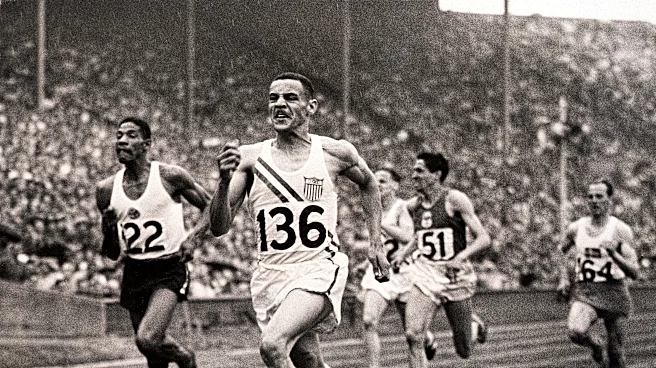
Before he became an Olympic legend — winning three golds, a silver, and a bronze — he already qualified for the honor of hero. During World War II, he served as a Tuskegee Airman and continued to serve in the Korean War, flying 27 combat missions as a tail gunner. Whitfield served in a segregated military during one of the most racially turbulent times in our country’s history, and won NCAA and Olympic titles in between.
Following WWII, Whitfield came to Ohio State and ran track under the legendary (and also heroic) Larry Snyder. As a Buckeye, he won the NCAA’s 800 meters in 1948 and 880 yards in 1949. His years in Columbus also happened to coincide with his first Olympic gold medals. Whitfield won gold in the 800 and 4×400 relay in London in 1948, added a bronze in the 400, then returned four years later to defend his Olympic title in the 800 — becoming the first man ever to do so — while also taking the 4×400 silver at Helsinki in 1952.
That alone should make Mal Whitfield someone far more revered in Buckeye history than he currently is, but his post-athletic life is just as inspiring. After his athletic career, Whitfield worked for the United States Department of State and the United States Information Service, serving as a sports ambassador and diplomat in Africa. He helped develop track and field programs in newly independent African nations during the Cold War era and played a meaningful role in growing international athletics throughout the continent.
During his time in Africa, not only did he coach and consult with dozens of athletes who would go on to represent their countries in the Olympics and other competitions, but he also arranged athletic scholarships for over 5,000 African athletes to study in the United States.
His work around the globe was singled out by both Presidents Ronald Reagan and George H.W. Bush. And yet if you asked the average Ohio State fan under 40 to identify him, there is a decent chance they either couldn’t or would only vaguely know the name.
Ohio State rightfully celebrates Jesse Owens as one of the most important figures in both university and Olympic history because his accomplishments transcended sports and intersected with world events in ways that continue to carry immense cultural significance. Whitfield deserves to be discussed far closer to Owens in the pantheon of Ohio State historical figures than he currently is.
No, he is not Owens — few people in sports history are — but few Buckeyes have ever used their athletic platform as directly and extensively to improve other people’s lives as Whitfield did. He was not only one of the best athletes in the world, but he also used his love of sports to help thousands of athletes better their lives through track, and untold more by the expanse of his efforts.
Unlike some sports heroes who we rightfully honor for their three or four years as a Buckeye, Whitfield’s legacy is not built around a single iconic play, a famous rivalry moment, or even just his time as an athlete. It is built around a life that reminds you that while sports in and of themselves are important, what they can do as a launching point for something greater and far more personal is where true impact comes from.
Mal Whitfield died in 2015 at the age of 91 and is buried at Arlington National Cemetery. Ohio State has produced countless great athletes and has even produced a number of true historical figures; Mal Whitfield was both.