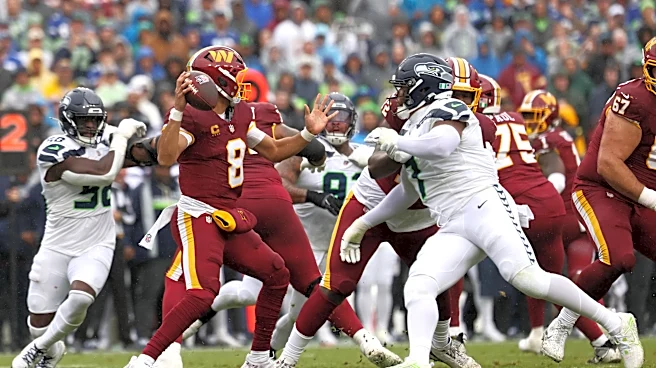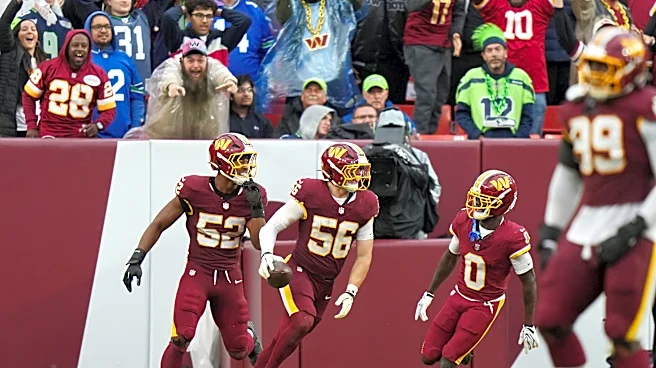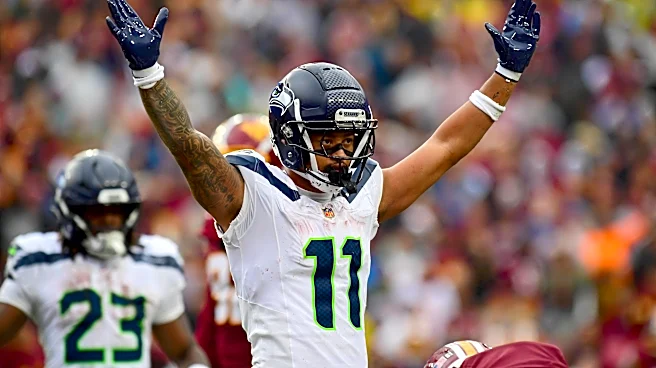

The Seattle Seahawks entered Week 3 after two wins to open the season, but the Washington Commanders exposed some of the problems that had been hidden during those first two weeks.
The Seahawks still moved the ball well (only in the air), finishing with 437 total yards and 28 first downs while averaging 6.8 yards per play. Sam Darnold threw for 379 yards and four touchdowns, while Jaxon Smith-Njigba continued his ridiculous start to the season with 10 catches for 128 yards and two touchdowns.
But none
of that was enough in the end.
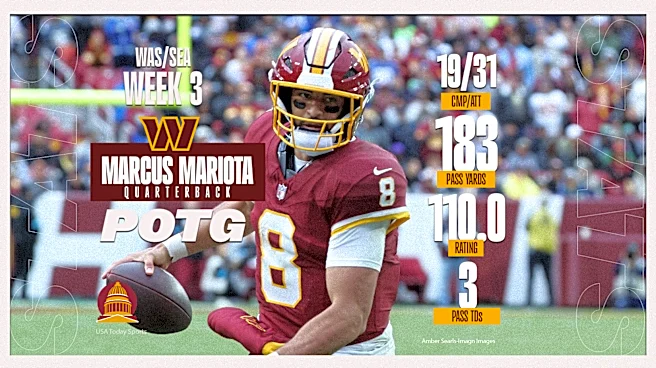
Seattle turned the ball over three times, with those mistakes producing 21 points for Washington. The Seahawks also struggled badly to run the ball, gave up several critical plays on defense and once again had issues on special teams. The Commanders finished with just 258 total yards, but Marcus Mariota and Washington’s offense made enough plays late to escape with a 33-31 win.
So, for the first time this season, let’s take a look at what worked and what went wrong in a loss.
The Bad
The run game was completely neutralized
There is plenty of blame to go around here.
Seattle finished with just 44 rushing yards on 18 attempts, a miserable 2.4 yards per carry. The offensive line struggled to create movement consistently, the running backs didn’t always find the available lanes, and the play-calling didn’t do enough to manufacture positive runs.
Here’s a clear example of one of the many mistakes along the offensive line. This is an outside zone run to the right, and Grey Zabel is supposed to execute a reach block on the 1-technique defender. It’s a difficult block, but a crucial one for the concept, and Zabel has already executed it brilliantly several times this season. He loses the block here, forcing the running back to bounce outside, where he runs directly into the defender who beat Abe Lucas for a four-yard loss. I’m not sure if Lucas was expecting help from AJ Barner before the tight end worked to his block, but the angle is poor and Lucas can’t recover.
We saw plenty of mistakes like this throughout the game. It was a recurring theme: two offensive linemen would execute their blocks well, while someone else would miss his assignment and turn the play into a significant loss.
The running back situation was also a factor. Price fumbled and, rightfully so, he was put in the doghouse afterward. However, Seattle needs to find a way to get its first-round running back on the field, and the running back also needs to stop putting the ball on the ground.
As mentioned, the offensive line’s work in the running game was extremely inconsistent. But Emanuel Wilson deserves some blame as well. He incorrectly decides to bounce this run outside when he should be hitting the inside gap created by Christian Haynes. It’s a simple read and one that is much more suited to his skill set. Wilson isn’t an explosive back; he’s a north-south runner.
Here’s a Price snap that really highlights the difference in explosiveness. Watch how much quicker he gets through the cut and how quickly he is able to turn the corner. On the same run concept where Wilson lost yardage, Price probably would have been able to get something out of it.
Another example of Wilson choosing to bounce outside and lacking the explosiveness and speed to make it work. I believe Price scores a touchdown on this play, but he was standing on the sideline in a jacket watching it happen.
The passing game was good enough to keep the offense moving, but Seattle can’t expect to throw for nearly 400 yards every week to compensate for a running game that produces almost nothing, especially against better defenses.
The coverage was strangely out of sync
This was probably the most concerning part of the defensive performance.
Seattle allowed just 258 total yards, 4.0 yards per play and 2.6 yards per rushing attempt. On paper, that’s a pretty good defensive performance.
The problem was when the mistakes happened.
There were several instances of poorly executed zone coverage and communication issues that allowed Washington to create explosive plays when they mattered most. The Seahawks looked much less precise than they had during the first two weeks.
There was some kind of rotation mistake here. I believe Devon Witherspoon thought this would be a play where he would become the RANGER, rotating down to the deep safety position. But given the movement from the rest of the secondary, I’m inclined to believe this was his mistake, leaving Terry McLaurin wide open on third down for the conversion.
This play shows the space between Seattle’s zones. That doesn’t give the pass rush enough time to get home and makes life much easier for the backup quarterback, who is constantly getting simple reads and quick throws.
Josh Jobe was particularly terrible. He has now allowed a touchdown in each of the last two games, with Terry McLaurin getting behind him for a 30-yard touchdown in this one.
And I’m not going to fall into the trap of believing we’re back in 2022: McLaurin finished with 77 receiving yards on six catches and nine targets, but Seattle still allowed him to make several important receptions, including the touchdown.
Jobe’s successful snaps usually come when he is able to establish his press technique. Once he loses at the line of scrimmage, as he does here, it’s basically impossible for him to recover.
The problem isn’t that Seattle suddenly became a bad defense. The numbers show the opposite. The issue is that the unit made a handful of mistakes in high-leverage situations, and Washington turned those mistakes into points.
The turnovers were devastating
This was the biggest difference between the two teams.
Seattle had three turnovers. If you include the turnover on downs, that’s four possessions ending in a turnover. Washington had zero. Those three actual turnovers, against a team that had yet to force one coming into the game, produced 21 points for Washington.
Darnold deserves credit for how he responded after the pick-six. Instead of collapsing, he immediately led a 68-yard touchdown drive in just 1:06, finding Cooper Kupp to put Seattle back ahead 33-31.
But that doesn’t erase the larger problem. Darnold already had turnover issues last season, and Seattle can’t afford to give opponents short fields and points while also struggling to run the football.
This is where the nonexistent running game comes into play. Watch how the EDGE, Odafe Oweh (No. 98), never even respects the run and immediately attacks Darnold. As the QB finishes the boot action, he has Kupp open. It wouldn’t be an easy throw, but Darnold has made more difficult throws already. The conservative choice was to throw the ball away and live for the next snap. Instead, Darnold makes the mistake and is intercepted.
It’s also worth mentioning that penalties played a role here. Seattle had already committed a penalty on first down, and after an incompletion on a deep shot to Shaheed, Seattle was facing second-and-15. In other words, the playbook was already more limited. Again, Seattle needs to clean up these execution mistakes.
On this play, Darnold decides to leave the pocket, and for a few moments he has George Holani open in the end zone. The quarterback never sees him, tries to extend the play, and it ultimately ends in a turnover on downs.
Special teams are becoming a problem
Seattle’s special teams unit had another rough afternoon, particularly when it came to field position.
Washington started just four of its 13 drives inside its own 30-yard line. That’s a huge advantage for an offense that otherwise produced only 258 total yards.
The kickoff coverage issues are especially concerning. Seattle has now allowed five kickoff returns of 30 or more yards on just 11 returns this season. They allowed eight such returns over the entirety of last season.
The Seahawks are currently allowing 30.1 yards per kickoff return, one of the worst marks in the NFL after three weeks and a stark contrast to the dominant unit we saw last year.
The Good
Jaxon Smith-Njigba is ridiculous
There isn’t much more to say about JSN that hasn’t already been said. He caught 10 passes for 128 yards and two touchdowns against Washington, continuing an absurd start to the 2026 season.
The most encouraging part is that this isn’t just a matter of volume. Seattle continues to find different ways to move him around the formation, create favorable matchups and get the ball into his hands in space.
Three weeks into the season, Smith-Njigba has already established himself as the focal point of this passing game. And considering the amount of attention defenses are going to have to give him, that should continue creating opportunities for Kupp, Shaheed, Horton and the rest of the receiving corps.
Rollout to the right, with JSN threatening a fade route. As soon as the corner positions himself to defend it, JSN works back toward the pylon, creating the separation he needs to score the touchdown.
Another touchdown where JSN deserves a lot of credit for the route. The Seahawks call a double post, with Elijah Arroyo occupying the safety. JSN again threatens the outside shoulder of the defensive back, and as soon as the defender commits, he makes a surgical cut at exactly the right moment to get open and score his second touchdown of the game.
The fact that Seattle kept going to JSN snap after snap eventually forced the defense into a mistake, and he occupies three defenders while Cooper Kupp is left wide open for the team’s touchdown immediately after the pick-six.
Brian Fleury did a good job with the passing game
Despite the loss, it’s difficult to criticize what Seattle’s passing game was able to produce.
The Seahawks finished with 393 passing yards, 8.5 yards per attempt and four passing touchdowns. Add the 44 rushing yards and Seattle finished with 437 total yards. The offense consistently moved the chains and finished with 28 first downs.
Brian Fleury deserves credit for that.
Here, he dials up a creative concept. The play initially looks like it will be a screen to JSN, but Seattle threatens a deep throw to AJ Barner, whose post route carries the defense toward the middle of the field. JSN then works back toward George Holani, who has plenty of open grass in front of him. Christian Haynes and Jalen Sundell do a good job working downfield but make mistakes.
First, they allow the first defender through, although Holani manages to escape. Then they are in position to block No. 0 and No. 35, which would have given Holani even more room to run.
The offense continues to use play-action, intermediate routes and formations designed to create space for its receivers. Here, the fake handoff is executed very well and is supported by the pulls from Zabel and Brady Russell. JSN’s route creates space for Cooper Kupp, who starts the play as a blocker before releasing into the route and picking up a nice gain.
The problem wasn’t Seattle’s inability to move the ball. It was the lack of support from the running game and another turnover on downs inside the red zone. Seattle is going to have to spend this week figuring out how to fix the running game because the last OC who needed his quarterback throwing 40-50 times a game didn’t exactly have a great ending…
The defense wasn’t nearly as bad as the score suggests
It’s important not to look at the 33 points and conclude that Seattle’s defense was terrible. Yes, it’s pretty concerning to give up nearly as many points as the team had allowed combined over the first two weeks, especially against a team playing its backup quarterback.
However, Washington gained just 258 total yards and averaged 4.0 yards per play. The Seahawks held the Commanders to 2.6 yards per rushing attempt, and Washington converted just three of 13 third downs.
The problem is that two of those conversions came on Washington’s final drive. First, Washington converted a third-and-9 with a 19-yard Mariota run. Then Mariota converted a third-and-7 with another rushing play, allowing the Commanders to walk away with the win.
The Commanders had already run away from Seattle’s crowded looks earlier in the game, looking to attack the edge rather than the middle of the defense. They find success here with the pull on Drake Thomas. And notice how this is a game of inches: Leonard Williams practically has the running back in his hands. If he finishes that tackle, this game could have been completely different.
But let’s get back to the positives from the defense…
How about Ernest Jones saving the gain by Mariota?! Incredible awareness from Jones to avoid getting locked onto his receiver, recognize what is happening and make a huge tackle.
Here, the Commanders line up in trips and play right into Seattle’s rules, leaving a wide receiver one-on-one against Ernest Jones. I believe Rodney Thomas should be a little closer to the opposite hash. He takes a moment to recognize what’s happening, and that makes the decision easy for Mariota with a linebacker-versus-receiver matchup. Ernest Jones makes an incredible play at the last possible second to get a hand on the ball.
It’s also worth highlighting how well Byron Murphy has played against the run. Again, look at his drop-knee technique and how quickly he explodes downhill to make the tackle. This is becoming a recurring thing, and it makes running through the middle of Seattle’s defense almost impossible.
Final Thoughts
This loss hurts, especially because the schedule isn’t getting any easier and Seattle just dropped a game that looked extremely manageable. At the same time, context matters: the Seahawks are still 2-1, just put up 437 total yards and 31 points, and the defense, despite its decisive mistakes, allowed only 258 total yards.
The problem is that several of the things that made Seattle look so dominant during the first two weeks showed up for the first time as vulnerabilities: the running game was completely neutralized, turnovers exploded, the defense had communication issues, special teams continued to hurt field position, and the team made some questionable decisions late in the game. Those are exactly the kinds of issues that need to be studied because better opponents will certainly try to reproduce them.
This isn’t the sky falling; not even close. But it is a massive warning. Seattle didn’t lose because Washington dominated them; they lost because they made enough mistakes to allow an opponent that finished with 179 fewer total yards to win the game. Now, the response to this loss will be much more important than the loss itself. The Seahawks need to fix the running game, clean up the turnovers, improve special teams and recover the defensive precision that made this unit so difficult to play against. If they do, Week 3 can end up being remembered as nothing more than a stumble. If they don’t, the problems exposed in Washington could become a pattern — especially with a difficult stretch of the schedule ahead.
Go Hawks!