
Pitching, defense, and three-run homers. It was legendary Orioles manager Earl Weaver’s recipe for success during the Birds’ dominant runs of the 1960s and 70s. It’s a simple rule of thumb, but those three components
aren’t always so easy to replicate.
The 2026 Orioles might have the pitching. They’re banking on the homers. But the defense? Ehh…
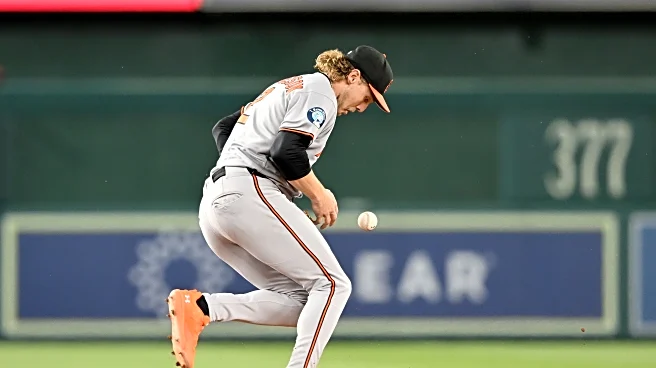
With the Orioles’ position-player group all but finalized, this is not a team that figures to excel with the leather. And that may be putting it mildly. As things stand now, the O’s might have below-average to downright bad fielders at two-thirds of their defensive positions.
The outfield is shaping up to be particularly dicey. In center field, the most important defensive position on the grass, the O’s are rolling the dice with Colton Cowser, who took over the spot after the Cedric Mullins trade last year. In his young career, Cowser generally has been a quality defender — as a corner outfielder. But center field is a different beast, requiring more range and speed, and it remains to be seen if Cowser has the aptitude to cover that kind of ground on an everyday basis. Cowser has a career -5 Defensive Runs Saved in 791 innings in center field, compared to +7 in left field, his usual position. There’s a real risk that he’ll be overexposed in regular duty in center.
That risk could be mitigated if Cowser had solid defenders on either side of him. He very much does not. Left field belongs to new acquisition Taylor Ward, a former minor league catcher who later shuffled to third base and center field before finally settling in left. All 294 of his defensive games in the last two seasons have come at that spot. In 2024, advanced defensive metrics graded him favorably, with a Statcast Fielding Run Value of 4, an above average mark. In 2025, though, that dropped to -2. His DRS was also in the red last year at -3.
Could Ward’s 2025 numbers have been a fluke? Maybe. But his job won’t get any easier playing half his games in the awkward left-field dimensions at Oriole Park, even if Walltimore no longer stands as the looming behemoth it once was.
As for right field, the Orioles’ defensive success may depend on who’s playing. Dylan Beavers could get most starts against right-handed pitchers. And while his 35-game introduction to the majors last year was too small a sample size to get a good read on his fielding abilities, he’s got a solid defensive reputation in the minors.
But Beavers’ projected platoon partner, Tyler O’Neill, has been on a drastic defensive decline for years. Once a back-to-back Gold Glove winner for the Cardinals in 2020-21, O’Neill barely looked playable in the field for the O’s last year, showing all the range of a potted plant. As injuries have wracked his career, his FRV has declined every year for the past four seasons, from a high of 7 in 2021 to -5 last year. O’Neill posted an ugly -7 DRS in just 295 innings in right field for the Orioles.
In the infield, the defensive metrics aren’t much kinder, and injuries may have played a role. Jordan Westburg suffered a -5 DRS at third base last year in only a half-season’s worth of games, his campaign interrupted first by a left hamstring strain in May and then a right ankle sprain in August. Gunnar Henderson, who began the year on the IL with a right intercostal strain, had his worst defensive season yet (-3 DRS). In the case of both players, especially Henderson, there’s hope that a return to full health will lead to improved defense in 2026. Orioles fans have seen the kind of sparkling glovework that Gunnar is capable of. He has the potential to be the best defender on the field for the Birds if he’s no longer plagued by the nagging oblique issue.
Second baseman Jackson Holliday, too, is capable of improving with the leather as he moves into his age-22 season. But, boy, his 2025 was rough. His -10 DRS and -6 FRV were among the worst marks of any major league second baseman last year, and he seemed to struggle with his range, especially up the middle. Holliday simply didn’t take to the position as smoothly as one would expect from a converted shortstop.
Meanwhile, the Orioles’ new first baseman for the next half-decade is Pete Alonso, whose defensive performance for the Mets last year was the worst of his career (-9 DRS, -8 FRV). Alonso is considered a good scooper at first base, which could save his infield teammates some throwing errors, but he’s not particularly mobile around the bag and has struggled with his throws at times. That doesn’t figure to get much better as he heads into the season at age 31. Alonso is a defensive downgrade from last year’s first baseman, Ryan Mountcastle, but of course the significant offensive upgrade should more than make up the difference.
And that, in a nutshell, is what the Orioles are counting on: that their offense will be so prolific that it will overcome any defensive deficiencies. The strategy could pay off. The Orioles’ additions of Alonso and Ward, who combined for 74 home runs last year, bring some much-needed thump to an O’s lineup that was light on sluggers in 2025. And if the homegrown core can bounce back from their struggles last year, the Birds could have a dynamic offense from top to bottom. They’re probably going to need it.
It’s not all doom and gloom for the O’s defense. Adley Rutschman remains solid behind the plate, where his 10 DRS and 24% caught stealing percentage last year were his best marks since his rookie season in 2022. And certainly there’s a chance that several of the Orioles’ fielders could improve over last year as they get more experience or stay healthier. They can’t all be be as bad as last year, can they? (Don’t answer that.)
Pitching, defense, and three-run homers. Well, maybe two out of three ain’t bad.