





A few weeks ago, I looked at the landscape around the NHL to try to determine if there were any worthy offer sheet candidates.
It takes a unique set of circumstances for an offer sheet to go through and actually be successful. Not only does one need to target a team that has a lack of cap space, but they need to possess their own draft picks in order to do so.
I didn’t consider Utah to be a potential offer sheet target when I wrote that article. I didn’t consider them mostly because they had, at the time,
a fairly significant amount of cap space. I also didn’t consider Barrett Hayton to be a target, partly because he was coming off of a down season.
However, things changed on the first day of unrestricted free agency. Utah swung a trade for former Rangers center Vincent Trocheck in an effort to improve down the middle (more on this in a moment). Trocheck has three years and $5.625M AAV remaining on his deal. They signed former Islanders captain Anders Lee to a three-year deal worth $5.4M AAV. The Mammoth signed Kevin Stenlund (1x$2.75M), Kailer Yamamoto (2x$1.75M), Nick DeSimone (2x$1M), and Sebastian Cossa (2x$2M) to new deals in the past week. Additionally, Logan Cooley ($10M AAV), Nick Schmaltz ($8M AAV), and Dylan Guenther ($7.142M AAV) are entering the first year of their respective long-term deals.
All of these dollars add up, leaving Utah with roughly $8.5M in available cap space and the potential target of an offer sheet.
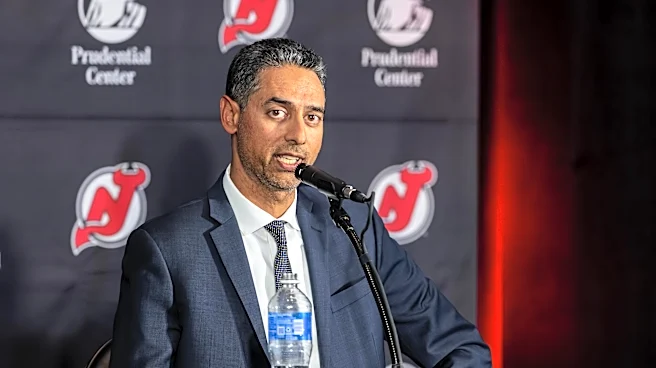
Devils GM Sunny Mehta and the team announced late Wednesday that the team indeed tendered Utah Mammoth C Barrett Hayton an offer sheet for one-year at $4.775M.
According to the CBA, Utah has seven days to decide whether or not to exercise their right to match the offer sheet. If they decline to do so, Hayton will become a member of the Devils and Utah will receive a 2027 2nd round pick as compensation.
This offer sheet is interesting for a few reasons. According to Elliotte Friedman, Utah can not trade him for one calendar year if they decide to match the offer sheet. The potential issue with that is that Hayton is scheduled to become a UFA in one year. In a way, this is a defacto “poison pill”, as Utah runs the risk of losing Hayton for nothing next summer.
Utah was one of the better stories in the NHL this past season, ending a long playoff drought. They have a lot of young, talented players with more on the way. That said, the NHL is an arms race and Utah was one of the last teams in the playoffs in a relatively soft Western Conference once you get past the top teams. It’s not impossible the Mammoth take a step back, and if they want to sell at the deadline, moving Hayton for futures is off the table if they match this offer sheet. Nor can they flip his negotiating rights in the days leading up to July 1, 2027.
The Mammoth are seemingly set with Trocheck and Cooley as their top 2 centers and Stenlund as their 4C. They also have Nick Schmaltz who can seemingly slide over at center if necessary. Hayton is currently slotted to be their third line center.
But how much do the Mammoth actually value Hayton in the big picture?
Hayton, a former 5th overall pick in 2018, has played parts of seven seasons with the Coyotes/Mammoth organization. Taking a quick look at his counting stats, his production hasn’t been what one would expect from someone who was a former Top 5 pick. He has had 20 goals in a season once in his career and has topped the 40 point threshold twice.
That’s not to say he’s not an NHL player. It’s just an acknowledgement that Hayton hasn’t quite lived up to expectations for the Mammoth.
If Utah was content with their center depth, would they have gone out and traded Sean Durzi, Cole Beaudoin, and a third round pick for three seasons of Vincent Trocheck? If Utah was pleased with Hayton’s development, wouldn’t they have extended him as a key piece of their young core like they did with Cooley and Guenther by now? Add in that the Mammoth have last year’s 4th overall pick Caleb Desnoyers waiting in the wings and Utah is seemingly set down the middle for the foreseeable future.
I say all that to say that while Utah may ultimately wind up matching the offer sheet (they have the cap space to do so), it’s certainly possible they do not. But if they don’t, what are the Devils getting?
The Devils would be getting Hayton for one season at $4.775M before he’s eligible for UFA next offseason. They’d be getting a player who plays a solid two-way game and creates chances, but struggles to finish (he sounds like a Devil already). He’s solid in the faceoff dot, has a high hockey IQ, and is a plus skater. You can watch some of his highlights here.
According to Cam Robinson, the Devils and Mammoth had a deal in place for Hayton at the draft that Utah pulled out of late. So this is clearly a player Sunny Mehta has had his eye on and that Utah was shopping around to some extent.
I’m not sure how Hayton will fit with the Devils if Utah declines to match. I don’t know if the plan is to play him on Jack Hughes’ wing and have him take faceoffs on that line. I don’t know if the idea is for Hayton to be the 3C for the Devils and they either move Cody Glass to 4C or if they wind up trading Glass or Nick Bjugstad.
I do know that I trust Sunny Mehta’s vision for how he wants to reshape this roster. I do know that if Mehta feels there’s additional levels for Hayton to gain, this is a relatively low cost in order to bring him in.
I also have a gut feeling that it Utah viewed Hayton as a long-term piece, they wouldn’t have shopped him at the draft. They probably would’ve signed him long-term by now. They probably don’t go and swing the trade for Vincent Trocheck. Things wouldn’t have gotten to the point where he would actually go out and seek to sign an offer sheet.
Utah has the capabilities to match this offer sheet. But is it worth doing so for a player who might not be part of their long-term future, and if there is any doubt, are they better off taking the 2nd round pick now and moving on?
These are questions that are likely being asked by Mammoth GM Bill Armstrong and his staff. We’ll ultimately find out the answer at some point in the next seven days. Either way, I commend Sunny Mehta for identifying his guy and being aggressive in trying to bring him to New Jersey. It might not work, but fortune favors the bold. Be aggressive. Be ruthless. And if it doesn’t work, it doesn’t work. You simply move on to the next guy.
Sunny Mehta is trying to make the Devils better. He clearly feels that Barrett Hayton can be part of that or he wouldn’t be trying to sign him to an offer sheet.
Time will tell if he is ultimately successful.