
BOSTON — A month ago, Jordan Walsh’s name was little-discussed at the national level. The 21-year-old Celtics forward was buried on the bench, a former second-round pick who seemed at risk of never breaking
through in the NBA.
But a month of spectacular basketball on both ends of the floor has changed everything for Walsh.
In Boston, he has become a household name. All the while, national basketball media (and opposing players) have begun to herald him as one of the league’s promising young forwards. After the Celtics beat the Lakers, Austin Reaves told reporters he could see Walsh becoming “one of the best defenders in the league for many years to come.”
And, as the hype around Walsh has ballooned, Jaylen Brown, who sits next to Walsh on the team plane, recently alluded to a concept that Joe Mazzulla and the Celtics have brought up numerous times over the years: just like criticism, praise can be harmful to internalize, too.
“I don’t want to boost his head up too much,” Brown said of Walsh, seemingly only half-kidding. “I don’t want him to start getting cute. You gotta still take care of the details.”
The art of staying even-keeled through criticism and praise
The notion of not internalizing praise is one that Mazzulla has mentioned on numerous occasions this season.
After winning the 2024 NBA title, the Celtics head coach was asked about the highs and lows of his tenure, and reflected on how he stayed even-keeled through the outside praise and criticism: “If someone tells you, ‘Good job,’ That’s just as dangerous as someone telling you, ‘You suck.”
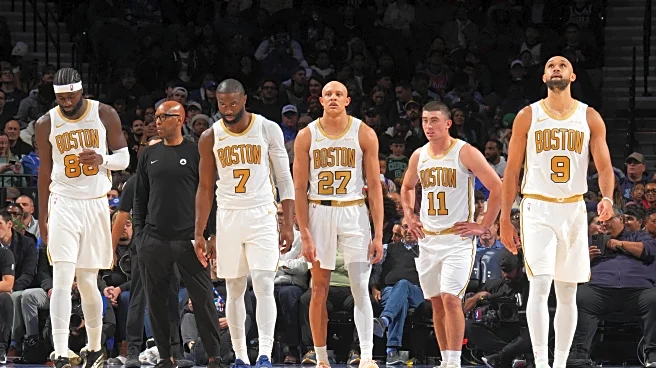
Several Celtics players have been hearing lots of “good job” from the outside world, whether from fans or the media; 22-year-old Josh Minott is averaging 19.2 minutes this season, up from 6 per game last year with the Minnesota Timberwolves. Minott has quickly become a fan favorite, and was a regular started for a 9-game stretch earlier this season. Then, there’s 26-year-old Neemias Queta, who has effectively gone from the Celtics’ fourth-string big to the starting center.
Rookie Hugo Gonzalez is playing his first NBA minutes, while second-year forward Baylor Scheierman has gone from spending most of his time in the G League to averaging 12 minutes per game with the parent club.
At Celtics practice on Saturday, Mazzulla was asked about the process of ensuring his young players are not overly impacted by both the newfound praise and criticism they’ve been met with.
“When you have young players, you have to have all those conversations,” Mazzulla said. “It’s stuff that happens in life. But I think our guys here — we have a good culture and atmosphere of that mental performance — to be able to work through that.”
Mazzulla also noted that staying steady throughout the highs and lows is a part of the learning process when it comes to acclimating to the NBA.
“Everyone talks about player development as skills on-court, but what you’re talking about is a piece of player development as well — how you handle those things throughout the season,” he said. “It’s not just the praise, too. It’s handling not playing well. It’s handling, ‘Can you bounce back?’”
For Baylor Scheierman, not getting too high or too low was a valuable lesson learned in his rookie season. Last year, the former Creighton star spent the majority of his season in Maine — but he burst onto the scene with some hot shooting in March for the parent club.
At the beginning, it may have been tempting to ride the emotional high of that early success, but as a second-year player, Scheierman has learned to avoid that.
“If you do play well, or you don’t play well, or you play a lot, or you don’t play a lot, you kind of just take it for what it is and move on to the next game,” he said.
Some players already live on the other side of that lesson; Payton Pritchard, for example, experienced a ton of the newfound praise and attention last season, when he was named Sixth Man of the Year. The 27-year-old is much more used to the highs and lows of an NBA season than he was earlier in his career, and has also learned the relish the moments in which things are going well.
“When you’re playing well, you definitely want to — not like, soak in it, but you want to appreciate it,” Pritchard said. “Because you want to acknowledge that ‘I’m playing well.‘ And then when you’re playing bad, obviously, people are going to tell you, and it’s not something you want to dwell on. But you can [acknowledge]: ‘I am playing bad, I can acknowledge I need to be better.’ So it’s a balance.”
Already this season, Pritchard has experienced both ends of the performance spectrum. On one hand, he began the season ice-cold, shooting 18% from three-point range across the season’s first 7 games. On the other, he’s had several big-time performances, including a 42-point night against the Cleveland Cavaliers.
While experiencing both ends of the success totem poll, he’s made sure to never internalize the results too much.
“You don’t want to be so high on it that when you have a good game, it’s like ‘Oh, I’m on top of the world,‘” Pritchard said. “Because when you have a bad game, then you’re like, ‘Oh, I’m the worst player.‘ So, it’s definitely a middle ground of how to handle it.”
Joe Mazzulla wants to see his young players continue to master the art of bouncing back, of not getting carried away with either the highs and lows.
That includes a great win streak, a bad loss, or even a couple of poor plays.
“We always say, the greats are able to suck for a quarter, and they come right back,” he said. “They suck for four possessions, they come right back. How quickly can you get back to being yourself — as an individual, as a team? It’s just good learning experiences.”