



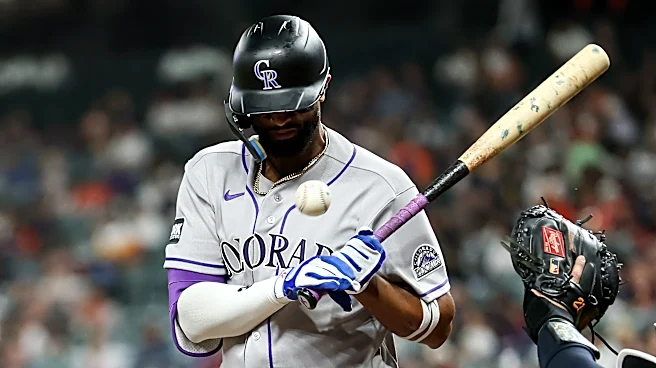
The Rockies love versatility.
They collect it. They prioritize it. They build around it — players who can move, adjust, and fill gaps across the roster.
Under the current front office, that emphasis has been explicit.
In theory, it works. But, like any philosophy, it only works if you know when to stop applying it.
Tyler Freeman might be that moment.
The Rockies didn’t invent the experiment — but they’ve kept it going
Freeman wasn’t developed as a utility player.
In the minors, he was overwhelmingly an infielder — developed at shortstop with the expectation he’d eventually
slide to second base as his long-term home.
Cleveland began expanding that role late, even moving him into center field in 2024 and asking him to learn a new position on the fly. By the time Colorado acquired him, the flexibility was already part of his profile.
The Rockies didn’t create that version of Freeman. They chose to keep going.
The Rockies saw a problem — and chose more flexibility
In 2025, Freeman hit .281, posted a .354 OBP, and still finished with negative bWAR
Because, as Joelle Milholm wrote here on the Row — he “raked at the plate, tanked in the field.”
The Rockies have a real reason to hesitate here. Freeman struggled defensively across positions, including second base.

And in 2026, they’ve already leaned on players like Willi Castro and Edouard Julien to cover those innings. That approach isn’t irrational, but the response has been more movement for Freeman.
And defense, especially in the infield, is built on repetition.
Freeman hasn’t gotten that.
The profile has never really changed
For years, the reports have been consistent:
- Elite bat-to-ball skill
- Advanced feel for contact
- Modest but developing gap power
- A likely defensive home at second base
Statcast tells a similar story now:

This isn’t a star profile. But it is: An everyday, contact-oriented profile the Rockies haven’t fully defined
So what’s missing?
The last step.
Freeman makes contact as well as almost anyone. But he hasn’t consistently turned that into damage.
And development like that doesn’t happen in abstraction — it happens in routine.
It’s the same glove. The same angles. The same pre-pitch rhythm. The feel of the dirt under your cleats, every inning.
Freeman hasn’t had that.
Instead, it’s been different gloves, different sightlines, different responsibilities. One night he’s reading hops on the infield dirt, the next he’s standing in the outfield grass, waiting instead of reacting.
That instability matters — even if the exact effects are hard to isolate.
Sports psychology research consistently shows that role clarity can influence confidence, decision-making, and perceived effectiveness. Baseball-specific evidence is more limited, but the general principle holds: players tend to perform best when expectations are stable.
And when things aren’t stable, hitters often get more conservative.
They shorten up. They put the ball in play. They avoid risk.
So a player with developing pop can become: a contact hitter who never fully taps into it
That’s not proven cause and effect, but it’s a pattern worth considering.
What happens if they choose a lane?
Make Freeman the everyday second baseman.
Not because it’s guaranteed to work, but because it hasn’t really been given a chance to.
Once that decision is made, the rest of the roster starts to organize itself.
Ryan Ritter isn’t part of the current roster, but that actually reinforces the point. His path isn’t as a primary second baseman — it’s as a true super-utility player. When he’s up, his value comes from moving between the infield and outfield, not competing for a single position. Castro already fills a version of that role at the major-league level, rotating through shortstop, second, and third base in a way that makes the roster more flexible without blurring development.
The real redundancy is elsewhere.
Freeman and Julien share a similar offensive identity — contact-driven, bat-first players whose value comes from what they do at the plate. Both have been moved around defensively. Both have below-average defensive track records. But they’re not interchangeable.
Freeman brings more athleticism. He was developed as an infielder. His profile — contact, speed, and just enough developing pop (maybe) — fits more cleanly at second base if given the chance to settle there.
Julien’s path is narrower. His value likely comes as a bat-first option moving between second, first, and DH. And if that role overlaps too heavily with Freeman’s, the Rockies eventually have to decide whether carrying both actually creates value — or just duplicates it.
Just as importantly, the outfield stops being a catch-all.
Instead of absorbing infield uncertainty, it can stabilize around players like Brenton Doyle, Mickey Moniak, Jordan Beck, Troy Johnston, and Jake McCarthy — players who are actually being evaluated as outfielders, not filling gaps created elsewhere.
That clarity extends beyond the active roster.
With Freeman anchored at second, the path for the next wave — Charlie Condon (No. 1 PuRP), Zac Veen (No. 9 PuRP), Cole Carrigg (No. 4 PuRP) — becomes easier to see. Not guaranteed, not blocked, but defined. They’re no longer competing against positional drift; they’re competing within structure.
And that’s the real point. Choosing a lane for Freeman doesn’t just answer one question.
It forces the Rockies to decide which overlapping skill sets they actually believe in — and which ones they don’t.
The clock is ticking
Freeman is 26 and under club control through the 2028 season.
That gives the Rockies a limited window to define him, develop him, or extract value.
Right now, they’re still figuring out what he is.
Let him be the exception
Purple Row has already documented the Rockies’ embrace of optionality. The front office has been clear about valuing adaptability.
That philosophy has value, but it still requires decisions.
Tyler Freeman doesn’t need more positions. He needs a clearer role.
On the Farm
Triple-A: Oklahoma City Comets 13, Albuquerque Isotopes 12
The Isotopes (10-9) fall just short to the Comets (10-9) in a scoring bonanza. Charlie Condon led the way, going 3-for-5 with three RBI, while Cole Carrigg drew two walks and Chad Stevens stayed hot with a 2-for-5 performance. On the mound, Luis Peralta took the loss as pitching struggled to contain the Comets’ offense. Welinton Herrera was a bright spot, tossing two scoreless innings to open the game.
Double-A: Richmond Flying Squirrels 7, Hartford Yard Goats 4
The Yard Goats (5-8) fell to the Flying Squirrels (11-2) in a hard-fought game. Aidan Longwell led the way on offense, going 3-for-5 with a home run, while Andy Perez added three hits of his own. Pitching proved to be the difference, as every arm allowed at least one run, with starter Alberto Pacheco taking the loss after giving up three earned runs in 2.1 innings.
High-A: Vancouver Canadians 0, Spokane Indians 1
The Indians (6-7) walked it off in the 10th inning, edging the Canadians (4-9) after a scoreless battle through nine. Robert Calaz delivered the game-winning single in extras to seal the win. On the mound, Jordy Vargas and Fisher Jameson were outstanding, combining for a shutout. It was a tightly played game throughout, with pitching dominating until the final swing.
Single-A: Fresno Grizzlies 5, Ontario Tower Buzzers 4
The Grizzlies (9-4) edged the Tower Buzzers (6-6) in a close contest, scoring five runs on just five hits despite striking out 11 times. Wilder Dalis provided the biggest swing of the night, going 1-for-3 with a crucial three-run homer in the seventh. On the mound, Austin Newton delivered a strong start, allowing one run while striking out six over 5.2 innings. It was a gritty win, with Fresno making the most of limited opportunities.
Through early season bumps, Tovar’s on trip ‘to the next level’ | MLB.com
In this piece by Thomas Harding on MLB.com, Ezequiel Tovar is off to a slow start, but underlying metrics suggest better results could be on the way. The Rockies remain encouraged, as he looks to turn those signs into production while aiming to reach a higher level this season.
Snow covers Coors, inspiring impromptu snowman | MLB.com
Snow blanketed Coors Field before the Dodgers-Rockies game, where Emmet Sheehan even paused to admire a snowman near the field. Crews cleared it in time, but the scene added a perfect “only in Colorado” twist to an April night at the ballpark.
Albuquerque Isotopes 2026 walk-up songs | Purple Row
Renee Dechert of Purple Row takes a fun look at the Albuquerque Isotopes’ 2026 walk-up songs, highlighting the mix of personality and culture throughout the roster. From hip-hop and reggaeton to rock and country, the playlist reflects each player’s style and adds a behind-the-scenes feel to the team’s at-bats.
Join the conversation!
Sign up for a user account and get:
- Fewer ads
- Create community posts
- Comment on articles, community posts
- Rec comments, community posts
- New, improved notifications system!
Please keep in mind our Purple Row Community Guidelines when you’re commenting. Thanks!