

“But it turned out awful nice, I’ll tell you that — 16 years. You know, I lasted more than I thought I would. Boy, what a life. I really enjoyed every minute of it. Even when I was horseshit, I still liked it.”
As he approached his 100th birthday in 2025, Bobby Shantz took the opportunity to reflect on his career in baseball. More than 60 years since he’d hung up his cleats, he still had the mind of a ballplayer, reminiscing about the legends he played with and against with vividness and vibrancy.
But he also had the perspective of a man who’d been on a long journey — and was grateful for every stop along the way.
Robert Clayton Shantz
Born: September 26, 1925 (Pottstown, PA)
Yankees Tenure: 1957-60
Shantz grew up in the suburbs in Pennsylvania. A small kid (his height peaked at 5-foot-6 as an adult), the young Bobby distinguished himself through pinpoint control and all-around athleticism. After his high school coach refused to let him pitch due to his size, a youth baseball manager saw Shantz working out his curveball and decided to give him a shot on the mound. He joined the Army in 1944 and continued to hone his craft on Army baseball teams while stationed in the Philippines, competing against big-leaguers and building confidence in his ability to go pro.
Upon his return to the States, Shantz continued to impress in semipro ball but struggled to find any takers among MLB teams due to his stature. Finally, after a couple of teammates with connections in the Philadelphia A’s organization put in a good word, Harry O’Donnell, a scout with the team, signed him to an A-Ball deal. He immediately impressed, winning 18 games in 28 starts and striking out nearly a batter an inning. The next year, at the age of 23, he made the leap all the way to the big leagues, where he would be managed by none other than Hall of Famer and baseball lifer Connie Mack.

In his first three seasons in Philly, the southpaw established himself as a strong contributor, pitching around league average and making his first All-Star team in 1951. But it was the following year that would be Shantz’s campaign for the ages. Seemingly out of nowhere, he emerged as the best pitcher in baseball, winning 24 games, posting a 152:63 K:BB ratio, recording a 2.48 ERA, 9.4 rWAR, and taking home the AL MVP. The career year was aided in part by the use of a knuckleball Mack had forbade him from employing but his new manager, Jimmie Dykes, encouraged.
In the ‘52 All-Star Game, Shantz struck out the side in his only inning of work, including punchouts of Jackie Robinson and Stan Musial. His newfound stardom even netted him a guest spot on the Ed Sullivan Show.
As is so often the case after a superlative season like Shantz’s ‘52, the pitcher took a step back in the years that followed. As he struggled with injury and inconsistency, he went 13-26 with a 4.42 ERA over the next four years, failing to recapture his peak form on floundering A’s teams as the franchise moved to Kansas City. After the ‘56 campaign, the A’s traded their former MVP to the Yankees as part of a 13-player trade. Shantz was a man reborn, leading all of baseball with a 2.45 ERA in ‘57 and earning his first All-Star berth since his MVP season.
Shantz also took home the very first AL Gold Glove for a pitcher, his first of eight such awards earned between both leagues. The man’s legacy as one of the greatest fielding pitchers has never been in question. “I’ll occasionally hear a guy introduce me and say, ‘He was the best fielding pitcher in baseball,’ and I’ll say, ‘No, Bobby Shantz was,’” said Jim Kaat, winner of 16 Gold Gloves himself. “He didn’t win a Gold Glove until ’57. Had they given them out starting in ’50, he would have had 16 or 17 as well.”
Shantz made the only World Series start of his long career that October, taking the ball in Game 2 against the Milwaukee Braves. He struggled, allowing four runs (three earned) in three innings, but rebounded well in Game 4, tossing three scoreless innings in relief to keep the Yankees in a game they’d eventually tie up in the ninth.
Shantz spent three more years in pinstripes, eventually transitioning to a bullpen role, where he pitched well as a proto-closer. Despite finding his greatest individual success in Philadelphia, Shantz would later recount that his time with the Yankees—who won a championship in 1958 and the pennant in three of his four seasons there—was the most rewarding of his career.
After the ‘60 season, the Yankees left him exposed in an expansion draft. Shantz was selected by the Washington Senators, who flipped him to the Pirates. He’d spend the final four seasons of his career in a state of perpetual motion, pitching for five different teams as a trusted reliever. After the ‘64 season, at the age of 39, Shantz retired. The 5-foot-6 non-prospect who was rejected repeatedly at the start of his career had stuck around for 16 years in the big leagues.
Shantz retired back to Pennsylvania, where he managed a restaurant and co-owned a bowling alley. In 2010, Pottstown High School renamed their baseball park Bobby Shantz Field in honor of their famous alumnus.

As the years have gone on and he’s passed the century mark, Shantz has increasingly become the “oldest living” designee in many areas — oldest living MLB MVP, oldest living A’s player, and on down the line. He’s accepted this status with grace and humor, giving colorful interviews and staying connected to the game he loves.
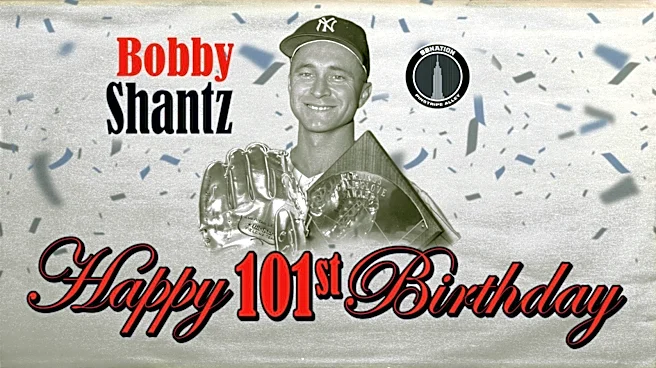
On the occasion of his 101st birthday, we celebrate the oldest living Yankee, Bobby Shantz. We’ll let him take us out in his own words: “I had a great life. Jesus, great life. Boy, I’d like to do that all over again.”
See more of the “Yankees Birthday of the Day” series here.