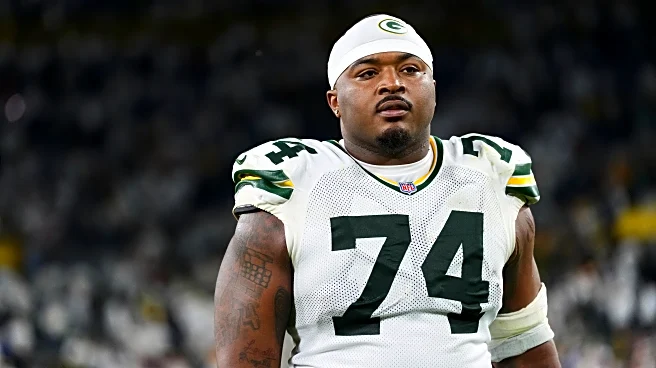

Our cap casualty series continues today with Elgton Jenkins. Heading into his age-31 season, will Jenkins be a part of the Green Bay Packers? Let’s find out.
Jenkins was one of general manager Brian Gutekunst’s
earliest and most successful draft picks. After grabbing Rashan Gary and Darnell Savage in the first round of the 2019 NFL Draft, Gutekunst snagged Jenkins with the 46th overall pick — though he reportedly would have taken quarterback Drew Lock had Denver not taken him off the board two picks earlier.
Jenkins didn’t waste much time settling in as a core member of the Packers’ offensive line. After an injury to Lane Taylor in Week 2, Jenkins slid into the Packers’ left guard spot and never gave it back, though he made cameo appearances at left tackle (two snaps), right guard (one snap) and right tackle (one snap) that season.
Jenkins began to showcase his versatility in earnest the next season, making starts at both left guard and center and playing significant chunks of games at both right tackle and left tackle. He continued that trend into the 2021 season, when he spent most of the year starting at left tackle until a torn ACL ended his year. He returned near the start of the 2022 season (and would sign a four-year, $68 million extension in December of that year) but never really found his footing at right tackle before shifting over to left guard, which is where he stayed throughout the entirety of 2024. After the departure of Josh Myers prior to the 2025 season, Jenkins was installed at center and played nine games before an injury again ended his season.
The case for Elgton Jenkins
The case for keeping Jenkins starts with his performance at center. In nine games, he wasn’t a world beater, but he was workable, and it stands to reason he’d be better in his second full year on the job. He was ranked as the 20th best center in football last year by Pro Football Focus (among players with at least 500 snaps at the position), and was the charting service’s third-best graded pass blocker. Yes, that means he wasn’t great as a run blocker (25th out of 34 centers in that ranking), but pass blocking is probably more valuable than run blocking in the grand scheme of things.
In theory, the versatility that made Jenkins a valuable asset for most of his Packers career to this point could be an asset going forward. With Sean Rhyan hitting free agency, the Packers may have a hole at right guard heading into next season, potentially opening a door for Jenkins at a position he’s played before, albeit somewhat sparingly. He gives the Packers a safety net at two spots, though it’s an expensive one.
The case against Elgton Jenkins
Unfortunately, the expense is significant. Jenkins’ cap hit for 2026 is $17.6 million — highest among all centers in the NFL by a fair margin. Lloyd Cushenberry in Tennessee, Drew Dalman in Chicago, and Creed Humphrey in Kansas City are the only other centers in the league with a double-digit cap hit in 2025, and only Jenkins and Humphrey will break $18 million in 2026. Humphrey, widely considered the best center in the league (his multiple All-Pro bids support that claim), will count just $18.1 million against the Chiefs’ cap in 2026. Jenkins, who may not even be widely considered the best center in Green Bay (depending on your opinion of Sean Rhyan), will count $24.8 million against the Packers’ cap in 2026.
Even if you’re high on Jenkins’ pass blocking ability or his versatility, that’s an abysmal intersection of price and value. Worse, Jenkins will turn 31 in December, while Humphrey will be just 27 as of June. Worse still, Jenkins is coming off a major injury, having fractured his fibula in November.
Bottom line: Elgton Jenkins got old, hurt, and expensive fast at a position the Packers don’t really value
Dating back to the middle portion of the Aaron Rodgers era, the Packers have never really devoted big resources to the center position. They once signed an aging Jeff Saturday to man the spot for a year, but he didn’t even last a full season before he was supplanted in the lineup (though he did make a farcical Pro Bowl berth that year). The only other significant outlays at the position were a contract extension for Corey Linsley (a modest three-year, $25.5 million deal in 2017) and a second round pick that they used to take Josh Myers in 2021.
Jenkins cap hit for 2025 was more than two-thirds of Linsley’s entire contract in Green Bay, and it was more than Myers made during his entire Green Bay tenure. There’s really no justifiable reason to spend even more than that in cap space in 2026. Count on Jenkins being a cap casualty this spring barring an unexpected and immense reworking of his contract.