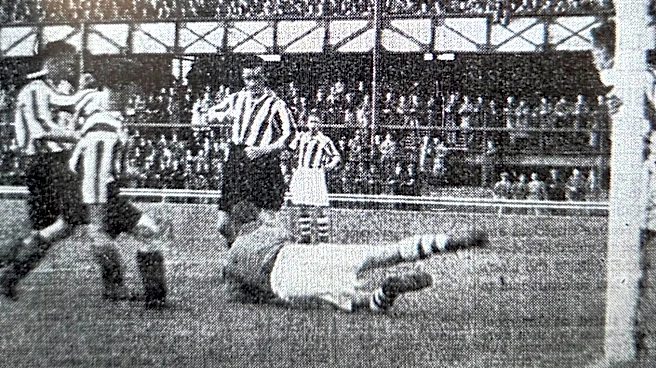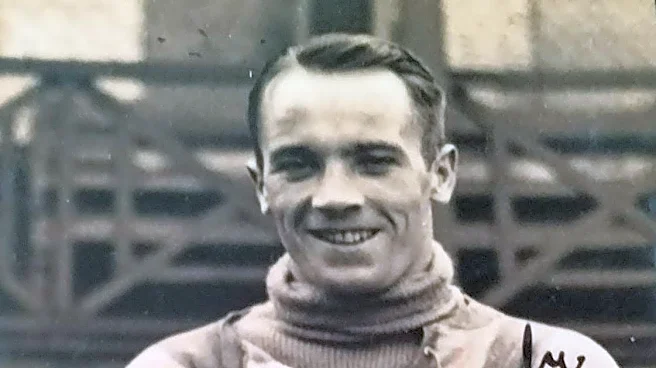




Stoke City were the opposition at Roker Park in Sunderland’s third game of the 1933/34 season. The first two games had been lost and, despite scoring in the season-opener against Huddersfield Town, Benny Yorston had been dropped for the second game against Portsmouth at Roker Park. Reinstated for this game, at inside-right alongside Bobby Gurney and Patsy Gallacher, Johnny Cochrane was searching for a winning formula.
Stoke’s Gateshead-born forward Bobby Liddle was injured for this game, so eighteen-year-old
Stanley Matthews deputised on the right wing.
Stoke kicked off with the bright sun behind them and what little breeze there was blowing across the pitch.
Sunderland were quickly on the attack, with Yorston and winger Bert Davis prominent in the early minutes.
Five minutes into the game, the Yorston/Davis duo fashioned the first goal. The ball had been worked well to Davis on the right wing. As the winger glided forward, Yorston dummied to break and rocked his markers onto the flat of their feet. Darting between two defenders, the nippy Scot met Davis’s well-timed cross perfectly to nod past a static keeper for a neat first goal.
Sunderland’s right-hand side was proving a real handful for the Stoke defence. Within minutes of the first goal, Davis slid a sharp pass into the centre that Yorston burst onto, going past his marker at the same time. One-on-one with keeper Roy John, Yorston’s shot was deflected away by the keeper’s legs.
Sunderland were playing at pace and assuredly as Jimmy Connor on the left wing started coming into the game.
Another good opportunity went begging when Gurney found Davis on the right-hand side. His accurate cross landed perfectly at the feet of Patsy Gallacher, who controlled and shot in one movement. This effort was well saved by Roy John.
Sandy McNab and Bill Murray then combined well on the left wing to set Gallacher in on goal. He fired a great shot that John deflected to safety.
The second goal arrived in nineteen minutes, and what a goal this was.
Bert Davis pounced on a ball he should never have won, with two defenders looking likely to get to it. The winger broke through the defensive cordon and slid a very pacey pass to Yorston. With defenders closing in, the diminutive Scot fired a first-time shot. The kink and swerve on the ball saw it billow the net at the far corner, just inside the upright, giving John little chance.
The Stoke attack had been very much nullified by the Sunderland defence. However, the referee kept trying to give the Potters a chance as he ignored a number of blatant offsides, much to the ire of the Roker Park crowd.
Two goals in two feverish minutes followed, coming towards the end of the first half. The first score was Sunderland’s third goal of the game and it came from the right foot of Bert Davis. Picking the ball up around thirty yards out, the twenty-seven-year-old let fly with a right-foot blockbuster. John took the sting out of the shot but could not hold on to the ball and, lying flat out, could only watch as the ball trickled over the line.
Less than a minute later, some rare Stoke pressure saw left winger Joe Johnson stab home from close range to give the visitors a lift heading into half-time.
The break saw Sunderland applauded from the pitch for a dominant and dynamic display.
The second half saw the Black Cats on the attack almost immediately, as Gallacher and Yorston both had chances to add to the scoring. John did very well to stop Yorston’s shot from the edge of the box.
Yorston then slid a great through ball to Gurney, leaving him with just the keeper to beat. John deflected the shot with his legs.
Minutes later, Yorston worked a bit of space for himself on the edge of the box and cracked a goal-bound shot that the overworked Stoke keeper did well to save.
It was eighteen minutes from time when Yorston finally got his third goal, and a very deserved hat-trick it was.
The goal was fashioned by Gallacher, who, at his elusive best, escaped the attentions of two defenders in the box to dink a pass into space for Yorston to slam home.
It had been a fine performance from Sunderland and lifted some of the early-season gloom around Roker Park.
The hat-trick hero on this day, Benny Collard Yorston, never quite cemented his place in the team, with the emerging trio of Gallacher, Gurney and Raich Carter becoming Johnny Cochrane’s preferred choice up front.
Had the manager the luxury of naming a substitute, Yorston would have been the perfect candidate, given his ability to play either of the inside-forward positions as well as centre-forward. Sadly, it would be more than three decades before the twelfth man could take the field.
Benny Yorston could count himself unlucky to be around at the same time as the emergence of Sunderland’s much-vaunted trio, especially when you consider his twenty-six goals in fifty-two appearances between January 1932 and March 1934.
Born the son of a fishing trawler skipper in Nigg, Kincardineshire, Benny left school to work as an office boy at Pittodrie for Aberdeen FC whilst playing for their juvenile team Kittybrewster and then their junior team Mugiemoss. He was signed by Montrose in 1927 when he was twenty-two years old, but only stayed with the ‘Gable Endies’ for three months as Aberdeen stepped back in and offered him a full-time professional contract.
He played five seasons for the ‘Dons’, scoring one hundred and twenty-five goals in one hundred and fifty-six appearances.
Short, stocky and strong in the legs, he possessed a prodigious leap and burst of pace. His reputation grew with comparisons to the great Hughie Gallacher in Scotland.
In 1929/30, Benny scored forty-six goals for Aberdeen and is still their record goal-scorer in a season.
International recognition came his way in 1931, when he was capped for Scotland against Ireland. With his reputation on the rise, a controversy emerged that would cut across his career in November 1931. Benny Yorston was one of five Aberdeen players who were dropped after a one-one draw with Kilmarnock. All five never played for Aberdeen again.
The allegation, though none of the five were ever charged, was that they had been part of a betting scandal around the Kilmarnock game. The accusation was that a number of players had placed a fixed-odds bet that Aberdeen would be drawing at half-time and winning at full-time. When tracked down by Aberdeen club historian Jack Webster to his flat in Chelsea shortly before his death in 1977, Benny denied any knowledge of corruption and claimed to have no memory of the circumstances that led to his departure from Aberdeen.
In January 1932, Johnny Cochrane, a great scouter of talent north of the border and an equally good exponent in the art of spotting a bargain and timing his approach, stepped in with a £2,000 offer for the “wee man’s” services.
Yorston had an immediate impact in the latter third of that season, playing seventeen games and scoring twelve goals to help lift Sunderland to mid-table.
With Davis, Gallacher and the up-and-coming Carter in the forward line as well as Yorston, aerial threat might not have been the first thing that crossed the minds of opposition defenders and supporters. Even Bobby Gurney was only 5’ 8” tall; he must have stood like a veritable giant in that line-up. In truth, though, this group of “wee men” were all excellent in the air, with Yorston a match for most bean-pole half-backs.
Benny spent a couple of periods on the transfer list before finally being sold to Middlesbrough in March 1934 for £1,250. Despite breaking his leg in 1937, he scored fifty-four goals in one hundred and fifty-one appearances for the ‘Boro’ until the outbreak of the war in 1939.
He enlisted in the army and guested for a number of clubs in morale-boosting, fundraising wartime football when he was able. The likes of West Ham, Aldershot, Reading, Dundee United, St Mirren and Hibernian all saw Benny Yorston in their colours as a “guest player”.
After the war, Benny retired from playing. He was chief scout for Barnsley and Bury. When he eventually left football, he worked as a property agent in West London.
A small, nippy forward with a great leap and knack of scoring goals, Benny Yorston was a colourful character from a bygone era.
Division One
Date – 02.09.1933
Venue – Roker Park
Attendance – 14,639
Sunderland 4 – 1 Stoke City
Goal Scorers – Yorston 4, 16 & 72 mins; Davis 36 mins; Johnson 37 mins.
Sunderland – Thorpe; Murray; Shaw; McNab; McDougall; Edgar; Davis; Yorston; Gurney; Gallacher; Connor.
Stoke City – John; Spencer; Beachill; Jackson; Turner; Sellars; Mathews; Davies; Palethorpe; Sale; Johnson.