






The Green Bay Packers’ wide receiver depth chart, as it currently exists on Ourlads.com, includes exactly two players who I would consider “big:” Christian Watson and barely-a-receiver Savion Williams. Last year’s first rounder, Matthew Golden, is 5-11 and 191 pounds. Jayden Reed is 5-11, 187 pounds. The newly acquired Skyy Moore is 5-10, 195. Former cornerback Bo Melton is 5-11, 189. Something called Jakobie Keeney-James is a robust 6 feet, but still just 190 pounds. He’s currently second on the depth chart behind
Watson, by the way. Basically, every receiver on the team except Watson is my size (or smaller!).
At the very end of the bench you will find Isaiah Neyor and Will Sheppard, who are larger, but they are the very last people on a depth chart that includes Jakobie Keeney-James and so the problem still stands. Most of the team’s receivers are small. That’s not a problem for every team, but as long as Matt LaFleur is in charge, it’s a problem for this one because Matt needs his guys to block, and when the little guys try their hearts out to block bigger defensive players, their hearts get concussions. Sorry, I was never great with anatomy. Or analogies. Anatogies.
Fortunately, while this may not be the best ever draft for receivers, or really any position, it’s loaded with big fast tall guys at receiver. Last year’s draft was almost entirely small guys outside of Tet McMillan, and so this is quite the sea change. There are SO many big, fast, tall guys. Now, I grant that they’re not all great at “turning” or “catching” but they’re almost all fast, and huge, and MVS-esque, and so I’ll wager that the Packers grab at least one of them, especially as several athletic freaks will apparently be available late. And in the middle rounds. Also, early. Why don’t we start with the guys who will, per the consensus boards, be available in the general vicinity of the Packers first two picks (52nd and 84th overall).
(Note: I will be mentioning WROBA and SiYAA, which you can learn about here. But the short version is that WROBA tells us about how efficient a receiver was per play (100 is average) where SiYAA tells us how efficient a player was overall given their volume, expressed as Yards Above Average. Zero is average, players with above a 600 season are almost always outstanding pros, and good pros almost always have at least 200. I have SiYAA going back to 2018 and the all-time top 5 are Ja’Marr Chase (1046), DeVonte Smith (984), Jameson Williams (810), Jaxson Smith-Njigba (778) and CeeDee Lamb (761). This year’s leader was Wyatt Young of UNT (we don’t adjust for strength of schedule yet) with 564, just beating out Ohio State’s Jeremiah Smith at 502. The best draftable receiver this year was Carnell Tate with 470, which was 4th overall.)
Early Big Fast Freaks
Ted Hurst
6-4, 208. Consensus Board: 69. RAS: 9.9. SiYAA: -73 (259 in a more efficient, but less voluminous 2024) Ranks 41st (out of 4196 receivers) all time in RAS.
We here at Acme Packing Company have written about Hurst quite a bit already as he made a pre-draft visit to the team, but it’s worth revisiting why we’re interested. Even among this group of tall athletic unicorns, Hurst stands out, posting the 41st best RAS ever recorded for receivers. At 208 he’s thicker and more physical than many of his contemporaries, and he’ll be able to handle go routes, and the dirty work on run plays with no issues.
The difference between Hursts’ SiYAA numbers from 2024 to 2025 can mostly be explained by quarterbacking. In his two years at Georgia State, four different quarterbacks had at least 100 attempts, which is never a great sign for underlying talent or stability. In 2024 Hurst caught 57% of his targets for a 17.2 Y/R average, while in 2025 both numbers fell to 53%, and 14.1 Y/R respectively. When your catch% nears 50, small changes can result in big differences in your overall efficiency.
But, while Hurst has never had great hands, those issues are DRASTICALLY exacerbated by some pretty terrible quarterbacking, and at the next level he would likely improve. He’s clearly strong and uses his frame well, and despite the 7 drops in 2025, he also caught 16 of 27 contested catches. Hurst also has the most projectability out of this group of receivers as he’s only 21 years old, and he was willing to put himself in harms way, running the most slant routes in FBS as a percentage of his targets.
Hurst is exactly what Green Bay will be looking for, and checks every box on size, speed, physicality, and he could still be on the board when they’re up in the third round.
Chris Brazzell
6-4, 198. Consensus Board: 57. RAS: N/A but ran a 4.37 40. SiYAA: 333
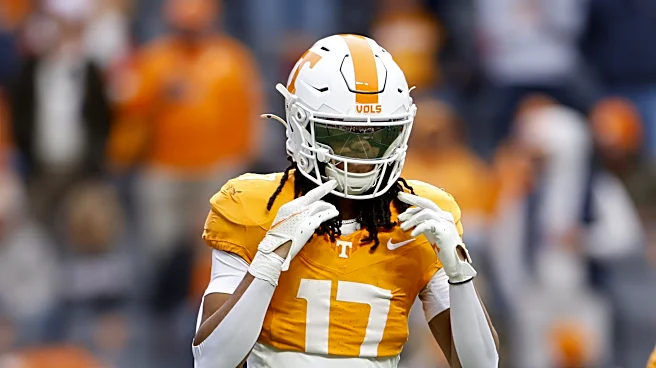
Chris Brazzell is ahead of Hurst on the consensus board, and I sort of understand why that is, but I also think he’s a tad overrated. More than anything, I don’t really trust receivers out of the Josh Heupel’s super-efficient Air Raid style Tennessee offense. I’ve seen those guys dominate SiYAA before, and in fact the one player above 600 SiYAA who hasn’t worked out great in the pros is former Volunteer Jalin Hyatt. Fool me twice…
On the other hand, Brazzell is a transfer (who isn’t these days), and as a redshirt freshman at Tulane, he put up an extremely efficient 711 yards and 5 scores, and so it’s not ALL the system to be sure. And there is plenty to like. Brazzell didn’t run agilities or explosion drills at the combine (who does these days?) and so all we know for sure is that he’s tall, and fast. However, he put those qualities to good use as one of the premier deep threats in college football, catching 13 of 23 targets of 20+ yards last season, while also excelling in the full route tree thanks to savvy deceleration skills and an exceptional catch radius.
He doesn’t carry weight as well as Hurst and he can be bullied as a result, but he also gets the most out of his wiry frame and knows how to use his length to create extra separation. He’s never going to be a dominant blocker, but there’s a good argument that he is the best “pure receiver” of this group. I wish we had agility numbers on Brazzell because his tape appears impressive in terms of quickness, especially near the end zone. My big concern is whether he can generate clean releases from NFL corners.
He’s likely to be available in the second. I’m not a fan of him there, but should he fall, he would be a fine addition in the third.
Malachi Fields
6-4, 218. Consensus Board: 76. RAS 7.49 (Slow, but fine 3-cone). SiYAA: 154
I’m cheating a bit here because Malachi Fields isn’t fast, though what he lacks in speed he makes up for in hugeness. This guy is absolutely enormous. The ten pounds he has on Hurst show up on tape, and if nothing else, Fields is a bully. Of this group, he has the best body control, and frequently asserts himself physically, which helps to compensate for the lack of separation he sometimes experiences due to that lack of top-end speed.
Speed isn’t everything though, and despite his size, he is shifty and got himself open enough to boast a robust 16.4 ADOT. Despite mostly doing work downfield, he suffered only one drop last season (and three in this last 25 games), though he did struggle slightly with actual contested catches (11/23). He’s a willing and able blocker, and I suspect the physical nature of his play (contested catches notwithstanding) will appeal to the Packers.
How you feel about Fields mostly comes down to whether you really want a burner or if you’re fine with a more complete receiver who isn’t going to scare NFL corners deep. That can definitely work, and Fields has much to offer, but at 52 I think you can likely do better.