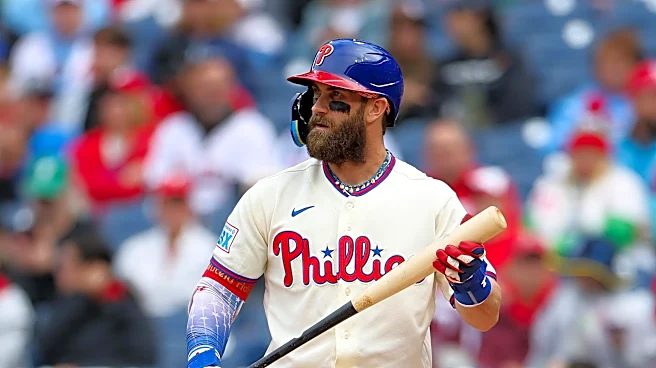


To answer it right off the bat: no, Bryce Harper did not have an elite season. A good season, certainly. But not elite. There certainly will not be a repeat the rigamarole on the matter that followed the 2025 season, in part because the matter is somewhat tired at this point: you get one passive-aggressive t-shirt for a controversy, and no more, that’s in the collective bargaining agreement. Speaking of CBAs, that’s the other reason why we won’t likely be spending the offseason discussing the question
of Harper’s eliteness. There are bigger fish to fry. And that frier may be located in a federal courtroom. But while the lawyers prepare to go to work, we can, and should, take a look at Harper’s 2026 season. We’ll look at the stats, and discuss, and provide a letter grade. We’re leaving adjectives out, though. You’ll have to provide one yourself.
2026 stats: 162 games, 269/.380/.485, 865 OPS, 29 HR, 87 RBI, 7 SB, 21.4 K%, 15.4 BB%, 135 wRC+, 3.3 fWAR
What went right
Much of the Phillies lineup struggled at the plate last year. Bryce Harper did not. He was just one of three qualified batters on the team to post a wRC+ above 100; his 135 in that category lead the team, and was 15th league-wide. He took a somewhat more patient approach at the plate, lifting his walk rate by 3.3%, while maintaining his power. And he did all this as an ever-present force in the lineup, playing in all 162 regular-season games. He also addressed a weak point from last year: in 2025, the best way to handle him was to throw him breaking balls(wOBA of .310 against, as compared to .405 for fastballs and .362 for breaking balls). His performance against the moving stuff was much better this year (wOBA of .342), chasing and whiffing on them less. The differences between Harper’s 2026 and his 2025 weren’t enormous. He was better in 2026, but not by a whole lot. Still, given that the baseline he was working with, slightly better than 2025 means “very good”. He received downballot MVP votes, finishing 15th in the Senior Circuit; that seems like a fair summary of his season.
What went wrong
Despite improvements at the plate, his 2026 fWAR wasn’t meaningfully different than the number he posted in 2025 (3.3 this season, 3.4 the year prior). That was due to a downturn in his glovework: he posted a -5 Outs Above Average and a Fielding Run Value that was -10 by FanGraphs’ numbers and -12 by Baseball Savant’s (vs. 1 OAA and -1 FRV a year prior). Among first basemen, only Spencer Torkelson of the Tigers posted a lower OAA, and none posted a lower FRV. His arm was good, but no first baseman was worse at receiving throws.
He also graded out as negative as a baserunner: his decisions on advancing and stealing ended up doing him more harm than good.
And while most of the news from his work at the plate was good, he did post a worrying downturn in his performance against offspeed pitches (wOBA of .294, down from .362). He swung at them less, but whiffed more often when he did. And when he did hit them, he didn’t hit them as hard as he had the year before. That’s part of a longer trend: his slugging percentage against offspeed pitches was .612 in 2024; now it’s .342. Not coincidentally, pitchers threw him more offspeed stuff than they had in 2025; he gave opposing hurlers an avenue of attack.
Final Grade: B
If we were grading by a universal standard, this would probably be higher. If you played well enough to pick up some MVP votes, you should probably be getting at least a B+/A-. But Harper, as a star and as the face of the franchise, is held to a higher standard, both by himself and those around him. His performance at the plate was good, though not on par with his best years. Fairly or not, Harper is expected to be superhuman and transformative for the team; him merely being very good with the bat in 2026 feels underwhelming, if only because we have so many memories of him being so much more. More fair is dinging him for his poor baserunning and lackluster fielding.
A Bryce Harper B-grade season is a better season than most players will ever produce. The B-tier work of an average player shows nothing to get excited about, while the B-tier work of a star shows the flashes of brilliance that remind us of their best work. You didn’t have to read this far to know that Bryce Harper wasn’t quite elite in 2026; not only did we state it at the top, but you saw it for yourself. But you’ve also seen enough to know he’s a player about whom the question will be asked. That’s an honor in itself.