
There is a particular kind of uncertainty that clings to every NBA draft pick — the wide-eyed, romantic uncertainty of projection. It is the mystery that animates fanbases, front offices, and entire ecosystems
of scouting jargon: Will he translate? Will he blossom early or late? Will he break your heart or redefine your franchise?
We accept this uncertainty because it feels hopeful. Even if it masks failure more often than it delivers greatness, it keeps the imagination alive. There is nothing more seductive than the blank canvas of potential.
But what we rarely discuss — and what the Mavericks now find themselves ensnared by — is the other side of that same uncertainty. The back half. The decline curve. The part of a career where the player is no longer being evaluated on who they might become, but who they were, and what remains.
This is the delta — the dangerous gap — between what a player expects to be paid for and what the market can reasonably justify, based on declining availability, diminishing lift, and the cruel actuarial math that governs professional sports. And no one sits more squarely in that delta right now than Anthony Davis.
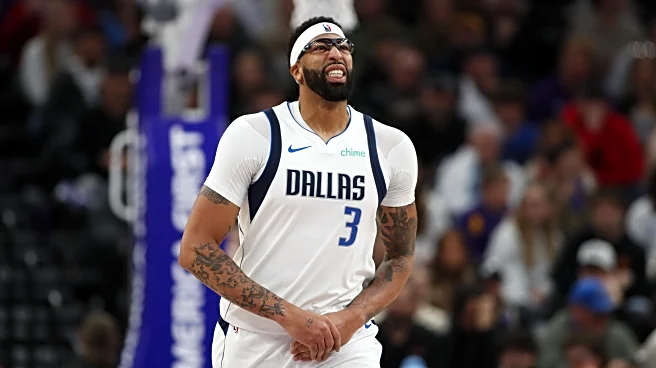
Let’s be clear: Davis, when healthy, remains an impactful player. The Mavericks have been undeniably better with him on the court this season. His presence still bends defenses, his timing on the glass still swings quarters, and on his best nights, he reminds you of why he once stood alongside the pantheon of current bigs that matter most.
But he turns 33 years old on March 11th, and that milestone arrives in the middle of his current three-year, $175 million contract, which includes a $62.8 million player option for 2027–28. Worse, he becomes eligible this August for an extension that could reach four years and nearly $275 million, pushing the total investment into the stratosphere for a player whose injury history is not speculative, but chronic.
The financial backdrop matters here. Davis is owed $54.1 million this year, then $58.5 million next season, followed by a $62.8 million player option in 2027–28. Come August 6, he’s eligible for a four-year, $275 million extension — a number that hovers like a storm cloud over every trade discussion. The Mavericks, already $1.1 million below the second apron and projected to exceed it next year, cannot legally take back more salary in a deal. The new CBA was designed to punish bloated rosters and inflexible cap sheets, and Davis is the embodiment of both. Davis’ agent Rich Paul knows what his client’s résumé demands. The cap system doesn’t care. The question for Dallas — or anyone else — is whether the production still justifies the weight. Whether the man is still worth the math.
In a vacuum, Davis can still help you win. But cap sheets are not vacuums. They are zero-sum constraint systems. And no matter how fondly you recall his Bubble dominance, the cost of betting on his body in 2026 is not theoretical — it’s your future.
This is what Golden State confronted last season with Jimmy Butler.
Pat Riley, presiding over Miami’s front office with his usual cold-eyed clarity, declined to offer Butler the max extension he sought. Not because Butler wasn’t beloved, and not because he wasn’t still effective. But because Riley understood the delta — that once a player’s production no longer justifies their financial weight across the arc of a contract, you are not just overpaying them—you are subsidizing mediocrity.
Golden State didn’t care. Desperate to give Stephen Curry one last run, they traded for Butler anyway. It made sense emotionally. It even worked on the court. But Butler tore his ACL earlier this month, and now the Warriors are staring down the barrel of two lost seasons and $100 million in sunk cost. The risk wasn’t theoretical. It came true.
So here’s the question: Is there a team out there desperate enough to make the same bet on Davis?
Because the Mavericks, despite whispers to the contrary, do not want to keep him long-term. They’ve postured otherwise, of course — suggesting that Davis and Kyrie Irving might finally align with Cooper Flagg in the future. But those statements felt less like conviction and more like a late-stage poker bluff — trying to create the illusion of leverage in a marketplace that saw through the hand. Then the hand injury came.
Now, Davis is sidelined through the trade deadline, unable to suit up, with teams hesitant to trade assets for a player they can’t see on the floor. Even if they believe in the talent, you don’t trade for a 33-year-old with a lingering injury and then immediately hand him a quarter-billion-dollar extension, unless you’re irrationally hungry or recklessly nostalgic.
Rich Paul knows this. And make no mistake: Davis still sees himself as a max player. He still envisions a post-career portfolio shaped by one final, massive contract. He is not merely playing for love of the game anymore. He is playing for a financial legacy. There is nothing wrong with that — it’s rational. But it collides violently with the direction Dallas must now pursue.
And here’s the cruelest irony in all of this: the Mavericks were just in the NBA Finals less than two years ago.
Most franchises would treat that as a mandate to stay the course. To make tweaks, yes — but not to abandon the path altogether. Instead, Dallas did the unthinkable. They traded Luka Dončić. For Davis. And Max Christie. And a pick. It was the basketball equivalent of selling a working engine for vintage parts and promising blueprints.
And the only thing — the only thing — that salvaged that decision was luck.
The Mavericks entered the 2025 Draft Lottery projected to pick 11th. But the ping-pong balls broke their way. And in an instant, Cooper Flagg became their new cornerstone. If that doesn’t happen? If they end up with Cedric Coward or Collin Murray-Boyles — solid, intriguing prospects, but not transformative ones — then this franchise isn’t just confused. It’s lost. Luka is gone. Davis is aging and seemingly stuck in an injury recursion loop. Kyrie Irving is eventually returning from a serious injury and nearing his own decline. The draft capital is spent. There is no salvation—or so it seemed.
Instead, they got Flagg. A star that wasn’t scouted — he was gifted.
And now, they must act like a team building around him. That means shedding salary, not hoarding it. Acquiring picks, not spending them. Finding developmental arcs, not delaying them. There is no version of this next era where Anthony Davis is your tentpole. And the longer you pretend otherwise, the more you betray the good fortune that saved you.
Every NBA front office eventually confronts the delta. The moment where a player’s self-worth exceeds their actual yield. The moment where the name on the jersey still echoes, but the knees underneath it say otherwise.
The best teams see that moment coming. The rest pretend it isn’t there.
Dallas has a week to decide which one it wants to be.