
The 2005 season marked the beginning of the end of an era in Yankees history. In his age-36 season, longtime center fielder Bernie Williams put together the worst performance of his career by far, accruing
-1.6 rWAR in 141 games thanks to a combination of lackluster defense and a paltry 86 OPS+. To make matters worse, the team had no obvious replacements on the roster, with Bubba Crosby and his career 47 OPS+ representing the best option. At the same time, despite having a small army of power hitters in the middle of the order, the Bombers lacked a prototypical leadoff hitter, pushing Derek Jeter out of his customary No. 2 spot and forcing manager Joe Torre to rotate Alex Rodriguez, Hideki Matsui, and a young Robinson Canó through Jeter’s old spot in the lineup.
Fortunately for the Yankees, the outfield market was filled with quality center fielders, with Mike Cameron, Kenny Lofton, and Juan Pierre all hitting free agency. In the end, though, it would be the former Boston Red Sox outfielder Johnny Damon — long a thorn in the Yankees’ side — who would shave his beard, cut his locks, and become the latest Boston fan favorite to defect to the Bronx.
Johnny Damon
Signing Date: January 3, 2006
Contract: Four years, $52 million
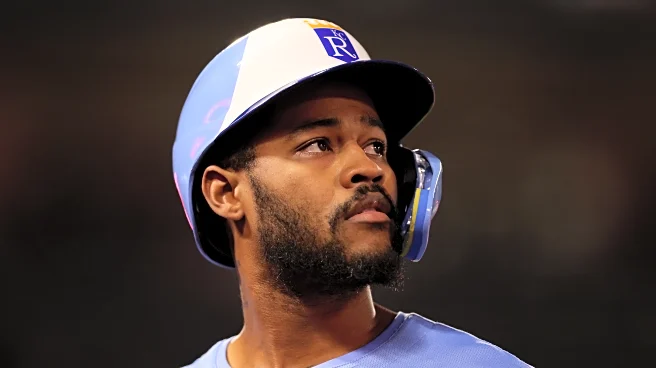
Johnny Damon was no stranger to switching teams. Originally drafted in 1992 by the Kansas City Royals, he had spent the first six years of his career in Missouri before being traded to the Oakland Athletics ahead of the 2001 season. After one year in California, Damon signed a four-year deal with the Boston Red Sox. As a core member of the 2004 squad that we don’t like to talk about here at Pinstripe Alley, he quickly became a fan favorite in Beantown, and his caveman-like facial hair became not only his defining feature, but one of the defining features of the Red Sox. And so, when he declared “There’s no way I can go play for the Yankees” in May 2005, Boston fans had little reason to disbelieve him.
Free agency is a funny thing, though — especially for Scott Boras clients. Heading into his age-32 season, Damon clearly knew that this was his last good shot at earning a long-term deal, and so, Boras started the winter seeking a seven-year deal for his client. Recognizing his age, though, the Red Sox held firm for a three-year deal, even as the center fielder lowered his demand from seven years to five. But with the Red Sox front office in turmoil — general manager Theo Epstein had resigned on Halloween that year, and while he would eventually return prior to the front office in January 2006, the organization had been directionless and leaderless throughout the entire free agent period.
And so, when the Yankees delivered a four-year deal worth $52 million (“Bubba Crosby is our center fielder” be damned), Damon ignored his previous comments and didn’t reject it out of hand. And when his old friend and Oakland Athletics teammate Jason Giambi called to pitch him on New York, he listened. And in the end, he committed to the razor, agreeing to the deal even as Red Sox chief baseball executive Larry Lucchino was speaking to reporters about the team’s stalled negotiations with their popular center fielder.

The move paid dividends for the Yankees. With a career-high 24 home runs and 25 stolen bases (his most in a season since 2003), Damon stabilized the top of the order and earned down-ballot MVP votes. His 2007 season, however, saw his OPS and home run total drop, and while it was not his fault he lost the starting center field job to Melky Cabrera — Damon was simply taking the majority of the DH at-bats while Giambi was on the shelf with an injury — it was fair to wonder whether the Yankees had paid solely for Damon’s decline.
Fortunately for them, Damon appeared to recognize that he needed a change, and he began to reinvent himself as a quasi-power hitter, a change that Brett Gardner would also make later in his career. Now serving as the full-time left fielder, he posted a .303/.375/.461 slash line with 17 home runs, 27 doubles, and 5 triples, while still managing to steal 29 bases.
Damon’s first three years in pinstripes were nice, but in the end, it was the 2009 season that turned Damon from a solid free agent acquisition into a permanent part of Yankees lore. It’s not just that Damon had one of the best seasons of his career, tying a career high in home runs (24) and setting a career high in walks (71). It’s not just that the Yankees won the World Series in that season. No, what really cemented Damon’s status as a Yankees fan favorite is the fact that he was at the center of the Yankees’ return to the top. He drilled a walk-off home run on May 19th, the third straight game the Yankees won in walk-off fashion, helping to cement the 2009 Yankees as a team that could never be counted out. He had nine hits in the ALCS, including a pair of home runs, to help lead the Bombers past the Angels in six.
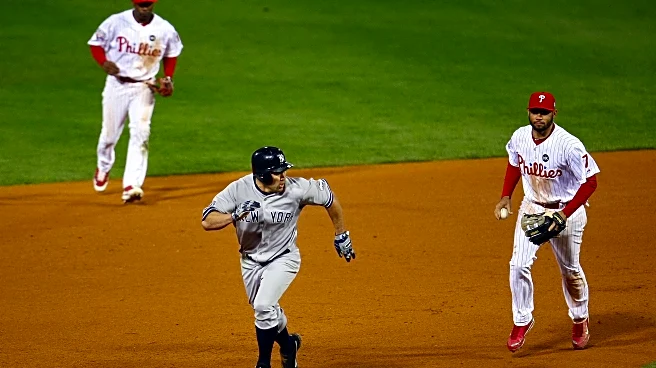
But his biggest moments in pinstripes came in the World Series. His numbers themselves were impressive enough — a .364/.440/.455 slash line with eight hits and four runs scored. But it was the ninth inning of Game 4 that made Damon a villain in the city of Philadelphia, one who is cursed by my Philly friends even two decades later. With two outs in the top of the ninth in a 4-4 game, Damon came to the plate against Phillies closer (and professional archaeologist) Brad Lidge. After falling behind 1-2, he battled back to force a full count, then laced a single to left field. On the first pitch to Mark Teixeira, he stole second, and then, noticing that third base was uncovered because the Philadelphia defense was in the shift, nabbed third on the same play. Having the go-ahead runner on third took Lidge’s best pitch away from him, and the middle of the order dropped a three-spot to put the Yankees one win away from their 27th World Series championship.
Due to his age, the Yankees opted not to re-sign Damon that winter despite his important role in the World Series championship. He proceeded to sign a trio of one-year deals — with Detroit in 2010, Tampa Bay in 2011, and Cleveland in 2012 — and while he hoped to return to the Bronx in 2013 to help his old team deal with the organization’s numerous injuries, that would be the end of Damon’s baseball career. And while having Damon on the 2013 Yankees may have been a fun epilogue to his career, at the end of the day, the fact that he left the Bronx as a World Series championship is perhaps the best legacy for the rare player who became beloved in New York and Boston.
Sources
Griffin, John. “25 Smartest Moves of the Past 25 Years: Yankees sign Johnny Damon.” Pinstripe Alley. January 27, 2022.
Hayes, Malachi. “Pinstripe Alley Top 100 Yankees: #99 Johnny Damon.” Pinstripe Alley. October 24, 2023.
“Johnny Damon.” Baseball Reference.
“Johnny Damon.” BR Bullpen.
Kepner, Tyler. “Yankees Add their Centerpiece: Damon Leaves Red Sox and Agrees to a 4-Year Deal.” New York Times. December 21, 2005.
Kepner, Tyler. “Yankees Outhustled Red Sox to Get Damon.” New York Times. December 22, 2005.
Marchand, Andrew. “Johnny Damon makes pitch to Yanks.” ESPN. February 25, 2013.
Sussman, Matthew T. “Boston Might Not Like Johnny Damon Anymore.” BC Sports. May 2, 2006.
See more of the “50 Most Notable Yankees Free Agent Signings in 50 Years” series here.