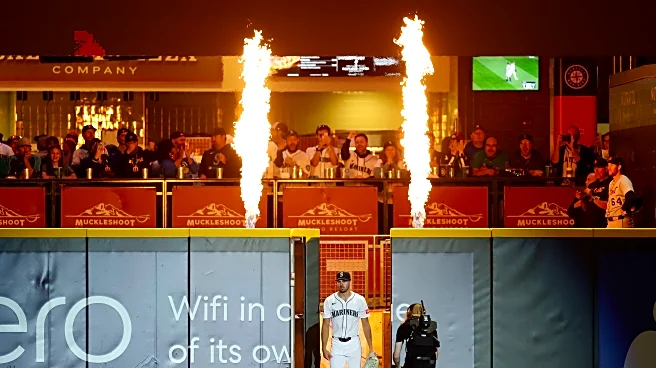

We thought we knew Matt Brash—a slider-slinging, fastball-fueled thrill ride of dominance and destruction with the occasional meltdown thrown in to keep you on your toes. But after Tommy John surgery kept
him out for the entire 2024 season, Brash flipped the script in 2025, using two new pitches to get steadier results. He’s no longer the Matt Brash we knew, and he may have even more in store for us this year.
The guy we’d grown accustomed to in 2022 and 2023 featured an outlier slider as his most frequent pitch, playing off a four-seamer with elite velocity and mixing in a wicked knuckle curve. It was one of the most visually satisfying arsenals in the sport, and he used it to make even the best hitters in the game look like whiffleballers. But the extreme features of his pitches allowed him to aim pretty far outside the zone, so while his overall walk numbers were tolerable, they could pile up if his command was shaky on a given day.
That’s not the guy we saw come back from Tommy John surgery.
The big thing that did not change—thank god—was the most important arrow in his quiver. That slider? Yep, Matt Brash is still the freakiest freak:

And it’s still the centerpiece of everything he does. He threw his slider nearly three-fifths of the time this past year, and it remains catnip for highlight reels and Pitching Ninja clip shows. Probably nothing will ever top the José Ramírez pratfall from 2023 (if I were Brash, I’d want my epitaph to just be a .gif of that pitch), but this is still pretty fun:
A new arsenal
To start with, he stopped throwing his knuckle curve this year. Brash would tell you that pitch is actually a second slider, so to be sure this wasn’t just a classification change, we double-checked with Mike Petriello, King of the Nerds over at MLB Advanced Media, who confirmed that this was actually a change in Brash’s repertoire. John Trupin thinks Brash ditched it this year because of the way he pulls his curveball down during release, making it hard for Brash to throw as he still recovers from his surgery. It’s a good pitch, so it doesn’t make a ton of sense for Brash to just abandon it. And it’s not uncommon for pitchers to have to drop a pitch in their first year back from TJ. We’ll ask Brash about this once action starts and Lookout Landing is back in the press box.
But despite how good a pitch the knuckle curve is, the other changes are actually more important. Most notably, he taught himself a kick change during his recovery. And it turns out to be an excellent one.
The key thing this has done is neutralize his splits against lefties. Developing an offspeed pitch is a tried and true strategy for guys with big platoon splits. It worked for Brash to the tune of knocking almost three points off his ERA and a point and a half off his FIP against southpaws. He increased his strikeouts against them, cut his walks in half, and the contact lefties made off him was about 25% worse.
But Brash ended up in about the same place, despite getting so much better against opposite-handed hitters. The big reason is that he stopped being quite so dominant against righties, and the culprit there is a change to his fastball, which involved a tradeoff of dominance for steadiness.
Brash’s fastball had previously been his weakest pitch, and I was totally willing to live with it because it made the whole package work. But in 2025, Brash replaced his four-seamer with a sinker, a pitch he’d toyed with before but never relied on. For most pitchers, swapping out a four-seamer for a sinker means sacrificing some whiffs in exchange for inducing worse contact. That’s a dangerous trade for a strikeout pitcher. But Brash can get whiffs from his slider whenever he wants, and the improvement on contact was so dramatic that this tradeoff worked out for him.
A new arsenal means a new profile
The combination of adding a changeup and swapping fastballs, has made Matt Brash one of the game’s foremost groundball pitchers while maintaining his penchant for punchies. The tradeoff from his fastball swap involved sacrificing some strikeouts, but fewer strikeouts for Matt Brash is still a lot. So among the 191 relievers who threw at least 40 innings last year, Brash is one of only five players who was in the top 20% for both strikeout rate and ground-ball rate.
The combination of strikeouts and ground balls means disaster is way less likely to strike no matter how many guys you walk, especially if you’re no longer vulnerable to a platoon pinch-hitter. Your command might get you into a jam, but you’re more likely to get that double-play ball or just get the guy at the plate; the game probably isn’t going to blow up. While the average reliever ended 51% of his appearances with a strikeout or a groundball, Brash’s figure is 62.4%. That’s 11th out of the 191 relievers in our sample. And indeed, Brash’s Meltdowns/Appearance ratio hit a new low. You might still think of Brash as a guy who’s prone to the occasional fiasco, but that’s not really his deal anymore.
With an overall package that was a little less flashy but also a little less prone to catastrophe, he ended up in the same place in a new way. Some of the summary stats will deceive you. His FIP went up because it punished him for fewer strikeouts, but did not reward him for improving his contact because its only way of accounting for contact quality is HR/9. Brash went from 3 dingers over 71 innings to 4 dingers over 47 innings, but while that’s a decent change to the HR/9 ratio, the absolute numbers just feel too fluky for me to put stock into. Meanwhile, his ERA went down as his BABIP came back to earth following the third highest mark in 100 years (which, by the way, remember how he had the third highest BABIP in a century?!). So, even if you mentally account for Brash having thrown fewer innings, his fWAR (based on FIP) doesn’t look as good as 2023, and his rWAR (based on RA/9) looks better. But his xERA, which accounts for strikeouts, walks, and contact quality, stayed at exactly the same 3.25 in 2025 as it was in ’23. Personally, I’ll take the steadier version, especially since the new version is still plenty flashy.
A new, new Matt Brash?
And yet, some of that lost flash might come back.
First, we can expect to see him bring back that knuckle curve this year. A fourth good pitch can only help him.
Second, I think there’s room for refinement in his fastball usage. His four-seamer is still a big whiff generator against righties, and if he starts throwing it again, but in a more limited, strategically deployed way, he may be able to pump up those K numbers against northpaws without doing too much harm to his contact quality.
But finally and perhaps most importantly, the other big difference this year was that his velocity dropped from where it was pre-surgery. In 2023, his heater averaged 98.1 mph (and his two-seamer was at 98.5), while in 2025, it dipped to 96.4, and his slider went from 88.8 to 86.0. It’s possible that’s the new normal. That can happen. But it’s not unusual for velocity to come back in the second year back on the mound after TJ. Brash might even be more likely to be one of those guys since he came back from surgery on the early side of the typical recovery timeline.
That’s a tantalizing possibility because extra velo can make a huge difference at this point on the spectrum. Using league averages, the difference between hard stuff in the 95-97 mph range and heaters in the 97-99 mph range is a difference of 0.79 points worth of ERA against fastballs. And that’s to say nothing of how having your other pitches play off a better fastball will improve those pitches too.
It can be easy to default to writing a 40 in 40 along the lines of He Might Be Better This Year. But I really can see it happening here. To be sure, it’s not something you should expect for Brash, but considering the high baseline, the possibility of an even better Matt Brash makes the mouth water.