
The Kansas City Chiefs can no longer ignore the problem staring them right in the face, growing larger by the day. It’s time to make another significant investment in the wide receiver position to find a long-term answer at the position.
The problem is obvious. The solution, less so.
The Chiefs enter the offseason with just six wide receivers signed to the 90-man roster: Xavier Worthy, Rashee Rice, Jalen Royals, Jason Brownlee, Andrew Armstrong and Jimmy Holiday. Only Worthy and Rice have seen meaningful
playing time among that group.
That makes depth important to address this offseason, but it isn’t a more significant need than to find a true alpha, no.1 receiver capable of carrying the load in 2026 and beyond.
If that wasn’t already the case, Rashee Rice’s latest offense — a civil suit filed by his ex-girlfriend alleging physical abuse over the course of a year and a half — emphasizes it. These are serious allegations that the NFL will take notice of because Rice will be viewed as a repeat offender under the league’s personal conduct policy if any discipline is deemed necessary.
A lengthy suspension based on these allegations would not be surprising.
That means Rice could miss a sizable portion of his final year under contract with Kansas City. It’s a massive loss on the field, but a stark reminder that the Chiefs simply can’t trust Rice; a long-term contract offer would be a mistake.
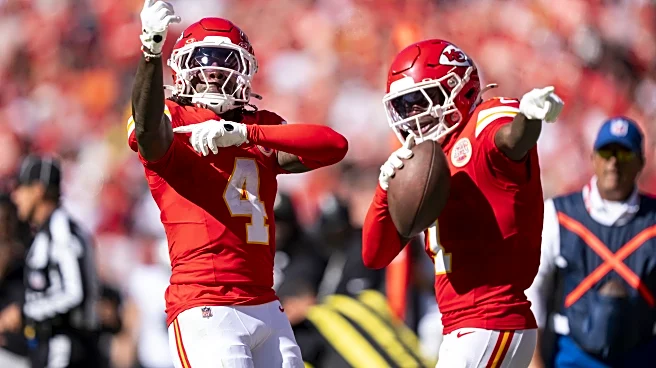
That leaves Worthy as Kansas City’s lone wide receiver under contract with any track record. Worthy has 1,170 receiving yards in his first 31 career regular-season games. There are explanations for why the production hasn’t been greater, but the reality is he can’t and shouldn’t be counted upon as the team’s number one wide receiver at this point in his career.
So, who could be? There are three ways to acquire players in the coming months:
Free Agency

Free agency is generally preferable because it simply requires monetary investment. It isn’t as straightforward for the Chiefs, who entered the offseason nearly $60 million over the cap. The team has already carved a large chunk out of that deficit with this year’s restructure of quarterback Patrick Mahomes’ contract, with the potential for more similar moves to come.
It’s hard to open up the kind of space necessary to add an alpha wide receiver, however.
Regardless, such a wide receiver will be hard to find in this particular free agent market. Among the best names of the bunch, one will just be an honorable mention: Deebo Samuel. He just doesn’t fit what the Chiefs need at this point in his career.
Rashid Shaheed is a fun player, but he’s probably not enough of a volume receiver to fill the role the Chiefs are looking for.
Alec Pierce is a good player, but he’s more of a deep threat than a target monster, and should command something in the neighborhood of $25 million per year.
Mike Evans doesn’t fit the typical model Kansas City follows being a 33-year old receiver with a recent injury history, but his production is hard to ignore. 2025 was the first season he failed to eclipse the 1,000-yard plateau in his 11-season career. He is a matchup nightmare in the red zone and should command more than 100 targets per year if healthy.
The Athletic is projecting Evans to earn a two-year contract worth more than $50 million, while Pro Football Focus is projecting a one-year, $18 million deal. Both are probably out of the Chiefs’ price range, barring significant changes to their cap situation.
Jauan Jennings and Romeo Doubs are projected to land deals three or four years in length worth roughly $15 million per season. That’s more palatable for the Chiefs’ cap situation.
Doubs fits more of what general manager Brett Veach typically looks for as a 26-year old receiver on the upswing of his career, but Jennings could provide Kansas City a plug-and-play for the offense. Both players could be strong additions, but may not be easily sold to the fans as the solution.
There is an enormous, yet familiar elephant in the room: Tyreek Hill. The risk is obvious: he’s prone to his own off-field issues, he is recovering from a catastrophic knee injury, he is 32 years old and his GPS tracking numbers have shown a decline in his speed even before his injuries.
The on-field rewards have always been easy to recognize: he knows the offense. He has prior relationships in the locker room. Before his injury last season, he was on pace for more than 1,000 receiving yards.
I personally wouldn’t advocate for the Chiefs to go this path, but purely from a football perspective, I understand the appeal.
Trade Options

The free agent options leave something to be desired.
You can’t say that about A.J. Brown. He’s a stud when he’s at his best for the Philadelphia Eagles, but the cost to acquire him is likely astronomical. Kansas City would have to depart with the 40th overall pick and then some, while Brown will be 29 years old next season with a significant salary for multiple years. It just doesn’t seem realistic.
DJ Moore and Michael Pittman Jr. are far more realistic. Both would cost slightly more than $20 million this year.
Pittman is entering the final year of his deal with the Indianapolis Colts, while Moore still has four years remaining with the Chicago Bears — but Moore could be cut if Chicago decides he is no longer worth that money. The cost to acquire either player shouldn’t be nearly as high as it would be to land Brown.
To compare, it feels preferable to sign from the group of Evans, Jennings and Doubs rather than committing money and a draft asset for Moore or Pittman.
The team the Chiefs should be calling to discuss trades is the Jacksonville Jaguars. Jacksonville made the decision in-season to extend Jakobi Meyers, even with two recent first-round picks at the position, including last year’s second-overall pick, Travis Hunter.
Parker Washington and Brian Thomas Jr. would be extremely interesting trade options for Kansas City. It would be interesting to know if the Chiefs’ second-round pick would be enticing enough to strike a deal.
The Draft
This feels like the most realistic path for Kansas City to solve the wide receiver quandary. There appear to be three wide receivers worthy of a top-10 selection this year:
- Makai Lemon, USC
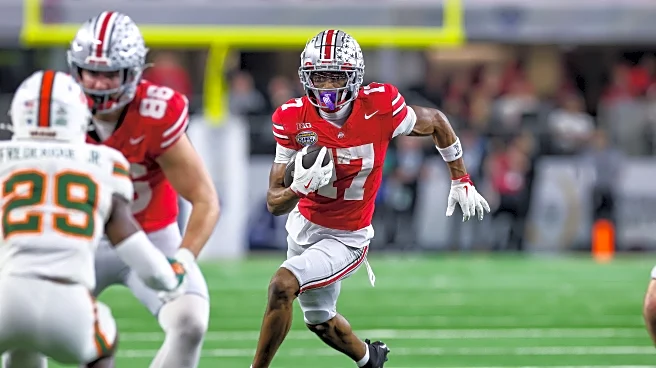
- Carnell Tate, Ohio State
- Jordyn Tyson, Arizona State
Each would immediately serve as a go-to weapon in the Chiefs’ offense — but the depth of this receiver class goes beyond the top 10 picks. Daniel Jeremiah of NFL.com has 11 wide receivers ranked among his initial top 50 prospects in the 2026 NFL Draft, including:
- Denzel Boston, Washington
- KC Concepcion, Texas A&M
- Antonio Williams, Clemson
- Chris Brazzell II, Tennessee
- Malachi Fields, Notre Dame
- Deion Burks, Oklahoma
- Zachariah Branch, Georgia
- Chris Bell, Louisville
That’s a long list of playmakers who could be available to the Chiefs — but the proper value in selecting them could come from trading cornerback Trent McDuffie for a late first-round selection, or just at 40th overall.
The bottom line
Fixing this wide receiver problem won’t be easy. It’s going to require significant investment. There are multiple paths Veach could go, and his ultimate choice will have a trickle-down effect on what he can do to fix other positions.
This wasn’t supposed to be necessary. Rice and Worthy were expected to be the future, but Rice has solidified mistrust from the Chiefs, who know a move needs to be made.
For now, we wait.