
Today is nomination day, so head to the comment section to nominate the next batch of prospects for Monday’s CPL.
The San Francisco Giants may be inactive at the moment, but the 2027 Willie McCovey Memorial Community Prospect List is not. The team doesn’t seem to see it fit to add any players, but we see it very fit to add players … to our list of the top 44 prospects in the organization.
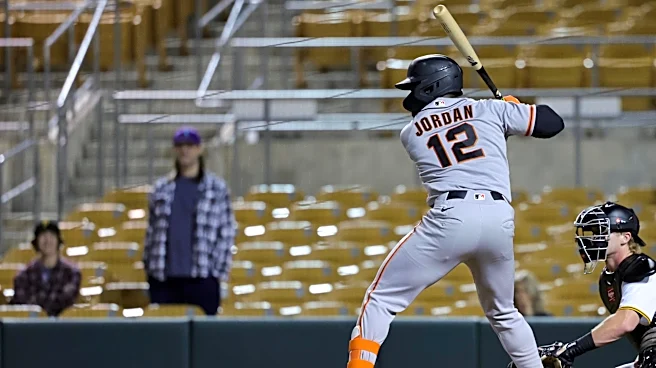
Our next prospect is a polarizing player entering a very critical year: it’s outfielder Dakota Jordan, who has
been voted as the No. 12 prospect in the system, which is a drop of seven spots from his No. 5 ranking a year ago.
Jordan, a right-handed hitter who was taken in the fourth round of the 2024 draft (but given a signing bonus commensurate with an early second-round pick), had a bit of a drop zone of a season. The spectacularly athletic Mississippi State alum, who turned 23 in May, had a first half of the season that was dreamily high, and a second half that was frighteningly low.
It started with a High-A debut which went (mostly) brilliantly. Jordan kicked off his second Minor League season with the Eugene Emeralds, where he hit .290/.346/.533, good for an .879 OPS and a 125 wRC+. In just 81 games he smashed 18 home runs (including three in his final game), and stole 15 bases, while primarily playing in center field (and playing well there, I’d argue). That stint earned him a spot on the Northwest League All-Star team, alongside shortstop Jhonny Level (No. 4 on this list), starter Jacob Bresnahan (No. 7), reliever Ryan Vanderhei, and manager Jacob Heyward.
But even in the highs, there were some warning signs. The hit tool for Jordan has always been the biggest (and perhaps only) concern, and it showed itself with a 27.6% strikeout rate and a 16.1% swinging strike rate … marks that were 47th and 58th, respectively, out of 70 hitters in the league (minimum: 200 plate appearances).
Still and all, the performance overpowered the red flags, and at the All-Star break he was sent across the country to test his fate against Eastern League competition for AA Richmond. He started out hot, but the league — and an injury — quickly caught up to him. Jordan — who was mostly moved to the corners in deference to the defensively-superior Trevor Cohn — lost over a month due to injury, and in his 21 games with the Flying Squirrels hit just .253/.330/.367 for a .697 OPS and an 87 wRC+, with just one home run in 88 plate appearances.
In Richmond, the red flags were just as red, as Jordan’s strikeout rate rose to 29.5% and his swinging strike rate to 16.8%. Those flags turned crimson after the season ended, when the Giants sent Jordan to the Arizona Fall League, where he hot 20-87 with one home run and struck out 33 times.
For Jordan, the positives are tantalizing. He is, I’d argue, the second-best athlete in the system behind only Josuar González, with power potential that rivals Bryce Eldridge, and speed that would make a sprint against Jonah Cox be worth watching. He finished fourth in the Giants system with 19 home runs, despite being just 19th in plate appearances, and he stole 21 bases while being thrown out just twice. If you close your eyes and dream a little, it’s not hard to imagine a 30-and-30 player providing either plus defense at an outfield corner or passable defense in center.
But the negatives — or negative, singular — is just as extreme as the positives. Jordan’s hit tool is simply too large to ignore. His ability to recognize spin is very poor, and his ability to make contact isn’t good enough to justify the magic that happens when he does make contact. One look at some Giants who have contact issues in the Majors tells you exactly how far behind Jordan really is: Jonah Cox, who struck out 38.5% of the time for the Giants this year, had just a 16.9% strikeout rate and a 10.2% swinging strike rate in AA this year.
For better or for worse, the best comp for Jordan might be Tyler Fitzgerald, who had very similar, but slightly worse strikeout and swinging strike rates in AA. On the one hand, Fitzgerald is an example of how much those loud tools can play despite the contact issues; on the other hand, he’s a painful reminder of how this profile usually ends up. So for Jordan, the question going into 2027, when he’ll resume life in Richmond, is twofold: can he improve on the 20 or 30-grade hit tool, and can he survive in spit of it? Those questions will ultimately determine wether he flames out in the Minors, flames out in the Majors, or has a successful big league career.
Now let’s add to the list! As a reminder, voting now takes place in the comment section. As a second reminder, it’s nomination day!
The list so far
- Josuar González — SS
- Jackson Flora — RHP
- Luis Hernández — SS
- Jhonny Level — SS
- Ramon Marquez — RHP
- Bo Davidson — OF
- Jacob Bresnahan — LHP
- Gavin Kilen — SS
- Henry Lalane — LHP
- Argenis Cayama — RHP
- Carson Bolemon — LHP
- Dakota Jordan — OF
Note: Clicking on the above names will link to the CPL where they were voted onto the list.
No. 13 prospect nominees
Trevor Cohen — 23.0-year old OF — .803 OPS/117 wRC+ in High-A (380 PA); .736 OPS/99 wRC+ in AA (228 PA)
Parks Harber — 25.1-year old 3B — .879 OPS/131 wRC+ in AA (298 PA); .739 OPS/98 wRC+ in AAA (250 PA)
Joniel Hernandez — 17.8-year old SS — .978 OPS/132 wRC+ in DSL (238 PA)
Keyner Martinez — 22.3-year old RHP — 4.61 ERA/4.77 FIP in Low-A (93.2 IP)
Note: Each player’s first name links to their Baseball-Reference page, and their last name links to their Fangraphs page. All stats are from the 2026 season.