
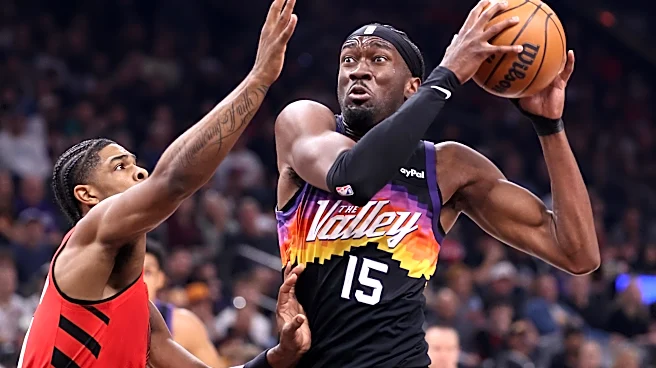

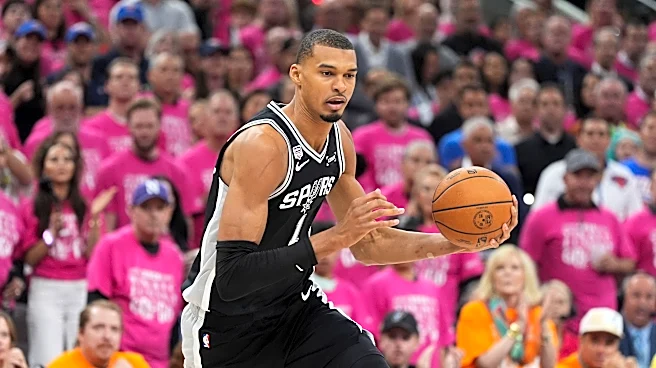
The NBA has largely accomplished what it set out to do. With the implementation of the tax aprons, building long-term, sustainable success has become increasingly difficult. If the league’s goal was to reduce dynasties, mission accomplished. Once the San Antonio Spurs and New York Knicks finish the 2026 NBA Finals, the league will crown its eighth different champion in eight seasons.
Teams across the NBA are feeling the effects. Front offices are constantly searching for ways to shed salary and navigate
the increasingly restrictive rules attached to the tax aprons. Business decisions are being analyzed more than ever, as the wiggle room has tightened.
The Denver Nuggets, despite winning a championship in 2023, are no exception.
A quick glance at Denver’s 2026-27 cap sheet tells the story. They’re top-heavy, as Nikola Jokic and Jamal Murray alone account for $109.1 million in salary. Add another $32 million for Aaron Gordon, and it’s easy to see why Denver is rumored to be looking for financial flexibility. The Nuggets currently sit $4.8 million over the 2026-27 first apron and only $2.6 million below the second apron.
For a franchise trying to maximize its championship window while a three-time MVP is still in his prime, difficult decisions are unavoidable. And those decisions aren’t going to involve the stars. They’re going to involve the middle class of the roster. One player who stands out is Christian Braun, who enters the first season of a five-year, $125 million extension next year. Yikes. My guess is that if Denver could revisit that negotiation today, it might look a little different.
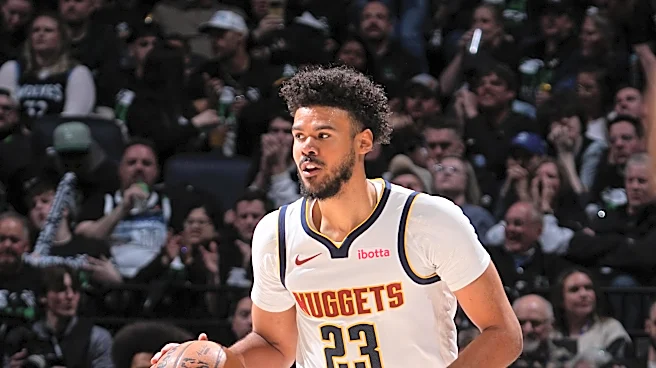
The other contract that jumps off the page belongs to former Phoenix Suns wing Cameron Johnson. Johnson is set to make $23.1 million next season, accounting for roughly 14% of Denver’s cap sheet. And when a team is searching for ways to create breathing room, those are the kinds of contracts that inevitably enter the conversation.
We know Cameron Johnson well here in the Valley. He was the unexpected 11th overall pick in the 2019 NBA Draft, a selection that caught plenty of people off guard at the time. But he was the best shooter in that draft, and he has continued to prove it throughout his seven years in the NBA, shooting 39.6% from beyond the arc.
He helped the Phoenix Suns reach the 2021 NBA Finals. The following season, when the Suns won a franchise record 64 games, Johnson finished third in Sixth Man of the Year voting after averaging 12.5 points off the bench while shooting 42.5% from three.
So yes, there is familiarity here. There is history here. And rumors are that the Nuggets are expected to shop Johnson this offseason as they look to reduce their tax bill and do what they can to get below the first apron.
That’s where the question and thought exercise begins. Should the Suns pursue him? Is bringing Cameron Johnson back to Phoenix something the Suns should explore?
Because if they do, they are adding payroll rather than subtracting it. Denver’s goal in moving Johnson would be to save money. It isn’t to bring back another expensive rotation player or replace him with a comparable shooting threat at the same price. Why would they? Johnson makes $23.1 million this season, and he’s on an expiring contract. If Denver is trying to create financial breathing room, taking back the same amount of money defeats the purpose.
So there’s plenty to consider with this potential roster decision. Let’s look at it holistically, weighing the pros and the cons. Let’s discuss whether a Cameron Johnson reunion actually makes sense for Phoenix.
The Trade

The mock trade I’ve seen circulating would send Grayson Allen to the Denver Nuggets in exchange for Cameron Johnson. The Nuggets would also include the 26th overall pick in this year’s draft, while the Phoenix Suns would send back the 47th overall selection.
There is one wrinkle, however. Because Denver has already traded away its 2027 first-round pick, the Stepien Rule comes into play. That means the Nuggets cannot simply trade the 26th pick outright before the draft. Instead, Denver would make the selection at No. 26 and then complete the transaction afterward, effectively making this a draft-night trade.
That’s an important distinction, but it doesn’t change the framework of the deal. The Suns would still be acquiring Johnson and moving up 21 spots in the draft, while Denver would gain financial relief ($4.9 million) and add Allen’s shooting to its roster.
The Case for Acquiring Cam Johnson
Where do you start when contemplating a Cameron Johnson reunion? I think you start by removing nostalgia from the equation. This isn’t about bringing back a familiar face because he was part of a memorable run. This is about evaluating a player through the lens of productivity and roster construction.
Adding Cameron Johnson would immediately give the Phoenix Suns a better option at the power forward spot and provide a legitimate floor spacer. One of Phoenix’s biggest challenges last season was size at the four. While Johnson isn’t the ideal solution at 6’8”, he’s still an improvement over what the Suns rolled out for much of last season. Phoenix started Royce O’Neale, who stands 6’6”, in 67 games. What you are doing is getting bigger and longer. And you’re adding one of the league’s better shooters to the rotation.
Now, I wouldn’t sit here and tell you Johnson is some massive defensive upgrade. He’s not. But the gap isn’t nearly as significant as some might assume. Last season, O’Neale posted a 115.1 defensive rating while Johnson came in at 114.7. So you’re not suddenly transforming the defense by making this move.
The other factor you have to consider is the viability of the trade itself. Because Denver’s motivation is an important factor in the equation. The Nuggets are trying to get off money, and they’re motivated to do so. That means any realistic trade discussion has to begin with that understanding.
They’re not looking to take back comparable salary if they can avoid it: they’re looking for relief. So before deciding whether Johnson is worth pursuing, we have to look at what the actual cost would be.
And that’s where things get interesting. When a team wants to get off a contract, it usually has to attach some kind of asset. That’s an important part of this conversation from the Suns’ perspective. If Phoenix could swap its second-round pick and receive Cameron Johnson along with Denver’s 26th overall pick, that becomes one of the strongest arguments in favor of making the deal.
Because it’s not only about Johnson. It’s about opportunity. Adding the 26th pick gives Phoenix another chance to bring in a young player and continue building through development.
No, the 26th pick isn’t likely to produce a future Hall of Famer. But there’s a very real chance you find a quality rotational player. History tells us as much. Bones Hyland was selected 26th overall by the Denver Nuggets in 2021, Payton Pritchard went 26th overall to the Boston Celtics in 2020, and our old buddy Landry Shamet was the 26th pick in 2018 by the Philadelphia 76ers. If you’re looking for the gold standard, it’s probably Vlade Divac, who was selected 26th overall by the Los Angeles Lakers in 1989.
Again, nobody is saying the Suns would be drafting the next Hall of Famer. That’s not the point. The point is that acquiring Johnson and a first-round pick creates value. You get a proven NBA rotation player who addresses a current need, and you get another developmental asset at a time when draft capital remains one of the most valuable commodities in the league. From Phoenix’s perspective, that’s a win.
And Denver could view it as a win as well. The Nuggets would save roughly $4.9 million in payroll, easing some of the pressure on their cap sheet and moving them just under the first apron. That’s what makes the framework interesting. It’s one of those rare trades where both sides can make a legitimate argument that they improved their position.
The final reason this trade makes sense is the contract itself. Cameron Johnson is on an expiring deal. Meanwhile, Grayson Allen has two years remaining on his contract, with the final season carrying a $19.4 million player option.
From a business perspective, there’s logic here. You acquire a first-round pick and inject another young player into your development pipeline. You add a player who can realistically replicate much of the shooting you’re sending out the door. You gain additional size on the wing. And perhaps most importantly, you create future financial flexibility. That’s valuable, especially for a team trying to balance competitiveness with long-term roster construction.
Johnson is a proven shooter. He’s familiar with Phoenix. He fits the style of basketball the Suns are trying to play. And because his contract expires after next season, you’re not making a long-term commitment that could limit future options. That’s a meaningful distinction. If things work, you can always explore bringing him back. If they don’t, the contract comes off the books, and you regain flexibility.
When you combine that with the potential addition of Denver’s 26th overall pick, the framework starts making a lot of sense from Phoenix’s perspective. You’re getting younger, you’re getting bigger, and you’re maintaining shooting. And you’re improving your long-term financial outlook.
That’s why, if Denver is willing to entertain a deal built around that framework, it’s one that the Suns should seriously consider.
The Case for Not Acquiring Cam Johnson
When you look at the Phoenix Suns’ offseason goals, the first question is simple. What are they prioritizing?
Are they trying to get below the luxury tax and reset their repeater tax status? Are they comfortable paying the tax but determined to stay below the first apron? Or are they willing to cross the first apron as long as they avoid the second? Those are important questions when evaluating a potential trade for Cameron Johnson.
Because in this scenario, Phoenix is taking on more money than it’s sending out. For a team that still has to navigate new deals for Collin Gillespie, Jordan Goodwin, and Mark Williams, that has merit. Every move has to be viewed within the context of the larger plan.
That’s why I keep coming back to the hierarchy of decisions. Where does Cameron Johnson rank on that list? You could easily argue that of those four players, Johnson is the least essential to what Phoenix is trying to accomplish.
He’s also the most expensive. Yes, the contract expires after next season, which certainly helps. But an expiring contract doesn’t magically erase the financial implications of carrying a $23.1 million salary. Especially for a team already carrying $23.2 million in dead cap. That’s the reality Phoenix is dealing with. You can’t simply start adding $20+ million contracts because the player fits a need. Every dollar has to be accounted for and every decision has to fit into a broader strategy.
That’s what makes the Cameron Johnson conversation so interesting. You can argue that the basketball fit makes sense. The financial fit is where things become much more complicated. And until the Suns decide exactly where they stand on the luxury tax, the first apron, and the second apron, it’s difficult to know whether a move like this is realistic or simply an intriguing idea on paper.
And speaking of strategy, where exactly does Cameron Johnson fit? Grayson Allen, the player you’d be sending out in this deal, is a bench player. An expensive bench player, sure, but a bench player nonetheless. Acquiring Cameron Johnson would likely mean inserting him directly into the starting lineup at power forward. Is that the right move?
Once again, the answer comes back to philosophy. What is the guiding principle for the Phoenix Suns entering next season? If development is truly at the core of what they’re trying to accomplish, then you have to consider what this move means for Rasheer Fleming. Fleming is sitting there with an opportunity to earn a starting role. If you bring in Johnson, are you once again limiting that opportunity? Are you reducing his exposure and slowing the learning process? Or is the plan to continue developing him in a reserve role while Johnson handles the bulk of the minutes?
That’s the question. And for me, the answer is pretty straightforward. I’d rather see Fleming out there. I’d rather see him making mistakes, learning on the fly, and gaining valuable experience than watching the Suns invest significant resources into a one-year rental of Cameron Johnson.
That’s not a knock on Johnson. He’s a good player. He fits. He helps. But if Phoenix is serious about development, then development has to win these tiebreakers. At some point, you have to give young players the runway to prove what they are. If the Suns truly believe Fleming is part of their future, I’d rather spend next season finding out exactly what they have in him.
You could make the argument that swapping Cameron Johnson for Grayson Allen makes the Suns younger. Technically, you’d be right. But only by 146 days. That’s it. Johnson is 30 years old. Allen is 30 years old. The age difference is practically nonexistent. Honestly, I was surprised when I looked it up.
The other piece of this conversation is the draft pick. If Denver includes the 26th overall selection, that player is coming in on a guaranteed contract. Compare that to the Suns staying at No. 47, where the most likely outcome is selecting a player, signing him to a two-way deal, and allowing him to develop in the G League.
There’s a financial difference there. Based on the current rookie scale, the 26th pick would sign a four-year deal worth roughly $16.3 million, with approximately $3.2 million hitting the books next season. So when you run the numbers, the equation starts to look very different. Phoenix would be sending out roughly $18.1 million in salary and taking back $26.3 million. That’s an increase of $8.2 million before we even explore Gillespie, Goodwin, or Williams.
For a team carrying $23.2 million in dead cap while trying to navigate the luxury tax and apron restrictions, every dollar matters. That’s why, despite the appeal of adding Johnson and a first-round pick, I keep coming back to the same conclusion. It’s not a basketball decision. It’s a math decision. And right now, the math doesn’t work. Not for a franchise in the Suns’ current position.
Maybe if the cap sheet looked different. Maybe if the dead money wasn’t sitting there. Maybe if the organization had more financial flexibility to absorb additional salary. But that’s not where Phoenix is today. At this point in the organization’s timeline, taking on an additional $8.2 million in payroll simply isn’t the smartest use of resources. No matter how intriguing the trade may look on paper.
I find this trade fascinating. There’s a legitimate case to be made on both sides. If you’re focused on improving the roster today, adding Cameron Johnson and moving up to the 26th pick feels like a smart piece of business. You get bigger, maintain shooting, add a first-round prospect, and create some future flexibility with Johnson’s expiring contract. There’s real value there.
At the same time, if your focus is continuity, development, and the preservation of financial flexibility, the argument against the trade is just as compelling. The added salary complicates an already delicate cap situation, potentially impacts opportunities for younger players like Rasheer Fleming, and forces Phoenix to make even tougher decisions elsewhere on the roster.
That’s what makes this such a great offseason thought exercise. There isn’t an obvious right answer. There’s simply a choice between two different paths, each with its own benefits and consequences. I can see the appeal of both. The question is which direction you would take. Would you make the move and bring Cameron Johnson back to the Valley, or would you stay the course and continue investing in the group already in place?