



In the last article, we covered the week 1 blitz of the week. In this article we’ll cover the pressure of the week. The difference between two is simple, a blitz sends five or more rushers at the quarterback.
A pressure can be generated without a blitz and it can involve simulated pressures and creeper pressures. Pressure is also loosely something used to describe what happens to a quarterback as soon as he’s throwing the ball (a hit, hurry, or sack).
Creeper and sim pressures are ways defenses disguise
pressure by sending different rushers than the front initially shows, while dropping a would-be rusher into coverage — keeping the same number of rushers (usually four) as a standard down, but changing who’s doing the rushing.
Simulated pressure
A sim pressure shows blitz-like pressure — often with multiple defenders walked up near the line — but ultimately rushes a “normal” number of players (typically four), just not the four the offense expects.
The defense drops a lineman or an edge player into coverage and replaces him with a blitzing linebacker or defensive back. It’s designed to confuse protection (it simulates a blitz look pre-snap and alters the offensive line slide protection without actually bringing extra numbers). It creates free access or leverage against the protection’s blocking rules.
Creeper pressure
A creeper is closely related but usually refers more specifically to bringing an off-ball defender (linebacker or DB) while dropping a down lineman or edge rusher into a shallow coverage zone (often a “spy” or hook/curl zone).
The name comes from the rusher “creeping” up late or from depth rather than lining up on the line pre-snap, making it harder for the quarterback and O-line to identify pre-snap. Creepers tend to emphasize disguise and late movement more than the wholesale front-to-coverage swap that defines a sim pressure.
In practice, the two terms overlap a lot in modern usage (Fangio-tree defenses especially), and people often use “sim” as the umbrella term with “creeper” as a specific flavor of it — a same-number pressure where the exchange rusher comes from depth or off the ball rather than off the edge.
Wasp creeper
“Wasp” is a simulated pressure to the weak side that attacks the A-gap with the Jack linebacker. In Fangio’s terminology, of which Jonathan Gannon is a part of, the “Jack” refers to the linebacker most teams would call the Will, or weak-side ILB.

On Wasp, the Jack linebacker shoots the A-gap on his side while the Nose occupies the A-gap on the opposite side or the center.

If the offense lines up 3×1, the defense rotates into a strong-side Cover 3; if it’s a 2×2 look instead, the defense plays Quads (Quarters) coverage, which has the option to bracket down into Palms (2-Read).

Facing a 3×1 double-slot alignment, the defense calls Wasp paired with cover-3 behind it. The offense counters with four verticals, a concept designed to attack the weaknesses in cover-3.

Here, the Vikings motion from a 2-back back field (the 3×1 side) to a 2×2 just before the snap. The coverage most likely would have shifted from cover-3 to quarters here.

At the second level, the Safeties will read the release of the tight end and opposite #2 receiver. If the tight end releases, like he does here, the safety will get over the top of a potential vertical. If the tight end were to stay in and block, there’s no more vertical threat and the safeties would redirect their eyes to the far side to wall off any crossing routes.
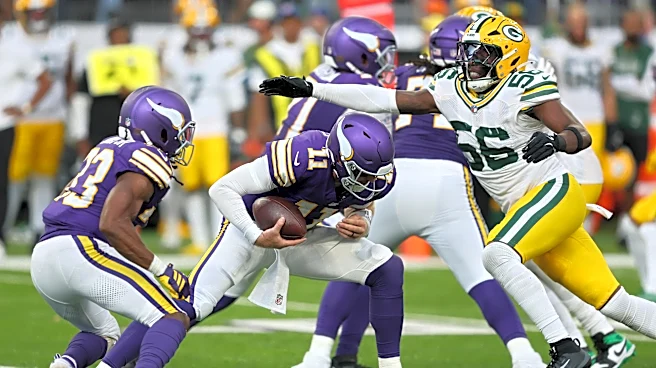
The routes barely develop here as linebacker Edgerrin Cooper sprints through the A-gap and sacks Carson Wentz as he barely hits the top of his dropback, forcing a 6-yard loss. Cooper gets a free run thanks to the nose tackle and defensive tackle occupying the center and left guard.
Unfortunately on this drive, the very next play resulted in an illegal contact penalty after Wentz was sacked by Cooper and Devonte Wyatt. A couple of ticky-tack penalties called on the Packers defense kept this drive alive and moving down the field until the Vikings eventually scored what would end up being the game-winning points.