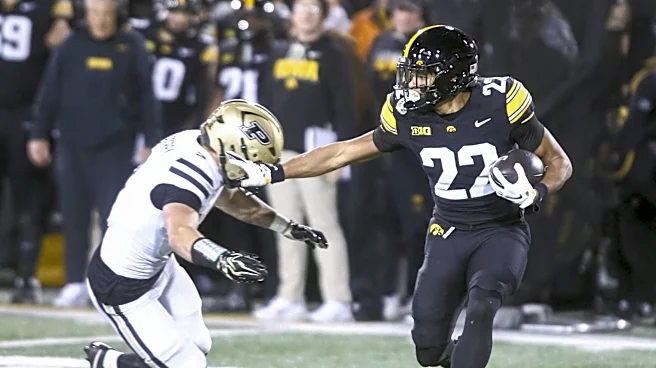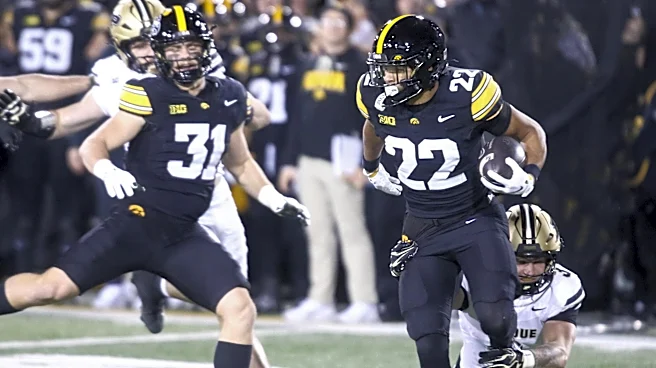

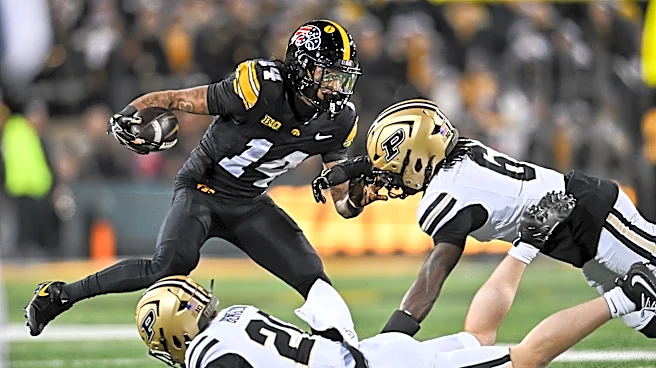
This weekend, the Iowa Hawkeyes travel to Champaign to take on Hawkeye alum Bret Bielema and his University of Illinois Fighting Illini.
The Illini are fighting for respectability and bowl positioning while Iowa, in theory, are fighting to keep its slim Playoff hopes alive, but unfortunately, the Playoff Committee doesn’t think much of Iowa.
I, like most Hawkeye fans and most fans of most teams, could go on a tirade about how disingenuous and silly the Playoff Committee is, but what would be the point?
Their goal is to stir up controversy so people will watch their phony show. In that, I suppose they are successful even if the long-term effects include projecting a lack of legitimacy.
The fact of the matter is the only thing the Hawkeyes can do is go out there and win. Everything else is out of their control.
3 Questions
Can Iowa Lay on the Style Points?
Iowa has dominated its opponents the last three games though the scoreboard may not reflect that. It reflects a dominant defense and the final score has covered the spread, but it is not a 56-0 drubbing which is what most people think of when they think of dominance.
It is evident that Kirk Ferentz and Tim Lester want to treat their offense as a defensive weapon. That means long drives that control the clock. In their last three games, the Hawkeyes have largely done that. The time of possession has been: Iowa 36:21, WI 23:39, Iowa 28:13, NU 31:47, Iowa 35:14, PU 24:46.
This, of course, is not how you get to 55-0. That usually involves fast drives so that you have more drives which allows you to score more.
According to Fourth and Short, Iowa ranks 85th nationally in terms of offensive pace. Interestingly, the Hawkeyes are one of the slowest teams in the country (125th) when trailing. In other words, no matter the situation, Iowa is the tortoise, not the hare.
If Ferentz and Lester have their way, expect more of the same against Illinois. It’s not that Iowa won’t take a big play for a quick touchdown, or multiple quick plays for quick touchdowns. It’s that this is not the gameplan.
I don’t know what the Playoff Committee looks for besides wins. I don’t know how the Playoff Committee defines dominance. But I am confident that Kirk Ferentz is not going to depart from his way of playing football, and in that respect, he’s right. You try to do things against your basic nature and that’s when bad things happen, like losing, which I am sure will not impress the Playoff Committee.
What Makes Illinois Good?
Good is relative, but the Illini certainly aren’t a bad team. They’ve got six wins, they beat Oregon and took UCLA to the wire, in California.
Yet, statistically they kind of suck. Both their scoring offense and scoring defense are ranked 12th in the Big Ten. They are 10th in total offense and 16th in total defense. Their red zone offense is 14th and their red zone defense is 16th. Their third-down defense is 16th though they do have a good third-down offense at third in the conference. I could go on, but on paper, this team isn’t impressive.
They lost to Purdue, but they beat Oregon. They have improved over the course of the season especially since firing their defensive coordinator. And Bielema is a good coach who does what good coaches do which is maximize his teams’ advantages and opportunities, stats be damned.
But maybe they have just been lucky. Fourth and Short has Illinois as the second “luckiest” team in the country (Iowa is sixth luckiest).
If it is something to do with luck, it’s another reminder that Iowa has to take a lead and put its boot on the Illini’s neck. You let a lucky team stick around and bad things happen.
Can Iowa Make Illinois One-Dimensional?
One area in which Illinois is impressive is its running game led by a solid offensive line. Illinois is fifth in the conference with 4.72 YPC, and it’s been consistent across wins and losses, conference and non-conference games, ranked and unranked opponents.
The Illini also have a very good receiver in senior Collin Dixon who has 72 receptions for 946 yards and 13 touchdowns. If Jeremiah Smith weren’t in the Big Ten this year, Dixon would be the Richter-Howard Award front runner. The problem is somebody has to get Dixon the ball.
With that said, Illinois will probably have to start its third-string quarterback. The starter, Kadin Hauser, broke his nose at the end of the UCLA game and is listed as doubtful. The second-string quarterback, Michael Clayton II (the guy who beat 13th-ranked Oregon) underwent an operation and is out. That leaves third-stringer and sophomore Carson Boyd who has completed one of four passing attempts in his career.
Due to this, it’s fair to assume the Illini will lean on the rushing game. This feeds right into the strength of the Iowa defense, the No.4 rush defense in the country (YPC allowed). If Iowa can squash the running game then the Illini will have to pass. And then the quarterback questions come into play.
If it comes to that, maybe there will be a chance for Iowa to extend its defensive touchdown streak.
2 Things to Look For
Kirk vs Bret
Bret Bielema walked on to the Iowa football team and played under Hayden Fry from 1989-1992. He then became a grad assistant under Fry in 1994 and became the Iowa linebackers coach in 1996.
When Kirk Ferentz took over the program in 1998, Bielema was one of two Fry coaches Ferentz kept on staff (the other being Chuck Long). Bielema stayed with Ferentz through 2000, and after working as a defensive coordinator at K-State and Wisconsin, he became the Badgers head coach in 2006.
Bielema has been outspoken about his respect for Ferentz and Ferentz has been mutually outspoken regarding how he feels about Bielema.
They have coached against each other eight times, five with Bielema at Wisconsin and three at Illinois. They are 4-4 with six of the games decided by a touchdown or fewer and four of them decided by a field goal or fewer. Only one of their matchups has been decided by more than 10 points (2008, in which Iowa won 38-16).
By comparison, Ferentz is 8-9 all-time vs Michigan and 11-9 vs Penn State.
Bielema and Ferentz are two coaches who know each other. These are two coaches who know how to coach in the Big Ten. But these are dissimilar coaches. Ferentz, as Iowa fans know, is conservative to a fault while Bielema is aggressive.
Take fourth-down attempts as an example. Iowa has the fewest attempts–seven–in the conference, by far. Illinois is in the middle of the pack with 16, but when you eliminate the teams at the bottom of the conference which largely make up the top of the fourth-down attempts because they are usually playing from behind, Illinois is tied for fifth.
As another example, take the 2010 game in which Iowa lost to Wisconsin 31-30. The game hinged on a fake punt in the fourth quarter. It seemed that everybody in the stadium and watching at home knew that Bielema was going to fake the punt. Yet Kirk Ferentz didn’t know because in Kirk Ferentz’s world view, nobody would fake that punt, on their own side of the field, at that juncture of the game. Wisconsin converted, and that defined Iowa and Wisconsin for the next few years.
Ferentz has been a wiser coach, in my opinion, since 2010, but he is still conservative to a fault and Bielema is still aggressive.
The Running Game
One of the most impressive elements of Tim Lester’s offense, especially since Kamari Moulton went down for the season, has been its versatility in the running game, its determination to get the ball into the hands of its playmakers and its creativity in putting them in a position to succeed.
Expect Illinois to stuff the box. As previously mentioned, Bielema knows how to play Big Ten football and he knows how to beat Kirk Ferentz. Along with this, the Illini are built to stop the run, so Iowa will likely use the pass to open up the run. Plus Illinois has the worst pass defense in the Big Ten.
However, the other option, once/if the run opens up, is the versatile running game.
The bellcow is LJ Phillips who has been a pleasure to watch these last few weeks. He lacks breakaway speed, but it seems like he seeks out contact. And as he largely missed the first six weeks of the season due to injury, he is as fresh as a person could ask of a starting running back in mid-November.
Meanwhile, freshman Braedon Jackson has ascended to the second-string spot. He doesn’t yet have the vision to be an every-down back, but he is a solid third-down option who is dangerous in space. He’s done damage on kickoff returns, but has also been an effective receiver out of the backfield.
The highest YPC on the team, with at least 10 carries, is receiver Tony Diaz at 7.67 YPC. Eight of his 12 carries have come in the last four games.
Lastly, quarterback Hank Brown has proven to be a rushing threat. He has 37 carries for 83 yards (2.24 YPC) and three touchdowns, but when you take sacks out of that total, he has 28 carries for 142 yards (5.1 YPC).
Just for a thought experiment, imagine any of Iowa’s previous offensive coordinators, especially the last one, finding so many different ways, using so many different runners, to move the ball on the ground.
1 Wild Prediction
As mentioned, Illinois has the worst passing defense in the conference. It’s fourth-worst in terms of opponent passing efficiency. And it’s only got four picks, tied for last in the conference.
Tony Diaz is listed as questionable for this game with a hamstring pull, but I still expect Iowa to come out passing. By the end of the game, with Diaz at worst out and at best limited, Reece Vander Zee and DJ Vonnahme get a lot of work. In effect, Iowa has its first 100-yard receiver, most likely RVZ, for the season.
The hell with the corrupt Playoff Committee. Go Hawks!